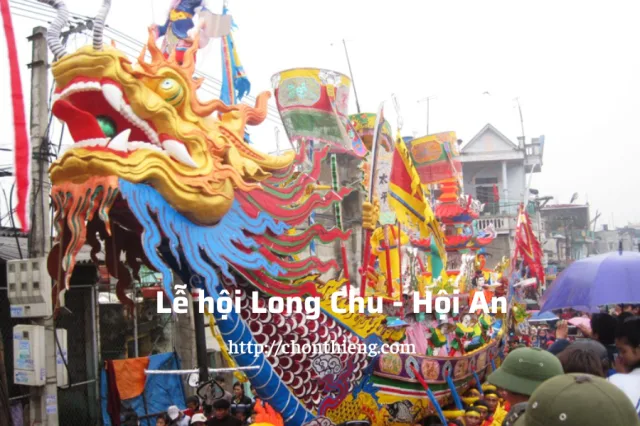


Khái quát
Lễ hội Long Chu là một hình thức tín ngưỡng dân gian gắn với tục tống thần ôn, thần gió, nhằm xua đuổi dịch bệnh, tà khí và những điều không may, cầu mong cho dân làng được bình an, khỏe mạnh, mùa màng thuận lợi và cuộc sống yên vui.
Theo quan niệm dân gian xưa, những trận dịch bệnh thường xuất hiện vào thời điểm giao mùa không chỉ do khí độc mà còn do sự tác oai tác quái của các thế lực vô hình như ma quỷ, ác thần gây nên. Vì vậy, người dân tổ chức lễ hội Long Chu để thực hiện nghi thức tống ôn, tống gió, đưa các thế lực gây bệnh tật và tai ương ra khỏi cộng đồng.
Địa điểm tổ chức
Lễ hội Long Chu thường được tổ chức tại các đình làng, miếu mạo, nơi sinh hoạt cộng đồng của cư dân hoặc các bến sông, bến nước thuộc các làng ven biển, ven sông. Tại Quảng Nam và Đà Nẵng, lễ hội phổ biến ở các làng ven biển, các vạn chài, đặc biệt là những nơi có chợ búa, bến ghe tàu đông đúc, nơi tập trung nhiều người qua lại buôn bán. Ở Hội An, lễ hội thường diễn ra tại các đình làng, miếu thờ hoặc những địa điểm cộng đồng như Tụy Tiên Đường và nhiều không gian tín ngưỡng khác trong các làng, xóm.
Thời gian tổ chức
Theo truyền thống, lễ hội Long Chu thường được tổ chức vào khoảng tháng Sáu hoặc tháng Bảy âm lịch, đặc biệt là dịp Rằm tháng Bảy. Đây là thời điểm chuyển mùa từ mùa nắng sang mùa mưa ở miền Trung. Trong điều kiện vệ sinh và y tế của xã hội xưa còn nhiều hạn chế, các loại bệnh nhiệt đới như đau mắt, dịch tả, thương hàn, đậu mùa, kiết lỵ thường dễ bùng phát và lan rộng, gây nhiều thiệt hại về người.
Riêng tại Hội An, lễ hội Long Chu thường được tổ chức vào Rằm tháng Bảy âm lịch hằng năm, mặc dù trước đây thời gian tổ chức có thể linh hoạt hơn, tùy thuộc vào tình hình dịch bệnh hoặc những biến động trong đời sống cộng đồng.
Nguồn gốc và ý nghĩa
Lễ hội Long Chu xuất phát từ nhu cầu phòng chống dịch bệnh của cư dân nông nghiệp và cư dân vùng sông nước ven biển. Người xưa cho rằng những trận ôn dịch xảy ra là do các thế lực siêu nhiên gây nên. Vì vậy, họ sáng tạo nên hình tượng Long Chu – chiếc thuyền rồng linh thiêng để chuyên chở tà ma, bệnh tật và những điều xấu xa ra khỏi làng xóm.
Theo nghĩa đen, “Long Chu” có nghĩa là thuyền rồng. Trong lịch sử, đây là loại thuyền sang trọng dành cho vua chúa dùng trong các chuyến tuần du hoặc ngự lãm trên sông nước. Trong tín ngưỡng dân gian, Long Chu lại trở thành biểu tượng của sức mạnh thần linh, có khả năng chế ngự ma quỷ, áp chế ác thần và tiêu trừ ôn dịch.
Tại Hội An còn lưu truyền câu chuyện rằng vùng đất này vốn là doi đất do phù sa sông Thu Bồn bồi đắp nên. Mặc dù cuộc sống người dân khá sung túc nhưng mỗi khi giao mùa, dịch bệnh lại thường xuyên bùng phát. Sau nhiều lần hội họp, các thầy cúng đã nghĩ ra nghi lễ tống ôn, tẩy uế và đuổi tà ma. Từ đó lễ hội Long Chu ra đời và được duy trì qua nhiều thế hệ.
Dưới góc nhìn hiện đại, nếu loại bỏ những yếu tố mang tính ma thuật, việc chuẩn bị cho lễ hội thực chất là một đợt “tổng vệ sinh” quy mô lớn của cộng đồng. Người dân cùng nhau dọn dẹp đường làng, khai thông cống rãnh, phát quang bụi rậm, xử lý các nơi nước tù đọng để hạn chế môi trường sinh sôi của ruồi muỗi, chuột bọ và các mầm bệnh.
Phần lễ
Công tác chuẩn bị
Trước ngày diễn ra lễ hội, các chức sắc trong làng thông báo cho từng gia đình tiến hành tổng vệ sinh nhà cửa và khu vực xung quanh. Mọi ngõ xóm, đường làng đều được quét dọn sạch sẽ; cỏ dại được phát quang; các tuyến đường được sửa sang; mương máng được khai thông; những bụi rậm, gốc cây cổ thụ hay những nơi được cho là chỗ trú ngụ của tà ma đều được dọn sạch và rải vôi bột. Một đoàn trai đinh do thầy phù thủy dẫn đầu mang theo dao, rựa, câu liêm đi khắp làng để kiểm tra việc vệ sinh, đồng thời thực hiện các nghi thức trấn yểm theo quan niệm dân gian.
Cùng thời gian đó, dân làng tập trung làm Long Chu. Thuyền rồng được dựng bằng khung tre, dài khoảng 4,5 mét, bên ngoài bồi giấy và vải, trang trí bằng các hoa văn hình học, tua giấy ngũ sắc hoặc giấy trang kim rực rỡ. Tại Hội An, mô hình Long Chu còn được trang trí công phu hơn với các hình nhân lính hộ vệ, một vị quan chỉ huy, lọng che và nhiều chi tiết tượng trưng cho đoàn quân hộ tống thần linh đi trừ tà. Bên trong thuyền đặt bàn hương án, bát hương cùng các lễ vật dâng cúng. Phần đáy thuyền được gắn trên thân cây chuối để có thể nổi trên mặt nước khi thả xuống sông.
Lễ khai quang và lễ cáo thần
Trước ngày chính hội, Long Chu được rước về đặt tại sân đình, đầu rồng quay về phía bàn thờ thần. Tại đây diễn ra lễ khai quang điểm nhãn. Thầy cúng thực hiện nghi thức mở mắt cho Long Chu và tiến hành lễ cúng Tổ. Theo truyền thống Hội An, nghi thức này còn được gọi là Lễ vô khoa, tức lễ cúng Tổ Phù thủy. Đến giờ Tý ngày chính lễ, lễ cáo thần (hay lễ túc yết) được tiến hành với hương hoa, trà quả và các lễ vật dâng cúng thần linh. Không gian đình làng lúc này rực sáng ánh đèn nến, khói hương nghi ngút, cờ xí giăng kín trước sân đình. Tiếng chiêng trống vang lên liên hồi như lời thỉnh mời thần linh về chứng giám và báo hiệu buổi lễ bắt đầu.
Lễ tế Long Chu
Lễ tế chính được tổ chức vào sáng hôm sau với quy mô trang trọng tương tự các lễ cầu an truyền thống. Chủ trì nghi lễ là thầy cúng hoặc thầy phù thủy. Thầy mặc áo pháp có hình bát quái, thắt lưng đỏ, đội mũ và thực hiện các nghi thức bắt quyết, niệm chú. Hỗ trợ cho thầy là các thầy điệu, học trò lễ và dàn nhạc bát âm. Trong lễ tế diễn ra các nghi thức đọc văn tế, dâng ba tuần rượu và ba tuần trà.
Tại Hội An, một nội dung đặc biệt trong bài văn cúng là nghi thức triệu thỉnh 32 vị tướng vô hình lên thuyền để dẫn độ và áp tải tà ma, bệnh tật ra khỏi làng xóm. Khi nghi thức kết thúc, dưới sự điều khiển của vị chánh bái hoặc thầy cả, đầu Long Chu được từ từ xoay hướng ra cổng đình, tượng trưng cho việc chuẩn bị đưa các tai ương rời khỏi cộng đồng.
Nghi thức rước và đưa tiễn Long Chu
Sau khi hoàn thành các nghi lễ tế tự, Long Chu được khiêng ra khỏi đình làng. Mười hai trai đinh khiêng thuyền chạy theo nhịp trống giục. Theo sau là những người cầm roi dâu quất vào bụi cây ven đường để xua đuổi tà khí.
Tại Hội An, đoàn rước còn đi theo tuyến đường đã được trấn yểm từ trước. Người dân đứng hai bên đường cầm roi, gậy quất vào các bụi cây rồi ném lên thuyền rồng, với niềm tin rằng mọi điều xấu xa sẽ được chuyển hết lên Long Chu. Đám rước đi qua các ngõ xóm, ngã ba, ngã tư trong tiếng trống chiêng, tiếng pháo nổ và sự reo hò của dân làng.
Sau khi hoàn tất hành trình qua các khu dân cư, đoàn rước tiến ra bến sông. Tại đây, Long Chu được hạ xuống nước, thắp đèn lồng và đẩy trôi theo dòng sông ra biển trong tiếng hò reo tiễn biệt của dân làng. Người dân đứng nhìn theo cho đến khi ánh đèn trên thuyền chỉ còn là những đốm sáng chập chờn giữa sóng nước. Ở những nơi không có sông lớn, Long Chu được đưa ra cánh đồng rộng rồi đốt cháy. Ngọn lửa thiêng tượng trưng cho việc tiêu hủy hoàn toàn bệnh tật, tai họa và những điều không may.
Phần hội
So với phần lễ, phần hội của lễ hội Long Chu không quá nổi bật nhưng vẫn giữ vai trò quan trọng trong đời sống cộng đồng. Sau khi hoàn thành nghi thức đưa tiễn Long Chu, dân làng tập trung tại sân đình hoặc những bãi đất rộng để tổ chức các hoạt động vui chơi, giao lưu và sinh hoạt văn nghệ. Mọi người cùng nhau hò hát, đối đáp, trò chuyện và vui chơi đến khuya. Đây là dịp để cộng đồng gặp gỡ, gắn kết tình làng nghĩa xóm sau những ngày lao động vất vả.
Ngày nay, nhiều địa phương đã bổ sung thêm các hoạt động văn hóa, văn nghệ, thể thao và trò chơi dân gian nhằm tăng tính hấp dẫn cho lễ hội, đồng thời góp phần bảo tồn những giá trị văn hóa truyền thống.
Lễ hội Long Chu trong giao lưu văn hóa Việt Nam – Nhật Bản
Một số nhà nghiên cứu cho rằng lễ hội Long Chu ở Hội An có thể có mối liên hệ với lễ hội Gion của Kyoto. Lễ hội Gion ra đời từ năm 869 với mục đích cầu trừ dịch bệnh. Trong lễ hội cũng xuất hiện các đoàn rước lớn mang tính biểu tượng đi qua các tuyến phố của thành phố. Những điểm tương đồng về mục đích trừ ôn dịch, hình thức đoàn rước, thời gian chuẩn bị kéo dài và sự tham gia của cộng đồng khiến nhiều học giả đặt ra giả thuyết về sự ảnh hưởng văn hóa giữa hai lễ hội trong bối cảnh giao thương mạnh mẽ giữa Hội An và Nhật Bản từ thế kỷ XVI – XVII.
Tuy nhiên, trong quá trình tiếp biến văn hóa, lễ hội Long Chu đã mang những đặc trưng rất riêng của cư dân Việt Nam. Nếu lễ hội Gion sử dụng các kiệu và xe rước Hoko, Yama được bảo tồn để dùng nhiều năm thì Long Chu là mô hình thuyền rồng bằng tre giấy được thả trôi hoặc đốt sau lễ hội. Bên cạnh đó, lễ hội Long Chu còn tiếp nhận nhiều yếu tố từ tín ngưỡng dân gian Việt Nam, Phật giáo, Đạo giáo, văn hóa Trung Hoa và cả những lớp văn hóa bản địa của vùng đất Hội An.
Giá trị văn hóa
Lễ hội Long Chu là một loại hình lễ hội dân gian độc đáo của cư dân ven biển và ven sông miền Trung, phản ánh khát vọng muôn đời của con người về sức khỏe, bình an và cuộc sống hạnh phúc. Mặc dù trong quá trình phát triển có sự đan xen của nhiều yếu tố tín ngưỡng dân gian và quan niệm huyền thuật, nhưng cốt lõi của lễ hội vẫn là mong muốn bảo vệ cộng đồng trước dịch bệnh, đồng thời tăng cường sự đoàn kết, gắn bó giữa các thành viên trong làng xã. Đây cũng là một minh chứng sinh động cho quá trình giao lưu, tiếp biến văn hóa giữa nhiều cộng đồng cư dân trong lịch sử hình thành và phát triển của vùng đất Quảng Nam – Hội An.
Tài liệu tham khảo
- Thạc Phương – Lê Trung Vũ (2015), 60 lễ hội truyền thống Việt Nam, Nxb Tổng hợp Thành phố Hồ Chí Minh.
- Thái Mỹ, Đưa tiễn Long Chu, Báo Đà Nẵng, ngày 12/08/2023.
- Đỗ Thị Ngọc Uyển, So sánh lễ hội Gion ở Kyoto – Nhật Bản và lễ hội Long Chu ở Hội An – Việt Nam, Trung tâm Bảo tồn di sản văn hóa thế giới Hội An.
Ngôn ngữ khác
Tiếng Anh (English)
Overview of the Festival
The Lang Ong Tra On Festival is one of the most representative traditional festivals of the Mekong Delta region. It is held at the Mausoleum of Tien Quan Thong Che Dieu Bat Nguyen Van Ton, located in My Hoa Hamlet, Thien My Commune, Tra On District, Vinh Long Province. This communal festival of the Kinh, Khmer, and Hoa (Chinese) ethnic groups takes place annually on the 3rd and 4th days of the first lunar month to commemorate the merits of Tien Quan Thong Che Dieu Bat Nguyen Van Ton, a distinguished military commander who contributed significantly to reclaiming wasteland, safeguarding the southwestern frontier, and fostering ethnic solidarity in the regions of Tra On, Cau Ke, and Mang Thit.
The mausoleum is situated on Thanh Bach Sandbank, about 2 kilometers from Tra On Town. It serves both as the burial site and the place of worship for Nguyen Van Ton and his wife. The complex was originally built in 1820 and underwent several restorations in 1937, 1953, 1960, 1963, 1967, 1992, 1994, 1997, and 2004, while still retaining its ancient and solemn appearance. On February 13, 1996, the Ministry of Culture and Information recognized the site as a National Historical and Cultural Relic. Subsequently, on January 22, 2020, the Lang Ong Tra On Festival was inscribed on the National Intangible Cultural Heritage List under Decision No. 261/QĐ-BVHTTDL.
More than merely a death anniversary ceremony for a historical figure, the festival also serves as an occasion to pray for blessings at the beginning of the new year, wishing for national prosperity, favorable weather, abundant harvests, and peaceful, prosperous lives. Through generations, Nguyen Van Ton has been revered by local people as a tutelary deity who protects the community of Tra On.
The Honored Figure: Tien Quan Thong Che Dieu Bat Nguyen Van Ton
Tien Quan Thong Che Dieu Bat Nguyen Van Ton was born in the Year of the Goat (1763) in Nguyet Lang Village, Vinh Binh District, present-day Binh Phu Commune, Cang Long District, Tra Vinh Province. He was an ethnic Khmer whose birth name was Thach Duong, courtesy name Duyen, and was commonly known among local people as Ta Duong.
In his youth, he joined and supported Lord Nguyen Anh and made many contributions to the process of national reunification. When Nguyen Anh was forced into exile in Siam (present-day Thailand) in 1787 due to attacks by the Tay Son forces, Nguyen Van Ton accompanied him. Upon returning to Vietnam, he was assigned to recruit militia forces in Tra Vinh, Mang Thit, Cau Ke, and Tra On. In addition to organizing defense forces for the southwestern region, he also encouraged local people to reclaim land, establish settlements, and develop new villages.
After Nguyen Anh ascended the throne in 1802 under the reign title Gia Long, Nguyen Van Ton was appointed Cai Co and Commander of the Naval Forces stationed in Tra On under Tran Giang Commandery. He continued to contribute to stabilizing the southwestern frontier, resisting incursions from Siamese forces, and improving the livelihoods of settlers in newly developed lands.
In the tenth year of Gia Long’s reign (1811), in recognition of his achievements in safeguarding the borders, he was promoted to the rank of Thong Che and granted the noble title Dung Ngoc Hau. In 1819, he was appointed Dieu Bat Nhung Vu and led laborers and soldiers to Chau Doc to assist Thoai Ngoc Hau in excavating the Vinh Te Canal, a project of great strategic significance for transportation and national defense in southern Vietnam. Due to the immense burden of overseeing the project, he fell ill and passed away on the 4th day of the first lunar month of the Year of the Dragon (1820) at the age of 58.
Following his death, the Hue imperial court dispatched high-ranking officials bearing offerings to conduct a three-day state funeral. Emperor Minh Mang posthumously conferred upon him the title Tien Quan Thong Che Dieu Bat, reaffirmed his noble title Dung Ngoc Hau, and ordered soldiers to maintain and guard his tomb.
In the minds of the people of Tra On, Nguyen Van Ton was not only a military commander but also a pioneer who helped reclaim new lands and foster unity among the Kinh, Khmer, and Hoa communities. Consequently, local residents continue to honor and worship him as the guardian spirit of the region.
The Relic Complex
The Lang Ong historical site covers an area of approximately 8,000 square meters, including the main hall, the traditional opera stage, guest house, incense house, and the joint tomb of Nguyen Van Ton and his wife. The entire complex exudes an ancient and solemn atmosphere, surrounded by trees and ornamental plants that create a peaceful setting.
The main hall is dedicated to Nguyen Van Ton. His altar occupies the central position, with a ceremonial sword displayed in front as a symbol of his authority and military prestige. To the right stands the altar of his wife, Nguyen Thi Bach, whose memorial tablet bears the four Chinese characters meaning “Spirit of the Virtuous and Gentle Lady.” To the left are the altars of his son, Commander Nguyen Van Vy, and other notable historical figures such as Deputy Marshal Nguyen An, General Le Van Duyet, Supreme Commander Truong Dinh, and national hero Nguyen Trung Truc.
Behind the main hall lies the joint tomb of Nguyen Van Ton and his wife. The tomb follows the traditional architectural style of southern Vietnam, featuring a screen wall, decorative pillars, guardian qilin statues, and ornamental motifs of dragons and stylized foliage.
Inscribed on the decorative pillars is a pair of parallel sentences:
Hoa Di cộng ngưỡng
Mân Quảng đồng tri ân
“The Hoa and Khmer peoples alike admire him;
The Fujianese and Cantonese alike remember his gratitude.”
These inscriptions vividly express the deep respect and gratitude that diverse ethnic communities have for Nguyen Van Ton’s virtues and achievements.
Rituals
Raising the New Year Pole
Although the main festival takes place on the 3rd and 4th days of the Lunar New Year, preparations begin on the 30th day of the twelfth lunar month with the ritual of raising the New Year pole (cây nêu), a custom deeply rooted in East Asian culture.
The bamboo selected for the pole must be a slender yet sturdy variety capable of remaining fresh for a long period. Villagers count the bamboo nodes, and only if the top node corresponds to the auspicious sign of “Life” in traditional divination is the bamboo considered suitable. All branches and leaves are removed except for a small tuft of green leaves at the top.
After village elders conduct rituals to Heaven and Earth and report to Lord Nguyen Van Ton, the pole is erected in front of the mausoleum. Attached to the top are protective charms and symbolic objects such as clay or wooden carp, bells, and chimes. As the wind blows, these ornaments produce gentle sounds. Local people believe the pole serves as a guide for the spirit of the honored lord to return home and celebrate the New Year with his descendants.
The Tuc Yet Ceremony
From the early morning of the 3rd day of the Lunar New Year, the festival atmosphere becomes lively and vibrant. The Khmer five-tone orchestra (Ngu Am) from Go Xoai Pagoda performs festive music throughout the mausoleum grounds. This is followed by a Buddhist chanting ceremony conducted by Khmer monks to pray for peace, prosperity, and favorable weather in the coming year.
After the prayer ceremony, Chinese lion dances and traditional Khmer performances such as Robam, Sa-dam, and Du-ke theater are presented. These performances serve both as ritual offerings and as joyful celebrations welcoming the festival season.
At the beginning of the Than Hour (mid-afternoon), the Tuc Yet Ceremony officially commences with the participation of village elders. This ritual marks the formal opening of the annual memorial festival. Offerings of incense, tea, and wine are presented solemnly before the ancestral altar.
Offerings include local products such as a cleaned white pig, pig’s head, sticky rice, cakes, tea, wine, betel leaves, areca nuts, rice, salt, and many traditional southern dishes including braised pork with eggs, pickled mustard greens, pork-bone soup, and curry with bread. Together they symbolize a family meal prepared for the honored lord.
The Main Sacrificial Ceremony
The Main Sacrificial Ceremony (Chanh Te) takes place on the 4th day of the first lunar month and is the most important ritual of the festival. It commemorates the death anniversary of Nguyen Van Ton while also praying for national prosperity, abundant harvests, and the well-being of the people.
Village elders dressed in ceremonial attire perform solemn rites before the altar, offering incense, tea, and wine while reciting memorial texts praising his contributions. Following the tea offering comes the “Receiving Blessings” ritual (Am Phuoc), during which participants share the wine that has been offered to the spirit, symbolically receiving his blessings. Afterwards, local residents enter the shrine to pay respects and pray for health, peace, and good fortune.
The Xay Chau Dai Boi Ceremony
After the Main Sacrificial Ceremony comes the Xay Chau Dai Boi ritual, which is intended to pray for peace and prosperity throughout the country.
The ceremonial drum is brought onto the stage, and a representative of the villagers assumes the role of drum master. Traditional Hat Boi (classical Vietnamese opera) troupes then perform a sequence of ritual acts, including:
Opening Heaven and Purifying the Earth;
Saluting the Sun and Moon;
Celebrating the Three Blessings of Happiness, Prosperity, and Longevity;
Honoring the Four Heavenly Kings;
Bestowing Titles and Blessings;
Presenting Longevity Offerings by the Eight Immortals.
These performances carry both ritual significance and the community’s aspirations for prosperity and well-being.
Festive Activities
The festive portion of the Lang Ong Tra On Festival is exceptionally rich and vividly reflects the cultural exchange among the Kinh, Khmer, and Hoa communities.
The Khmer community presents five-tone orchestral performances, Sa-dam dances, Robam dances, Du-ke theater, and monkey dances. The Hoa community contributes lion dances, dragon dances, unicorn dances, and Tua Lau Cau music. The Kinh community organizes Hat Boi performances, traditional ritual music, and Don Ca Tai Tu music.
Following the rituals, Hat Boi troupes stage historical and patriotic plays such as:
Ly Thuong Kiet Defeats the Song Dynasty;
Mu Guiying;
Luu Kim Dinh;
Hua Mulan;
Thach Kim Hue;
The Two Fortune Stars Descend to the Mortal World.
These performances often continue late into the night and attract large audiences.
In addition, the festival features numerous communal activities, including lion dance competitions, tug-of-war contests, volleyball tournaments, culinary competitions, and traditional folk games. These activities create a lively atmosphere, strengthen community bonds, and help the festival preserve its traditions while embracing contemporary life.
Cultural Value and Community Significance
The Lang Ong Tra On Festival is a vivid expression of the Vietnamese tradition of “remembering the source when drinking water.” Through the festival, people honor the contributions of Tien Quan Thong Che Dieu Bat Nguyen Van Ton to the development and defense of southern Vietnam.
The festival also serves as a cultural space that showcases the solidarity of the Kinh, Khmer, and Hoa communities. The coexistence of Hat Boi, Khmer five-tone music, lion dances, and Tua Lau Cau music demonstrates the diversity and harmony of cultural life in the Tra On region.
Beyond fulfilling religious and spiritual needs, the festival contributes to preserving traditional performing arts, promoting patriotism, and safeguarding local cultural identity.
Today, the Lang Ong Tra On Festival is regarded as one of the key cultural highlights in Tra On District’s tourism development strategy.
Tra On possesses significant tourism potential thanks to its dense river network, distinctive orchard culture, and large Khmer population. In addition to the Lang Ong Festival, the district is home to important Khmer festivals such as Ok Om Bok, Chol Chnam Thmay, and Sen Dolta, as well as traditional craft villages, including the over-100-year-old Cu Lao May rice paper village.
Local authorities are promoting a model of river-based ecotourism combined with cultural heritage tours, traditional craft villages, Don Ca Tai Tu music, and Khmer folk arts. Within this strategy, the Lang Ong Festival plays a vital role as a representative cultural tourism product, helping to promote the image of Tra On while preserving the traditional cultural values of southern Vietnamese communities.
References
- Thạc Phương – Lê Trung Vũ (2015), 60 lễ hội truyền thống Việt Nam, Nxb Tổng hợp Thành phố Hồ Chí Minh.
- Thái Mỹ, Đưa tiễn Long Chu, Báo Đà Nẵng, ngày 12/08/2023.
- Đỗ Thị Ngọc Uyển, So sánh lễ hội Gion ở Kyoto – Nhật Bản và lễ hội Long Chu ở Hội An – Việt Nam, Trung tâm Bảo tồn di sản văn hóa thế giới Hội An.
Tiếng Trung (中文)
概述
龙舟送瘟节(Lễ hội Long Chu)是一种与“送瘟神”“送风神”习俗密切相关的民间信仰活动,其目的在于驱逐疫病、邪气和各种不祥之物,祈求村民平安健康、五谷丰登、生活安乐。
按照古代民间观念,季节交替时期出现的疫病不仅源于瘴气和毒气,也与鬼魅、恶神等无形力量作祟有关。因此,人们举办龙舟送瘟节,通过“送瘟”“送风”的仪式,将疾病、灾祸和不祥之气驱离村庄与社区。
举办地点
龙舟送瘟节通常在村亭、庙宇、祠堂等社区公共信仰空间举行,或在沿海、沿河村落的码头、河岸等地举办。
在广南省和岘港市,该节庆广泛流行于沿海渔村和渔业聚落,尤其是在市场繁荣、船只往来频繁、人群聚集的地区。
在会安,龙舟送瘟节一般于村亭、神庙以及诸如聚仙堂(Tụy Tiên Đường)等社区信仰场所举行,并遍布各村落与街坊。
举办时间
按照传统习俗,龙舟送瘟节通常在农历六月或七月举行,尤以农历七月十五日(中元节)前后最为常见。
这一时期正值越南中部由旱季转入雨季。在古代卫生与医疗条件有限的情况下,红眼病、霍乱、伤寒、天花、痢疾等热带传染病极易暴发并广泛传播,给居民生命财产造成严重损失。
会安地区的龙舟送瘟节现今多固定于每年农历七月十五举行,而在过去,其举办时间则较为灵活,往往根据疫病流行情况或社区实际需要而定。
起源与意义
龙舟送瘟节起源于农业社会和滨海水域居民防治疫病的现实需求。古人认为瘟疫源于超自然力量,因此创造出“龙舟”(Long Chu)这一神圣象征,用以载运邪魔、疾病和各种灾厄离开村庄。
从字面意义来看,“龙舟”即“龙形之船”。在历史上,它原本是帝王巡游水域时所使用的华贵船只;而在民间信仰中,龙舟则逐渐演变为具有神力的象征,被认为能够镇压妖邪、驱逐恶神、消除瘟疫。
会安地区还流传着这样的传说:当地原本是由秋盆河(Thu Bồn)泥沙冲积形成的土地。虽然居民生活富足,但每逢季节转换便常有疫病流行。经过多次商议后,法师和祭师创立了送瘟驱邪仪式,以净化环境、驱逐邪祟。自此,龙舟送瘟节逐渐形成,并代代相传至今。
从现代视角来看,如果剔除其中带有神秘色彩的因素,节庆筹备过程实际上相当于一次全社区参与的大规模环境卫生整治行动。居民共同清扫街巷、疏通沟渠、清理杂草和积水,有效减少蚊虫、鼠害及病菌滋生环境,从而达到预防疾病传播的实际效果。
仪式部分
筹备工作
在节庆开始前,村中长老和管理人员会通知各家各户进行全面清洁。
村道巷陌全部打扫干净,杂草被清除,道路得到修整,沟渠被疏浚;茂密灌木、古树根部以及被认为是邪祟藏身之处的地点都会被清理,并撒上石灰粉进行净化。
由法师带领的一队青年男子手持镰刀、砍刀和长柄钩刀巡查全村,检查卫生状况,同时按照民间观念进行驱邪镇煞仪式。
与此同时,村民开始制作龙舟。
龙舟以竹篾为骨架,长度约4.5米,外层糊纸覆布,并饰以彩纸、鎏金纸和几何纹样等装饰。
在会安地区,龙舟制作尤为精细,往往还配有护卫兵俑、指挥官形象、华盖以及象征神灵出巡降妖的各种装饰元素。
船内设有香案、香炉和供品,船底则固定于香蕉树干之上,以便下水后能够漂浮。
开光仪式与告神仪式
正式节日前夕,龙舟被迎请至村亭广场,龙首朝向神坛。
随后举行开光点睛仪式,由法师为龙舟“开眼”,并举行祭祖仪式。
按照会安传统,这一仪式又被称为“入科礼”(Lễ vô khoa),即祭祀法师祖师的仪式。
至正祭日子时,举行告神仪式(又称宿谒礼)。人们供奉香花、水果、茶品等祭品,以禀告神灵。
此时的村亭灯火通明,香烟缭绕,彩旗飘扬。锣鼓声此起彼伏,既是恭请神灵降临,也是正式宣告祭典开始。
龙舟祭礼
主祭仪式于次日上午举行,其规模与传统祈安仪式相当隆重。
主持者通常为法师或祭师。他身穿绘有八卦图案的法袍,腰系红带,头戴法冠,进行掐诀、诵咒等法事活动。
辅助人员包括礼生、弟子以及八音乐队。
仪式内容包括诵读祭文、三献酒礼和三献茶礼。
在会安地区,祭文中有一项极具特色的内容,即恭请三十二位无形神将登上龙舟,引领并押送邪灵、疫鬼和疾病离开村庄。
仪式结束后,在主祭者的主持下,龙舟船首缓缓转向村亭大门,象征灾厄即将被送离社区。
送龙舟仪式
祭礼结束后,龙舟被抬出村亭。
十二名壮丁抬着龙舟,在急促鼓声的节奏中奔跑前行。队伍后方的人们则手持桑枝鞭打道路两旁的树木,以驱散邪气。
在会安,送行队伍还会沿着事先完成镇煞仪式的路线行进。沿途居民手持木棍和藤鞭抽打灌木,并将树枝抛向龙舟,寓意将一切灾厄转移到龙舟之上。
队伍穿过村巷、路口和街道,在锣鼓、鞭炮和群众欢呼声中缓缓前行。
完成巡行后,队伍抵达河岸码头。
人们点亮龙舟上的灯笼,将其放入河中,任其顺流漂向大海。村民们站在岸边目送,直至龙舟上的灯火化为远方水面上若隐若现的光点。
在没有大河的地区,人们则将龙舟送至旷野焚烧。熊熊烈火象征彻底消灭疾病、灾难和一切不祥之物。
娱乐活动部分
与庄严的祭祀仪式相比,龙舟送瘟节的娱乐活动并不算特别突出,但依然是社区生活的重要组成部分。
送龙舟仪式结束后,村民们聚集在村亭广场或空旷场地,开展文艺表演、民间娱乐和社区联谊活动。
人们一起唱歌、对歌、聊天和游戏,常常持续至深夜。
这不仅是劳动之余放松身心的机会,也是增进乡邻感情、强化社区凝聚力的重要时刻。
如今,许多地方还增加了文艺演出、体育比赛和传统民间游戏等活动,使节庆更具吸引力,同时促进传统文化的传承与保护。
龙舟送瘟节与越日文化交流
部分学者认为,会安的龙舟送瘟节可能与日本京都的祇园祭(Gion Matsuri)存在一定联系。
祇园祭起源于公元869年,其初衷同样是祈求消除瘟疫。节庆期间,也会举行规模盛大的巡游活动,队伍穿行于城市街道之间。
在驱疫目的、巡游形式、长期筹备过程以及广泛的社区参与等方面,两者存在诸多相似之处。因此,不少研究者提出,在16—17世纪会安与日本贸易往来频繁的背景下,两种节庆文化之间可能发生过相互影响。
然而,在长期的文化融合过程中,龙舟送瘟节已经形成了鲜明的越南本土特色。
祇园祭使用的山车(Yama)和鉾车(Hoko)会被长期保存并反复使用;而龙舟送瘟节中的龙舟则采用竹纸制作,并在仪式结束后放流或焚毁。
此外,龙舟送瘟节还吸收了越南民间信仰、佛教、道教、中国文化以及会安本土文化等多种元素,形成独特的文化面貌。
文化价值
龙舟送瘟节是越南中部沿海和沿河居民独具特色的民间节庆形式,反映了人类自古以来对于健康、平安与幸福生活的共同追求。
虽然在历史发展过程中融合了诸多民间信仰和巫术观念,但其核心精神始终在于保护社区免受疫病侵害,同时增强村落成员之间的团结与凝聚力。
此外,这一节庆也是广南—会安地区历史上多元文化交流与融合的重要见证,生动展现了不同族群、不同信仰传统在长期共存过程中形成的文化创造力与适应能力。
参考文献
- Thạc Phương – Lê Trung Vũ (2015), 60 lễ hội truyền thống Việt Nam, Nxb Tổng hợp Thành phố Hồ Chí Minh.
- Thái Mỹ, Đưa tiễn Long Chu, Báo Đà Nẵng, ngày 12/08/2023.
- Đỗ Thị Ngọc Uyển, So sánh lễ hội Gion ở Kyoto – Nhật Bản và lễ hội Long Chu ở Hội An – Việt Nam, Trung tâm Bảo tồn di sản văn hóa thế giới Hội An.
Tiếng Pháp (Français’)
aperçu de la fête
La fête de Long Chu est une forme de croyance populaire liée au rituel d’expulsion des divinités des épidémies et des vents néfastes. Elle vise à chasser les maladies, les influences malfaisantes et les malheurs, tout en priant pour la paix, la santé, des récoltes abondantes et une vie prospère pour la communauté.
Selon les croyances populaires anciennes, les épidémies qui apparaissaient lors des changements de saison n’étaient pas seulement causées par les miasmes ou les conditions naturelles, mais aussi par l’action de forces invisibles telles que les esprits malfaisants ou les démons. C’est pourquoi les habitants organisaient la fête de Long Chu afin de réaliser des rites d’expulsion des épidémies et des mauvais vents, dans le but d’éloigner de la communauté toutes les causes de maladie et de malheur.
lieu de célébration
La fête de Long Chu est généralement organisée dans les maisons communales, les sanctuaires villageois ou les lieux de rassemblement communautaire, ainsi que sur les quais et les berges des villages côtiers ou riverains.
Dans les provinces de Quảng Nam et de Đà Nẵng, elle est particulièrement répandue dans les villages de pêcheurs situés le long du littoral, notamment dans les zones commerçantes et les ports où transitent de nombreuses personnes. À Hội An, la fête se déroule habituellement dans les maisons communales, les sanctuaires ou d’autres espaces cultuels communautaires tels que Tụy Tiên Đường et divers lieux de culte des quartiers et villages.
période de célébration
Traditionnellement, la fête de Long Chu se déroule au sixième ou au septième mois lunaire, plus particulièrement à l’occasion de la pleine lune du septième mois.
Cette période correspond à la transition entre la saison sèche et la saison des pluies dans le Centre du Vietnam. Dans les sociétés anciennes, où les conditions sanitaires et médicales restaient limitées, des maladies tropicales telles que les conjonctivites, le choléra, la typhoïde, la variole ou la dysenterie se propageaient facilement et causaient de lourdes pertes humaines.
À Hội An, la fête est aujourd’hui célébrée chaque année lors de la pleine lune du septième mois lunaire, même si autrefois sa date pouvait varier selon la situation sanitaire ou les circonstances particulières de la communauté.
origine et signification
La fête de Long Chu trouve son origine dans le besoin des communautés agricoles et des populations vivant au bord des fleuves et de la mer de se protéger contre les épidémies.
Les anciens croyaient que les maladies contagieuses étaient provoquées par des forces surnaturelles. Ils imaginèrent alors le Long Chu, un bateau-dragon sacré destiné à emporter hors du village les esprits malfaisants, les maladies et toutes les influences néfastes.
Littéralement, « Long Chu » signifie « bateau-dragon ». Dans l’histoire vietnamienne, ce type d’embarcation luxueuse était réservé aux souverains pour leurs déplacements et leurs promenades sur les cours d’eau. Dans la croyance populaire, il est devenu un symbole du pouvoir divin capable de maîtriser les démons, de repousser les mauvais esprits et d’éliminer les épidémies.
À Hội An, une légende raconte que la ville s’est développée sur des terres alluviales déposées par la rivière Thu Bồn. Malgré la prospérité de la région, les maladies revenaient régulièrement lors des changements de saison. Après de nombreuses consultations, les maîtres rituels imaginèrent des cérémonies destinées à purifier l’espace et à chasser les esprits nuisibles. C’est ainsi qu’est née la fête de Long Chu, perpétuée depuis de nombreuses générations.
D’un point de vue moderne, si l’on écarte les aspects magiques, les préparatifs de la fête peuvent être considérés comme une vaste campagne communautaire d’assainissement. Les habitants nettoyaient ensemble les rues, débouchaient les canaux, éliminaient les broussailles, asséchaient les eaux stagnantes et réduisaient ainsi les foyers favorables aux moustiques, aux rongeurs et aux agents pathogènes.
la partie cérémonielle
les préparatifs
Avant le début de la fête, les responsables du village informaient chaque foyer de la nécessité de nettoyer sa maison et ses alentours.
Les ruelles et les chemins étaient balayés, les herbes sauvages coupées, les routes réparées, les fossés curés et les endroits considérés comme des refuges pour les esprits malveillants étaient nettoyés puis recouverts de chaux. Un groupe de jeunes hommes, conduit par un maître rituel, parcourait le village avec des outils tels que des machettes et des faucilles afin de vérifier l’état de propreté des lieux tout en accomplissant des rites protecteurs selon les croyances populaires.
Parallèlement, les habitants construisaient le Long Chu. Le bateau était réalisé à partir d’une armature de bambou d’environ 4,5 mètres de long, recouverte de papier et de tissu. Il était décoré de motifs géométriques, de franges multicolores ou de papier doré. À Hội An, la maquette était encore plus élaborée, avec des figurines de gardes, un mandarin commandant, des parasols cérémoniels et divers éléments représentant une escorte divine chargée de combattre les forces maléfiques.
À l’intérieur étaient disposés un autel, des brûle-parfums et diverses offrandes. Le dessous du bateau était fixé sur des troncs de bananier afin qu’il puisse flotter lorsqu’il serait mis à l’eau.
la cérémonie d’ouverture des yeux et la déclaration aux divinités
Avant le jour principal de la fête, le Long Chu était placé dans la cour de la maison communale, sa tête orientée vers l’autel des divinités.
Le maître rituel procédait alors à la cérémonie dite d’« ouverture des yeux », destinée à insuffler symboliquement la vie au bateau-dragon. À Hội An, cette cérémonie est également appelée « lễ vô khoa », c’est-à-dire la cérémonie dédiée aux ancêtres des maîtres rituels.
À minuit du jour principal, avait lieu la cérémonie de présentation aux divinités, également appelée cérémonie de veille. Des fleurs, des fruits, du thé et diverses offrandes étaient présentés aux puissances protectrices. La maison communale était illuminée de lanternes et de bougies, tandis que les fumées d’encens montaient vers le ciel. Les sons des tambours et des gongs résonnaient sans interruption pour inviter les divinités à assister à la cérémonie.
la cérémonie principale du Long Chu
La cérémonie centrale se déroulait le lendemain matin selon un protocole solennel comparable aux grandes cérémonies de prière pour la paix.
Elle était dirigée par un maître rituel vêtu d’une robe ornée du symbole du bagua, ceint d’une écharpe rouge et coiffé d’un bonnet cérémoniel. Il exécutait des gestes rituels et récitait des incantations. Des assistants et un orchestre traditionnel de huit instruments l’accompagnaient.
La cérémonie comprenait la lecture des textes sacrés ainsi que trois séries d’offrandes de vin et de thé.
À Hội An, un élément particulier consistait à invoquer trente-deux généraux invisibles chargés de conduire et d’escorter les esprits nuisibles et les maladies hors du village. Une fois le rite achevé, la proue du Long Chu était lentement tournée vers la sortie de la maison communale, symbolisant le départ prochain de tous les malheurs.
la procession et l’envoi du Long Chu
Après les cérémonies religieuses, le Long Chu était transporté hors de la maison communale.
Douze jeunes hommes portaient le bateau au rythme des tambours. Derrière eux, d’autres participants frappaient les buissons avec des branches de mûrier afin de chasser les influences néfastes.
À Hội An, la procession suivait un itinéraire préalablement consacré. Les habitants se tenaient le long du parcours, frappaient les arbustes avec des bâtons puis jetaient symboliquement ces éléments sur le bateau-dragon, convaincus que tous les malheurs seraient ainsi transférés à bord.
Le cortège traversait les ruelles, les carrefours et les quartiers dans le bruit des tambours, des gongs, des pétards et des acclamations populaires.
Une fois arrivé au bord de la rivière, le Long Chu était mis à l’eau. Des lanternes étaient allumées à bord, puis le bateau était poussé vers le large. Les habitants observaient son éloignement jusqu’à ce que les lumières ne soient plus que de faibles lueurs vacillantes sur les flots.
Dans les régions dépourvues de grands cours d’eau, le bateau était conduit dans un vaste champ puis brûlé. Le feu symbolisait alors la destruction totale des maladies, des catastrophes et des malheurs.
la partie festive
Comparée à la partie rituelle, la partie festive occupe une place plus modeste mais demeure importante pour la vie communautaire.
Après le départ du Long Chu, les habitants se rassemblaient sur la place du village ou dans de grands espaces ouverts afin de participer à des activités récréatives, des échanges culturels et des spectacles populaires. Chants, jeux, discussions et divertissements se prolongeaient souvent jusqu’à une heure avancée de la nuit.
Ces moments favorisaient les rencontres et renforçaient la solidarité entre les habitants après les périodes de travail intensif.
Aujourd’hui, de nombreuses localités ont enrichi la fête avec des activités culturelles, artistiques, sportives et des jeux traditionnels afin de la rendre plus attrayante tout en préservant son patrimoine culturel.
la fête de Long Chu dans les échanges culturels entre le Vietnam et le Japon
Certains chercheurs estiment que la fête de Long Chu à Hội An pourrait présenter des liens avec la célèbre fête de Gion à Kyoto.
La fête de Gion est née en 869 dans le but de conjurer les épidémies. Elle se caractérise également par de grandes processions symboliques parcourant les rues de la ville.
Les similitudes concernant la lutte contre les maladies, les cortèges processionnels, la longue préparation et la participation collective ont conduit plusieurs spécialistes à envisager l’existence d’influences culturelles réciproques dans le contexte des relations commerciales intenses entre Hội An et le Japon aux XVIe et XVIIe siècles.
Cependant, au cours du processus d’adaptation culturelle, la fête de Long Chu a développé des caractéristiques propres à la culture vietnamienne. Alors que la fête de Gion utilise des chars et des sanctuaires mobiles conservés pendant de nombreuses années, le Long Chu est un bateau-dragon en bambou et papier destiné à être abandonné aux eaux ou détruit par le feu à la fin des célébrations.
En outre, cette fête a intégré de nombreux éléments issus des croyances populaires vietnamiennes, du bouddhisme, du taoïsme, de la culture chinoise ainsi que des traditions autochtones de la région de Hội An.
valeur culturelle
La fête de Long Chu constitue l’une des formes les plus originales du patrimoine festif populaire des communautés côtières et riveraines du Centre du Vietnam.
Elle exprime l’aspiration universelle à la santé, à la paix et au bonheur. Bien qu’elle intègre divers éléments de croyances populaires et de pratiques rituelles anciennes, son essence demeure la protection de la communauté contre les épidémies et le renforcement de la solidarité entre les habitants.
Elle représente également un témoignage remarquable des échanges et des processus d’acculturation qui ont marqué l’histoire et le développement de la région de Quảng Nam et de Hội An.
références bibliographiques
- Thạc Phương – Lê Trung Vũ (2015), 60 lễ hội truyền thống Việt Nam, Nxb Tổng hợp Thành phố Hồ Chí Minh.
- Thái Mỹ, Đưa tiễn Long Chu, Báo Đà Nẵng, ngày 12/08/2023.
- Đỗ Thị Ngọc Uyển, So sánh lễ hội Gion ở Kyoto – Nhật Bản và lễ hội Long Chu ở Hội An – Việt Nam, Trung tâm Bảo tồn di sản văn hóa thế giới Hội An.