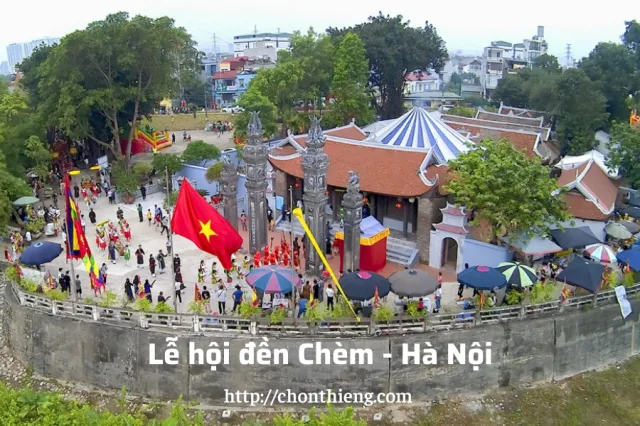


Khái quát về hội đền Chèm
Hội đền Chèm là một trong những lễ hội cổ truyền tiêu biểu của vùng ven sông Hồng thuộc đất Thăng Long xưa. Lễ hội được tổ chức tại đình và đền Chèm, nay thuộc phường Thụy Phương, quận Bắc Từ Liêm, thành phố Hà Nội, nhằm tưởng nhớ công lao của Đức Thánh Chèm – Lý Ông Trọng cùng phu nhân là Bạch Tính Cung công chúa. Đây không chỉ là một lễ hội tín ngưỡng dân gian mà còn là nơi lưu giữ nhiều lớp trầm tích văn hóa, lịch sử và phong tục cổ của cư dân nông nghiệp đồng bằng Bắc Bộ.
Làng Chèm nằm bên tả ngạn sông Hồng. Từ trung tâm Hà Nội đi về phía cầu Thăng Long, tới chân cầu rồi men theo đê khoảng một kilômét là tới làng. Từ lâu, nơi đây đã nổi tiếng là vùng đất cổ linh thiêng, gắn với truyền thuyết về vị anh hùng huyền thoại Lý Ông Trọng. Dân làng Chèm từ nhiều đời nay luôn tự hào về vị Thành hoàng của quê hương mình và xem lễ hội là dịp quan trọng nhất trong năm để tưởng niệm công lao của Ngài.
Lễ hội được tổ chức thường niên từ ngày 14 đến ngày 16 tháng Năm âm lịch. Không gian lễ hội trải dài từ đình Chèm, chùa làng cho tới bến Ngự trên sông Hồng. Theo truyền thuyết, đây là dịp Đức Thánh Chèm mở tiệc khao quân sau chiến thắng, vì vậy các nghi lễ và trò hội đều mang đậm dấu ấn của tinh thần thượng võ, tín ngưỡng cầu mùa và sự gắn kết cộng đồng.
Đối tượng được thờ phụng chính trong đình Chèm là Lý Ông Trọng, thường được nhân dân gọi bằng những danh xưng kính trọng như Đức Ông, Đức Thánh Cả hay Đức Thánh Chèm. Phu nhân của Ngài là Bạch Tính Cung công chúa được nhân dân gọi là Đức Bà. Ngoài ra còn có Ông Sứ, Lục vị vương cùng nhiều nhân vật gắn với truyền thuyết và tín ngưỡng địa phương.
Lý Ông Trọng – vị anh hùng huyền thoại của đất Chèm
Theo truyền thuyết dân gian, Lý Ông Trọng tên thật là Lý Thân, quê ở làng Chèm. Ông sinh ra với tư chất khác thường, thông minh, khỏe mạnh và có thân hình khổng lồ. Dân gian mô tả ông có “bề cao hai trượng bề dày mười gang”, là người có sức khỏe phi thường và khí chất đường bệ.
Ngay từ thuở nhỏ, ông đã nổi tiếng là người cương trực, chính nghĩa và thương dân nghèo. Tương truyền vào đời Hùng Vương thứ mười tám, ông từng giữ một chức nhỏ ở huyện ấp. Một lần chứng kiến tên lính huyện đánh đập dân phu, ông tức giận dùng vồ đánh chết tên lính đó. Có lần khác, thấy dân nghèo đói khổ, ông đã phá kho thóc công chia cho dân. Vì những hành động ấy, ông bị quan trên quở phạt và bị tâu về triều xin xử tội chết. Tuy nhiên, vua nhận thấy ông là người có tài đức nên không nỡ giết. Khi bị quở trách, ông từng than rằng: “Làm người phải có chí lớn như chim phượng hoàng bay muôn dặm xa, sao chịu làm tôi tớ người để cho người mắng mỏ?”. Sau đó, ông rời quê hương đi cầu học phương xa.
Trong dân gian còn lưu truyền nhiều câu chuyện thần kỳ về Lý Ông Trọng. Tương truyền ông từng giúp Sơn Tinh giăng lưới sắt trên sông Nhị để tiêu diệt loài thủy quái trong cuộc chiến với Thủy Tinh. Có lần, một con yêu quái xuất hiện quấy phá vùng sông Chèm, ông đứng dạng chân bên bờ sông, cầm gươm khoắng xuống nước chém con thủy quái thành ba khúc. Dân chài vùng Thăng Long – Hà Nội tin rằng nhờ có Lý Ông Trọng mà đoạn sông Hồng từ bến Chèm tới bến Phà Đen trở nên yên lành, không còn loài thủy quái nào dám xuất hiện.
Đến thời Thục Phán An Dương Vương, Lý Ông Trọng trở thành vị tướng tài của nước Âu Lạc. Khi sang sứ nhà Tần, ông được Tần Thủy Hoàng nhờ giúp chống quân Hung Nô đang quấy phá vùng biên ải phía Bắc. Ông được bổ làm quan Tư lệ hiệu úy, trấn giữ vùng Lâm Thao. Với tài thao lược và sức mạnh phi thường, ông nhiều lần đánh bại quân Hung Nô khiến chúng vô cùng khiếp sợ, không dám xâm phạm biên giới nhà Tần nữa.
Vua Tần rất khâm phục tài năng của ông, phong tước cao, ban thưởng hậu hĩnh và gả công chúa Bạch Tính Cung cho ông. Tuy nhiên, sau một thời gian ở đất Tần, ông nhớ quê hương nên xin trở về nước. Khi ông đã về Âu Lạc, quân Hung Nô lại kéo đến quấy phá. Nhà Tần tiếp tục sai sứ sang mời ông nhưng ông không muốn rời quê hương thêm lần nữa. Theo một truyền thuyết, ông đã tự vẫn để khỏi phải đi xa đất nước. An Dương Vương cho ướp xác ông gửi sang Tần làm bằng chứng. Tần Thủy Hoàng vô cùng cảm kích, tổ chức tang lễ trọng thể cho ông.
Một truyền thuyết khác kể rằng vua Tần cho đúc một pho tượng đồng khổng lồ giống hình ông đặt ở cửa Kim Mã thành Hàm Dương nhằm uy hiếp quân Hung Nô. Pho tượng được làm rỗng bên trong, có thể chứa nhiều người điều khiển cho cử động như người thật. Từ đó, người phương Bắc gọi những pho tượng lớn là “Ông Trọng”. Tên riêng của ông dần trở thành danh từ chung.
Sau khi mất, Lý Ông Trọng được nhân dân lập đền thờ và tôn xưng là Đức Thánh Chèm. Từ bao đời nay, đền thờ Ngài vẫn nghi ngút khói hương bên bờ sông Hồng, trở thành một trong những trung tâm tín ngưỡng nổi tiếng của đất Thăng Long.
Nhà thơ Phạm Sư Mạnh từng ca ngợi:
Văn Lang thành cổ sơn trung điệp,
Ông Trọng từ thâm vân đạm nùng.
(Văn Lang thành cổ non trùng điệp,
Ông Trọng đền thiêng mây nhạt nồng).
Trong đền hiện vẫn còn nhiều câu đối và thơ văn ca ngợi công lao của Ngài. Tiêu biểu là đôi câu đối:
Đồng tương khiếp cường dị, chung cổ thần uy dương Bắc tái,
Thiết la tiêu thủy quái, thiên thu thánh lực hư Nam Bang.
Nghĩa là:
Tượng đồng khiếp giặc mạnh, muôn thuở coi thần lừng ải Bắc,
Lưới sắt trừ thủy quái, ngàn thu sức thánh giữ trời Nam.
Đền Chèm và tục thờ Đức Thánh Chèm
Đền thờ Lý Ông Trọng được xây dựng từ thời Bắc thuộc, vào khoảng giai đoạn từ năm 603 đến năm 939. Ngôi đền tọa lạc tại vùng Thụy Phương ngày nay, trước kia còn gọi là Thị Điểm. Đền nằm dưới những rặng cây xanh bên bờ sông Hồng, mang vẻ cổ kính và linh thiêng dù đã trải qua nhiều lần tu sửa.
Nhân dân trong vùng thường gọi Lý Ông Trọng là Đức Ông, Đức Thánh Chèm hoặc Đức Thánh Cả. Một số người còn gọi duệ hiệu của Ngài là Hy Khang Thiên Vương để tránh phạm húy. Ngoài việc tổ chức lễ hội lớn vào tháng Năm âm lịch, người dân còn làm lễ vào ngày kỵ Đức Thánh Chèm mùng 10 tháng Giêng, ngày kỵ Đức Bà mùng 10 tháng Hai và vào các ngày sóc vọng trong năm.
Lễ hội do ba làng kết nghĩa cùng đứng ra tổ chức gồm làng Chèm, làng Hoàng Xá và làng Hoàng Liên. Làng Chèm là nơi thờ chính nên được gọi là anh cả, Hoàng Xá là anh hai và Hoàng Liên là anh ba. Việc xưng hô này thể hiện sự gắn bó, đoàn kết giữa ba làng từ nhiều đời nay. Trong các kỳ lễ hội, làng anh cả chịu trách nhiệm chính về tổ chức và phân công công việc cho hai làng còn lại.
Công tác chuẩn bị lễ hội
Ngay sau ngày kỵ Đức Bà mùng 10 tháng Hai âm lịch, các cụ trong làng đã bắt đầu họp bàn việc tổ chức hội. Công việc chuẩn bị gồm kiểm tra đồ thờ, đồ rước, trang phục nghi lễ và phân công nhân lực phục vụ lễ hội.
Lực lượng tham gia phục vụ lễ hội được tổ chức rất chặt chẽ. Đội phù giá gồm khoảng bảy mươi nam thanh niên khỏe mạnh, tuổi từ mười tám đến ba mươi lăm, có phẩm chất đạo đức tốt và chấp hành nghiêm các quy định của làng. Ngoài ra còn có đội thủ hiệu chuyên đánh trống lớn điều khiển nghi lễ, đội tiểu hiệu trực tiếp điều hành đội phù giá, ban lễ tân gồm phụ nữ của ba làng và đội sinh tiền là các thiếu nữ từ mười ba đến mười sáu tuổi.
Trước ngày hội hai ngày, dân làng tổ chức lễ phục y và thi nấu chè kho. Ngày 12 tháng Năm âm lịch, các cụ làm lễ phục y, tức thay y phục cho các vị thần được thờ trong đình như Đức Thánh Chèm, Đức Bà, Ông Sứ, Lục vị vương, ông quản voi và hai nàng hầu. Trước khi thay y phục, các cụ phải làm lễ xin phép rồi dùng nước sạch để bao sái tượng thờ.
Riêng việc phụng y cho Đức Bà được giao cho hai phụ giá nữ thực hiện dưới sự hướng dẫn của Trưởng ban Khánh tiết. Hai phụ giá này phải là phụ nữ góa chồng, trên sáu mươi tuổi, có phẩm chất đạo đức tốt và được dân làng tín nhiệm. Họ được xem như con gái hầu cận của Đức Bà trong những ngày hội.
Ngày 13 tháng Năm, dân làng tổ chức thi nấu chè kho tại đình. Đây là một hoạt động truyền thống gắn với việc chuẩn bị lễ vật dâng Thánh.
Phần lễ
Lễ rước nước
Lễ rước nước là nghi lễ quan trọng và đặc sắc nhất trong hội đền Chèm. Nghi lễ này diễn ra vào các ngày 14, 15 và 16 tháng Năm âm lịch, mang đậm dấu ấn của tín ngưỡng nông nghiệp cổ truyền.
Đoàn rước xuất phát từ đình Chèm với đội hình rất long trọng gồm đội rồng sư tử, cờ thần, cờ Tổ quốc, đội bát bửu, đội bát âm, các đoàn tế lễ, kiệu Đức Ông, kiệu Đức Bà cùng hàng trăm người tham gia. Sau khi làm lễ tại đình, đoàn rước xuống thuyền ra giữa sông Hồng lấy nước thiêng.
Đoàn thuyền rước gồm hai thuyền lớn nhỏ khác nhau. Một thuyền chở ba chóe nước tượng trưng cho Đức Ông, Đức Bà và Ông Sứ; thuyền còn lại chở đội tế lễ, đội dâng hương cùng những người tham gia nghi lễ. Thuyền đi hết địa phận của ba làng Chèm, Hoàng Xá và Hoàng Liên rồi quay ba vòng giữa sông trước khi lấy nước.
Cụ Chủ tế dùng gáo đồng múc nước sông vào từng chóe, mỗi chóe ba gáo. Sau đó đoàn thuyền quay trở lại đình. Khi cập bến, nước được rước vào hậu cung để dùng cho lễ mộc dục diễn ra ngày hôm sau.
Nghi thức rước nước không chỉ mang ý nghĩa lấy nước thiêng dâng Thánh mà còn phản ánh tín ngưỡng cầu mưa, cầu mùa của cư dân nông nghiệp ven sông Hồng từ xa xưa.
Lễ mộc dục
Lễ mộc dục hay lễ tắm tượng là nghi lễ linh thiêng bậc nhất của hội đền Chèm. Theo tục truyền, khi còn sống Đức Thánh Chèm là người rất giản dị, giỏi bơi lội và thường ra sông tắm nên dân làng về sau tổ chức lễ tắm tượng để tưởng nhớ sinh hoạt thường ngày của Ngài.
Trước kia, tượng Đức Ông được rước ra giữa sông Hồng để làm lễ tắm tượng. Tuy nhiên, ngày nay để bảo đảm an toàn và giảm vất vả cho người tham gia, nghi lễ được tiến hành tại đình.
Lễ mộc dục diễn ra vào giờ Ngọ ngày 15 tháng Năm âm lịch. Sau khi làm lễ bài ban để dọn các đồ thờ trong hậu cung, đội phù giá tiến hành rước long ngai của Đức Ông và Đức Bà ra tiểu vương đình. Khi rước long ngai Đức Thánh, tất cả những người trực tiếp tham gia đều phải bịt miệng bằng khăn đỏ. Đội phù giá liên tục hô “ù chóe, ù chóe” tạo nên bầu không khí trang nghiêm và huyền bí.
Nước dùng cho lễ mộc dục chính là nước thiêng được rước từ sông Hồng về. Các cụ sử dụng bảy gáo nước để làm lễ theo thứ tự nghiêm ngặt: ba gáo trên đầu, một gáo bên phải, một gáo bên trái, một gáo phía trước và một gáo phía sau. Theo quan niệm dân gian, con số bảy tượng trưng cho bảy vì tinh tú.
Việc tắm tượng Đức Bà do hai phụ giá nữ thực hiện dưới sự hướng dẫn của Trưởng ban Khánh tiết. Trong lúc diễn ra nghi lễ, các pháp sư và thầy cúng làm lễ quá độ nhằm ngăn tà ma xâm nhập.
Sau khi hoàn tất lễ mộc dục, long ngai của Đức Ông và Đức Bà được rước về ban công đồng để nghe kinh cúng quá độ rồi mới đưa trở lại hậu cung.
Các nghi lễ tâm linh khác
Ngoài lễ rước nước và lễ mộc dục, hội đền Chèm còn có nhiều nghi thức tín ngưỡng đặc sắc khác như lễ phát tấu, cúng phan, cúng Phật, cúng quá độ, cúng khai quang yên vị và rước văn.
Lễ phát tấu là nghi thức thỉnh mời ngũ vị sứ giả trên thiên đình về dự hội và cầu siêu cho những vong hồn chết oan nơi chiến trận. Trong nghi lễ này phải sử dụng tới mười ba bài sớ khác nhau.
Cúng phan là nghi lễ cầu siêu cho những vong hồn chết ngoài sông Hồng. Các thầy cúng thực hiện nghi lễ trước cổng đình với mong muốn những linh hồn này có thể bấu víu vào cờ Phật để được siêu thoát.
Cúng Phật là nghi lễ thỉnh Phật chứng giám cho các hoạt động của lễ hội. Trong khi đó, cúng quá độ được thực hiện để trừ tà và giúp các Ngài nghỉ ngơi sau khi làm lễ mộc dục.
Nghi lễ rước văn được tổ chức rất trang trọng. Bài văn tế được rước từ chùa về đình bằng kiệu long đình, có lọng che và đoàn tế lễ đi kèm. Sau khi rước về đình, đội tế bắt đầu làm lễ nhập tịch.
Từ năm 1990, lễ hội đền Chèm có thêm sự xuất hiện của các yếu tố Phật giáo và Đạo giáo. Các pháp sư tham gia làm lễ phát tấu, cúng phan, cúng khai quang, cúng quá độ; các nhà sư thực hiện lễ cúng Phật và lễ thả chim cầu siêu.
Phần hội
Thi thả chim bồ câu
Thi thả chim bồ câu là một trong những hoạt động hội nổi bật nhất của lễ hội đền Chèm. Tuy là hội thi chim vào loại muộn trong vùng nhưng từ lâu đã trở thành phong tục truyền thống nên thu hút rất đông người tham dự.
Trong ngày hội, hàng chục, thậm chí hàng trăm đàn chim từ nhiều nơi được đưa tới tham gia tranh tài. Khi mở lồng, từng đàn chim tung cánh bay lượn trên bầu trời trong tiếng reo hò của người xem. Khung cảnh những đàn chim chao lượn giữa không trung khiến ngày hội trở nên náo nhiệt và đầy sức sống.
Người dân quan niệm rằng việc thả chim mang ý nghĩa tâm linh sâu sắc. Những con chim sẽ cõng các vong hồn chết oan lên thiên đình và mời các vị thần linh về dự hội.
Thi bơi trải
Bên cạnh thi chim bồ câu, hội đền Chèm còn có tục thi bơi trải trên sông Hồng. Đây là hoạt động mang đậm tinh thần thượng võ và phản ánh đời sống sông nước của cư dân vùng ven sông.
Thông thường có khoảng mười thuyền tham gia, mỗi thuyền gồm hai mươi tay chèo mình trần đóng khố. Khi có hiệu lệnh pháo nổ, các thuyền lao vun vút trên mặt nước trong tiếng reo hò cổ vũ của hàng ngàn người đứng xem trên bờ.
Cuộc thi không chỉ tạo nên không khí sôi động cho lễ hội mà còn thể hiện sức mạnh tập thể và tinh thần đoàn kết cộng đồng.
Các trò chơi dân gian
Ngày cuối cùng của lễ hội, dân làng tiếp tục tổ chức nhiều trò chơi dân gian nhằm giữ chân khách thập phương và tạo không khí vui tươi cho ngày kết hội. Các hoạt động phổ biến gồm đánh cờ, đấu vật, hát chèo, biểu diễn sinh tiền và quân cờ người. Đây đều là những hình thức sinh hoạt văn hóa truyền thống quen thuộc của cư dân đồng bằng Bắc Bộ. Trong quan niệm của người dân Chèm, lễ hội càng đông vui, càng có nhiều người tham gia thì làng xóm càng hưng thịnh, cuộc sống càng bình an và sung túc.
Những kiêng kỵ và tục hèm trong lễ hội
Hội đền Chèm còn lưu giữ nhiều tục lệ và kiêng kỵ cổ truyền đặc biệt. Trong những ngày hội, dân làng chỉ dâng lễ chay. Người đi dự hội không mặc trang phục màu vàng vì đây được xem là màu hoàng bào vua ban riêng cho Đức Thánh.
Để tránh phạm húy, người dân trong vùng thường đọc chệch tên của Đức Thánh và Đức Bà. Từ “Trọng” được đọc thành “Trượng”, còn “Thân” được đọc thành “Thơn”.
Người vào đình không được ăn hành, tỏi. Các cụ Từ trong đình cũng không được đi dự đám tang và phải ở tại đình để thỉnh chuông báo giờ cho Đức Thánh.
Những kiêng kỵ và tục hèm này cho thấy sự tôn kính đặc biệt của cộng đồng đối với vị Thành hoàng của làng.
Giá trị văn hóa của hội đền Chèm
Hội đền Chèm là sự kết hợp hài hòa giữa tín ngưỡng thờ Thành hoàng làng với tín ngưỡng nông nghiệp cổ truyền của cư dân vùng đồng bằng Bắc Bộ. Những nghi thức như rước nước, tắm tượng, đua thuyền hay thả chim bồ câu đều gợi nhớ đến các nghi lễ cầu mùa, cầu mưa thuận gió hòa của cư dân nông nghiệp từ thời xa xưa.
Thông qua lễ hội, cộng đồng không chỉ thỏa mãn nhu cầu tín ngưỡng mà còn củng cố tinh thần đoàn kết giữa các làng xã, giáo dục truyền thống lịch sử và văn hóa cho các thế hệ sau. Đây cũng là dịp để người dân thể hiện niềm tự hào về quê hương và vị Thành hoàng linh thiêng của mình.
Với những giá trị đặc sắc về lịch sử, văn hóa và tín ngưỡng, Lễ hội đình Chèm đã được Bộ trưởng Bộ Văn hóa, Thể thao và Du lịch đưa vào Danh mục di sản văn hóa phi vật thể quốc gia theo Quyết định số 2067/QĐ-BVHTTDL ngày 13/6/2016.
Tài liệu tham khảo
- Trần Trọng Dương, Kẻ Chèm – lược sử một danh hương, Báo Công an Nhân dân, ngày 23/10/2019.
- Thạc Phương – Lê Trung Vũ (2015), 60 lễ hội truyền thống Việt Nam, Nxb Tổng hợp Thành phố Hồ Chí Minh.
- Linh Chi, Vị tướng Việt Nam khiến Tần Thủy Hoàng nể phục, được lập đền thờ ở Hà Nội, trang nguoiquansat.vn, ngày 26/03/2024.
- Đặng Việt Thủy (2005), 101 chuyện xư tích cũ (Việt Nam – Trung Quốc), Nxb Quân đội nhân dân.
- Lý Ông Trọng, trang nguoikesu.com.
- Phạm Lanh, Lễ hội truyền thống Đình Chèm năm 2023 quảng bá nét đẹp văn hóa của Thủ đô, Báo Quân đội nhân dân, ngày 02/07/2023.
- Lễ hội đình Chèm, trang Cục Di sản văn hóa.
- Đoàn Mạnh Hùng, Lễ hội Đình Chèm (Phường Đông Ngạc – Thành phố Hà Nội) di sản văn hóa phi vật thể Quốc gia, cần được gìn giữ và phát huy cho muôn đời sau, Trang thông tin điện tử phường Đông Ngạc – Thành phố Hà Nội, ngày 05/05/2026.
Ngôn ngữ khác
Tiếng Anh (English)
Overview of the Chem Temple Festival
The Chem Temple Festival is one of the most representative traditional festivals of the Red River riverside region in the former land of Thang Long. The festival is held at the communal house and temple of Chem, now located in Thuy Phuong Ward, Bac Tu Liem District, Hanoi, to commemorate the merits of Duc Thanh Chem (Ly Ong Trong) and his consort, Princess Bach Tinh Cung. More than merely a folk religious festival, it preserves multiple layers of cultural, historical, and customary traditions of the agricultural inhabitants of the Northern Delta.
Chem Village is situated on the left bank of the Red River. From the center of Hanoi, one travels toward Thang Long Bridge, then follows the dyke for approximately one kilometer to reach the village. For centuries, this area has been renowned as a sacred ancient land associated with the legend of the heroic figure Ly Ong Trong. The people of Chem have long taken pride in their tutelary deity and regard the annual festival as the most important occasion of the year to honor his contributions.
The festival is held annually from the 14th to the 16th day of the Fifth Lunar Month. Its ceremonial space extends from Chem Communal House and the village pagoda to Ngu Wharf on the Red River. According to local tradition, this was the occasion when Duc Thanh Chem hosted a victory banquet for his troops after a successful military campaign. Consequently, both the rituals and festive activities bear strong traces of martial spirit, agricultural fertility beliefs, and communal solidarity.
The principal deity worshipped at Chem Communal House is Ly Ong Trong, reverently addressed by local people as Duc Ong, Duc Thanh Ca, or Duc Thanh Chem. His consort, Princess Bach Tinh Cung, is respectfully known as Duc Ba. The temple complex also venerates Ong Su, the Six Royal Lords (Luc Vi Vuong), and numerous other figures associated with local legends and folk beliefs.
Ly Ong Trong – The Legendary Hero of Chem
According to folk tradition, Ly Ong Trong’s birth name was Ly Than, and he was a native of Chem Village. He was said to possess extraordinary qualities from birth, being intelligent, exceptionally strong, and of gigantic stature. Folklore describes him as having “a height of two truong and a breadth of ten spans,” emphasizing his remarkable physical strength and imposing presence.
From an early age, he became renowned for his upright character, sense of justice, and compassion for the poor. Tradition relates that during the reign of the Eighteenth Hung King, he held a minor administrative position in a local district. On one occasion, after witnessing a district soldier brutally beating corvée laborers, he struck the man dead with a mallet in anger. On another occasion, seeing the suffering of impoverished villagers, he broke open a public granary and distributed grain among the people. Because of these actions, he was reprimanded by higher authorities and reported to the royal court with a recommendation for execution. However, the king recognized his talent and virtue and spared his life. When criticized for his conduct, he is said to have declared:
“A man should possess lofty aspirations like the phoenix soaring thousands of miles. How can one submit to servitude and endure the scolding of others?”
Afterward, he left his homeland in search of knowledge and experience in distant lands.
Numerous miraculous tales concerning Ly Ong Trong continue to circulate in local folklore. One tradition recounts that he assisted Son Tinh by stretching iron nets across the Nhi River to destroy aquatic monsters during the legendary conflict with Thuy Tinh. Another story tells of a monstrous creature that terrorized the Chem River region. Standing astride the riverbank, Ly Ong Trong struck the waters with his sword and severed the monster into three pieces. Fishermen throughout the Thang Long–Hanoi region believed that, thanks to his protection, the stretch of the Red River from Chem Wharf to Pha Den Wharf became peaceful and free from dangerous water spirits.
During the reign of Thuc Phan An Duong Vuong, Ly Ong Trong became a distinguished general of Au Lac. While serving as an envoy to the Qin Empire, he was requested by Qin Shi Huang to assist in suppressing incursions by the Xiongnu along the northern frontier. He was appointed Commandant of Sili (Tu Le Hieu Uy) and stationed in the Lam Thao region. Through his military skill and extraordinary strength, he repeatedly defeated the Xiongnu forces, causing them to fear him greatly and refrain from further attacks on Qin territory.
The Qin ruler greatly admired his abilities, conferred high titles upon him, bestowed generous rewards, and married Princess Bach Tinh Cung to him. After spending some time in Qin territory, however, he became homesick and requested permission to return to Au Lac. Following his departure, the Xiongnu once again threatened the frontier. Qin authorities subsequently dispatched envoys to invite him back, but he refused to leave his homeland a second time. According to one tradition, he took his own life rather than depart from his native land again. An Duong Vuong ordered his body to be preserved and sent to Qin as proof. Deeply moved, Qin Shi Huang organized a grand state funeral in his honor.
Another legend relates that Qin Shi Huang commissioned a colossal bronze statue in Ly Ong Trong’s likeness and placed it at the Kim Ma Gate of Ham Duong. The statue was hollow and could accommodate several people inside, enabling it to move like a living person. Thereafter, large statues in the North came to be known as “Ong Trong,” and his personal name gradually evolved into a common noun.
After his death, the local population erected a temple in his honor and venerated him as Duc Thanh Chem. For generations, incense has continued to burn at his shrine on the banks of the Red River, making it one of the most important centers of folk worship in the Thang Long region.
The poet Pham Su Manh once praised him in the following verse:
“Van Lang citadel stands amid layered mountains,
Ong Trong’s sacred temple rests beneath drifting clouds.”
Many parallel sentences and literary compositions honoring his achievements remain preserved within the temple. Among the most notable is the following couplet:
“Bronze statues intimidate mighty enemies, divine prestige resounds forever across the northern frontier;
Iron nets destroy water monsters, sacred power safeguards the Southern Realm for a thousand generations.”
Chem Temple and the Worship of Duc Thanh Chem
The temple dedicated to Ly Ong Trong was originally established during the period of Chinese domination, approximately between 603 and 939 CE. Located in present-day Thuy Phuong, formerly known as Thi Diem, the temple stands beneath ancient trees along the Red River, retaining its venerable and sacred atmosphere despite numerous restorations over the centuries.
Local residents commonly refer to Ly Ong Trong as Duc Ong, Duc Thanh Chem, or Duc Thanh Ca. Some also employ his honorific title Hy Khang Thien Vuong in order to avoid violating naming taboos. In addition to the grand festival held in the Fifth Lunar Month, ceremonies are conducted on the death anniversary of Duc Thanh Chem on the 10th day of the First Lunar Month, the death anniversary of Duc Ba on the 10th day of the Second Lunar Month, and on regular new-moon and full-moon observances throughout the year.
The festival is jointly organized by three allied villages: Chem, Hoang Xa, and Hoang Lien. As the principal center of worship, Chem is regarded as the “elder brother,” while Hoang Xa and Hoang Lien are known respectively as the “second brother” and “third brother.” This terminology reflects the long-standing bonds of solidarity among the three communities. During festival periods, the elder brother village assumes primary responsibility for organization and allocates duties to the other two villages.
Preparations for the Festival
Immediately after the death anniversary of Duc Ba on the 10th day of the Second Lunar Month, the village elders begin meeting to discuss the organization of the festival. Preparatory work includes inspecting ritual objects, procession equipment, ceremonial costumes, and assigning personnel for various festival duties.
The festival service force is organized in a highly systematic manner. The phu gia team consists of approximately seventy physically fit young men between eighteen and thirty-five years of age, selected for their good moral character and strict observance of village regulations. In addition, there is a thu hieu team responsible for beating the large ceremonial drum and directing the rituals, a tieu hieu team that directly supervises the phu gia team, a reception committee composed of women from the three participating villages, and a sinh tien troupe consisting of girls between thirteen and sixteen years old.
Two days before the festival, the villagers hold the ceremonies of phuc y (changing the divine garments) and the competition for cooking che kho, a traditional sweet mung bean confection. On the 12th day of the Fifth Lunar Month, the elders conduct the phuc y ceremony, replacing the garments of the deities worshipped in the communal house, including Duc Thanh Chem, Duc Ba, Ong Su, the Six Royal Lords, the Elephant Keeper, and the Two Maidservants. Before changing the garments, permission must be ritually requested from the deities, after which the statues are cleansed with purified water.
The dressing of Duc Ba is entrusted to two female attendants under the supervision of the Head of the Ritual Committee. These women must be widows over sixty years of age, possess good moral character, and enjoy the trust of the community. During the festival they are regarded as the personal attendants of Duc Ba.
On the 13th day of the Fifth Lunar Month, the villagers organize the che kho cooking competition at the communal house. This traditional activity is closely associated with the preparation of offerings to the deity.
Ritual Ceremonies
Water Procession Ceremony
The Water Procession is the most important and distinctive ritual of the Chem Temple Festival. Conducted on the 14th, 15th, and 16th days of the Fifth Lunar Month, it preserves strong elements of ancient agricultural beliefs.
The procession departs from Chem Communal House in a highly solemn formation that includes dragon and lion dance troupes, sacred banners, national flags, the Eight Precious Objects procession (Bat Buu), the Eight-Sound Ensemble (Bat Am), ritual delegations, the palanquin of Duc Ong, the palanquin of Duc Ba, and hundreds of participants. After conducting ceremonies at the communal house, the procession boards boats and travels to the middle of the Red River to collect sacred water.
The flotilla consists of two boats of different sizes. One carries three large ceramic jars representing Duc Ong, Duc Ba, and Ong Su; the other transports the ritual officiants, incense-offering team, and participants. The boats travel through the territories of Chem, Hoang Xa, and Hoang Lien villages before circling three times in midstream and proceeding with the collection of water.
The Chief Ritual Officiant uses a bronze ladle to draw water from the river into each jar, placing three ladles into each vessel. The flotilla then returns to the communal house. Upon arrival, the water is carried into the sanctuary and reserved for the Moc Duc ceremony held the following day.
This ritual not only provides sacred water for offering to the deity but also reflects the ancient agricultural community’s prayers for rain and abundant harvests.
Moc Duc Ceremony
The Moc Duc Ceremony, or Ritual Bathing of the Deity, is among the most sacred rites of the Chem Temple Festival. According to local tradition, Duc Thanh Chem was a modest individual during his lifetime, skilled in swimming and fond of bathing in the river. The ritual therefore commemorates aspects of his daily life.
In earlier times, the statue of Duc Ong was carried into the middle of the Red River for the bathing ceremony. Today, however, for reasons of safety and convenience, the ritual is conducted within the communal house.
The ceremony takes place at noon on the 15th day of the Fifth Lunar Month. After the bai ban rite, during which ritual objects in the sanctuary are removed, the phu gia team carries the spirit thrones of Duc Ong and Duc Ba to the Tieu Vuong Pavilion. During the procession of the sacred throne, all participants directly involved must cover their mouths with red cloths. Meanwhile, members of the phu gia team continuously chant “u choe, u choe,” creating an atmosphere that is both solemn and mysterious.
The water used in the ceremony is the sacred water previously collected from the Red River. Seven ladles of water are employed according to a strict sequence: three over the head, one on the right side, one on the left side, one in front, and one behind. In folk belief, the number seven symbolizes the seven celestial stars.
The bathing of Duc Ba is carried out by the two female attendants under the direction of the Head of the Ritual Committee. During the ceremony, ritual masters and spirit-medium priests conduct rites of deliverance to prevent malevolent spirits from entering the sacred space.
After the completion of the Moc Duc ceremony, the spirit thrones of Duc Ong and Duc Ba are carried to the Communal Altar Hall to receive the chanting of deliverance scriptures before being returned to the sanctuary.
Other Spiritual Rituals
In addition to the Water Procession and Moc Duc ceremonies, the Chem Temple Festival includes numerous distinctive religious rites such as phat tau, cung phan, Buddhist offerings, rites of deliverance, khai quang yen vi, and the Procession of the Ritual Text.
The phat tau ceremony serves to invite the Five Celestial Messengers to attend the festival and to pray for the souls of those who died unjustly on the battlefield. Thirteen different memorial petitions are required for this ritual.
The cung phan ceremony is dedicated to the souls of those who perished in the Red River. Conducted before the communal house gate, the ritual expresses the hope that these wandering spirits may cling to the Buddhist banners and attain liberation.
The Buddhist offering ceremony invites the Buddha to witness and bless the festival activities. Meanwhile, rites of deliverance are performed to dispel harmful influences and allow the deities to rest after the Moc Duc ceremony.
The Procession of the Ritual Text is conducted with great solemnity. The ritual oration is carried from the pagoda to the communal house in a long dinh palanquin, accompanied by ceremonial parasols and ritual delegations. Upon arrival, the officiants commence the rite of nhap tich.
Since 1990, the festival has incorporated additional Buddhist and Daoist elements. Ritual masters conduct ceremonies such as phat tau, cung phan, khai quang, and rites of deliverance, while Buddhist monks preside over Buddhist offerings and bird-release ceremonies dedicated to the salvation of souls.
Festive Activities
Pigeon-Releasing Competition
The pigeon-releasing competition is one of the most prominent festive activities of the Chem Temple Festival. Although it developed later than similar competitions in neighboring areas, it has long become a cherished local tradition and attracts large numbers of participants.
During the festival, dozens or even hundreds of flocks of pigeons from various localities compete. As the cages are opened, the birds soar into the sky amid the cheers of spectators. The sight of numerous flocks circling overhead creates a lively and vibrant atmosphere.
Local people believe that the release of pigeons carries profound spiritual significance. The birds are thought to convey the souls of the unjustly deceased to the celestial realm and invite divine beings to attend the festival.
Traditional Boat Racing
Alongside the pigeon competition, the festival also features traditional boat racing on the Red River. This activity embodies a strong martial spirit and reflects the riverine lifestyle of local communities.
Typically, around ten racing boats participate, each crewed by twenty bare-chested rowers wearing traditional loincloths. At the signal of a ceremonial explosion, the boats surge across the water while thousands of spectators along the riverbanks cheer enthusiastically.
The race not only contributes to the festive atmosphere but also demonstrates collective strength and communal solidarity.
Folk Games
On the final day of the festival, villagers organize various traditional games and performances to entertain visitors and conclude the celebrations on a joyful note. Common activities include chess competitions, traditional wrestling, cheo singing performances, sinh tien dances, and human chess games. These are all familiar forms of traditional cultural expression among the inhabitants of the Northern Delta.
According to local belief, the more vibrant and well-attended the festival is, the more prosperous the village will become and the more peaceful and abundant life will be.
Taboos and Ritual Restrictions
The Chem Temple Festival preserves numerous distinctive traditional taboos and ritual restrictions. During the festival, only vegetarian offerings are presented. Participants are prohibited from wearing yellow garments, as yellow is regarded as the imperial color granted exclusively to Duc Thanh Chem.
To avoid violating naming taboos, local residents often alter the pronunciation of the names of Duc Thanh Chem and Duc Ba. The word “Trong” is pronounced as “Truong,” while “Than” is pronounced as “Thon.”
Visitors entering the communal house are forbidden to consume onions or garlic. The temple custodians are likewise prohibited from attending funerals and must remain at the communal house to ring the ceremonial bell announcing the hours for the deity.
These taboos and ritual restrictions demonstrate the community’s profound reverence for its tutelary deity.
Cultural Significance of the Chem Temple Festival
The Chem Temple Festival represents a harmonious combination of the worship of the village tutelary deity and the ancient agricultural beliefs of the Northern Delta. Rituals such as the Water Procession, Ritual Bathing of the Deity, boat racing, and pigeon releasing all evoke ancient ceremonies associated with prayers for favorable weather and abundant harvests.
Through the festival, the community not only fulfills its religious needs but also strengthens solidarity among villages, transmits historical and cultural traditions to younger generations, and reinforces collective identity. It is likewise an occasion for local people to express pride in their homeland and in their sacred tutelary deity.
Owing to its outstanding historical, cultural, and religious values, the Chem Communal House Festival was inscribed on the National List of Intangible Cultural Heritage by the Minister of Culture, Sports and Tourism under Decision No. 2067/QD-BVHTTDL dated 13 June 2016.
References
- Trần Trọng Dương, Kẻ Chèm – lược sử một danh hương, Báo Công an Nhân dân, ngày 23/10/2019.
- Thạc Phương – Lê Trung Vũ (2015), 60 lễ hội truyền thống Việt Nam, Nxb Tổng hợp Thành phố Hồ Chí Minh.
- Linh Chi, Vị tướng Việt Nam khiến Tần Thủy Hoàng nể phục, được lập đền thờ ở Hà Nội, trang nguoiquansat.vn, ngày 26/03/2024.
- Đặng Việt Thủy (2005), 101 chuyện xư tích cũ (Việt Nam – Trung Quốc), Nxb Quân đội nhân dân.
- Lý Ông Trọng, trang nguoikesu.com.
- Phạm Lanh, Lễ hội truyền thống Đình Chèm năm 2023 quảng bá nét đẹp văn hóa của Thủ đô, Báo Quân đội nhân dân, ngày 02/07/2023.
- Lễ hội đình Chèm, trang Cục Di sản văn hóa.
- Đoàn Mạnh Hùng, Lễ hội Đình Chèm (Phường Đông Ngạc – Thành phố Hà Nội) di sản văn hóa phi vật thể Quốc gia, cần được gìn giữ và phát huy cho muôn đời sau, Trang thông tin điện tử phường Đông Ngạc – Thành phố Hà Nội, ngày 05/05/2026.
Tiếng Trung (中文)
祠𥵚庙会概述
祠𥵚庙会(Den Chem,Chèm)是古升龙地区红河沿岸最具代表性的传统节庆之一。该节庆在祠𥵚亭庙与祠𥵚神庙举行,现位于河内市(Ha Noi)北慈廉郡(Bac Tu Liem)瑞芳坊(Thuy Phuong),旨在纪念祠𥵚圣神——李翁仲(Ly Ong Trong)及其夫人白性宫公主(Bach Tinh Cung)。这不仅是一项民间信仰节庆活动,同时也是保存北部平原农业居民历史文化积淀与古老风俗的重要载体。
祠𥵚村位于红河北岸左岸。自河内市中心向升龙大桥方向前行,至桥头后沿堤坝约一公里即可到达该村。自古以来,此地便以历史悠久、灵验神圣而闻名,并与传奇英雄李翁仲的传说密切相关。数百年来,祠𥵚村民始终以本村城隍神为荣,并将庙会视为一年中最重要的纪念盛典,以缅怀其丰功伟绩。
庙会每年于农历五月十四日至十六日举行。活动范围涵盖祠𥵚亭、村寺以及红河御津(Ben Ngu)等区域。根据传说,这一时期正是祠𥵚圣神凯旋后设宴犒赏将士之时,因此各项祭祀仪式与民俗活动均浓厚地体现出尚武精神、农业丰收信仰以及社区凝聚力。
祠𥵚亭主祀神为李翁仲,民间尊称其为“德翁”“大圣”或“祠𥵚圣神”。其夫人白性宫公主则被尊称为“德婆”。此外,庙内还供奉使翁、六位王以及诸多与地方传说和民间信仰相关的人物。
李翁仲——祠𥵚地区的传奇英雄
根据民间传说,李翁仲本名李申(Ly Than),出生于祠𥵚村。相传其天赋异禀,聪慧过人,体格魁伟。民间形容其“身高两丈,体宽十拃”,拥有超乎常人的力量与威严气度。
自幼年起,他便以刚直不阿、主持正义、体恤百姓而闻名。传说在雄王(Hung Vuong)第十八世时期,他曾担任地方小吏。一次目睹县兵殴打民夫,愤而挥槌将其击毙;又曾因不忍百姓饥饿而打开官仓,将粮食分发给贫民。由于这些举动,他遭到上级责罚,并被奏请朝廷处以死刑。然而国王认为其德才兼备,不忍加罪。
据传,当受到责难时,他曾感叹道:
“为人当有鸿鹄之志,如凤凰翱翔万里之外,岂能屈居人下,任人呵斥?”
此后,他离开故乡,远游求学。
民间还流传着许多关于李翁仲的神奇故事。相传他曾协助山精(Son Tinh)在二河(Song Nhi,即红河)上布设铁网,以消灭山精与水精(Thuy Tinh)大战中的水怪。又有一次,一头妖怪在祠𥵚河段兴风作浪,他立于河岸,两腿分开横跨河畔,挥剑斩入水中,将妖怪劈成三段。
升龙—河内地区的渔民相信,正因为有李翁仲镇守,自祠𥵚渡口至黑渡口(Pha Den)之间的红河水域方得安宁,再无水怪作祟。
至蜀泮安阳王(Thuc Phan An Duong Vuong)时期,李翁仲成为瓯雒国(Au Lac)的名将。出使秦朝时,秦始皇(Tan Thuy Hoang)因北方匈奴(Hung No)不断侵扰边境,遂邀请其协助防御。他被任命为司隶校尉,镇守临洮(Lam Thao)地区。
凭借卓越的军事才能与超凡神力,他屡次击败匈奴军队,使其闻风丧胆,再不敢轻犯秦朝边境。
秦始皇极为赏识其才能,赐予高爵厚赏,并将白性宫公主许配于他。然而在秦地居住一段时间后,他思念故土,遂请求返回瓯雒。
当李翁仲返回瓯雒后,匈奴军队再次南下侵扰边境。秦朝继续派遣使者前来邀请他出山,但他已不愿再次离开故土。根据一种传说,李翁仲为了避免远离祖国,选择自尽。安阳王命人保存其遗体,并送往秦朝作为证明。秦始皇对此深为感动,为其举行了隆重的葬礼。
另一种传说则记载,秦始皇命工匠铸造一尊与李翁仲形貌相同的巨型铜像,安置于咸阳(Ham Duong)金马门(Kim Ma)之外,以震慑匈奴。铜像内部中空,可容纳多人操纵,使其活动如真人一般。从此以后,北方地区将大型雕像统称为“翁仲”。李翁仲的名字也逐渐由专有名词演变为通称。
李翁仲去世后,当地百姓为其建庙立祀,尊奉为“祠𥵚圣神”。数百年来,其神庙香火不断,屹立于红河之滨,成为升龙地区最著名的信仰中心之一。
诗人范师孟(Pham Su Manh)曾赞颂道:
文郎古城山叠嶂,
翁仲神祠云淡浓。
(原文:
Văn Lang thành cổ sơn trung điệp,
Ông Trọng từ thâm vân đạm nùng.)
神庙内至今仍保存着大量赞颂其功绩的诗文与楹联。其中尤以以下对联最为著名:
铜像震慑强敌,千秋神威扬北塞;
铁网诛除水怪,万古圣力护南邦。
原文为:
铜相怯强夷,钟鼓神威扬北塞;
铁罗消水怪,千秋圣力护南邦。
祠𥵚神庙与祠𥵚圣神信仰
供奉李翁仲的神庙始建于北属时期,大约在公元603年至939年之间。庙宇位于今河内市北慈廉郡瑞芳坊,旧称市点(Thi Diem)。神庙掩映于红河岸边的古木之间,虽历经多次修缮,仍保持着庄严古朴的风貌。
当地民众通常尊称李翁仲为“德翁”“祠𥵚圣神”或“大圣”。部分居民则以其尊号“熙康天王(Hy Khang Thien Vuong)”相称,以避免触犯圣讳。
除农历五月举行盛大庙会外,当地居民还于农历正月初十举行祠𥵚圣神忌辰祭典,于二月初十举行德婆忌辰祭典,并在全年朔望日举行常规祭祀活动。
庙会由祠𥵚村(Chem)、黄舍村(Hoang Xa)与黄莲村(Hoang Lien)三个结义村共同举办。祠𥵚村为主祭村,被称为“长兄”;黄舍村为“二兄”;黄莲村为“三兄”。这种称谓体现了三村长期以来紧密的联盟关系。每逢庙会,长兄村负责统筹组织并向其余两村分配相关事务。
庙会筹备工作
每年农历二月初十德婆忌辰之后,村中长老便开始商议庙会筹备事宜。准备工作包括检查祭器、仪仗器具、礼服,并安排各项服务人员。
庙会服务队伍组织极为严密。其中抬驾队约由七十名十八至三十五岁的健壮青年组成,要求品行端正,并严格遵守村规。另设有司鼓队负责击大鼓指挥仪式,小旗队负责现场调度,礼宾组由三村妇女担任,生钱队则由十三至十六岁的少女组成。
庙会开始前两天,村民举行“服衣礼”与“煮糕羹比赛”。
农历五月十二日,长老们举行服衣礼,即为庙内供奉的诸神更换神衣,包括祠𥵚圣神、德婆、使翁、六位王、象官以及两位侍女等神像。更衣前必须先行禀告神明,然后以净水擦拭神像。
德婆神像更衣则专由两位女抬驾人员负责,并由庆节委员会主任指导。她们必须是六十岁以上、品德良好、深受村民敬重的寡妇,被视为德婆在庙会期间的侍从女儿。
农历五月十三日,村民于亭内举行煮糕羹比赛,以准备祭祀圣神所需供品。
礼仪部分
迎水仪式
迎水礼是祠𥵚庙会最重要、最具特色的仪式之一,于农历五月十四日至十六日连续举行,深刻体现了传统农业信仰特征。
迎水队伍自祠𥵚亭出发,阵容极为隆重,包括龙狮队、神旗队、国旗队、八宝仪仗队、八音乐队、祭礼团、德翁神轿、德婆神轿以及数百名参与者。
完成亭内祭礼后,队伍登船驶向红河中央汲取圣水。
迎水船队由大小两艘船组成。一船载有三只水瓮,分别象征德翁、德婆和使翁;另一船搭载祭礼人员、进香人员及参与仪式者。
船队依次巡行祠𥵚村、黄舍村和黄莲村水域,随后在河中央绕行三周后方开始取水。
主祭长老以铜勺从河中取水,每瓮三勺。随后船队返回神庙。靠岸之后,圣水被迎入后宫,用于次日举行的沐浴仪式。
迎水礼不仅具有向圣神进献圣水的意义,也反映出红河流域农业居民古老的求雨、祈丰收信仰。
沐浴礼
沐浴礼又称“浴像礼”,是祠𥵚庙会最神圣的仪式之一。
根据传统传说,祠𥵚圣神生前生活简朴,善于游泳,经常到河中沐浴。因此后世村民举行浴像仪式,以纪念其日常生活。
过去,人们会将德翁神像迎至红河中央进行浴像。如今为了保障安全并减轻参与者负担,仪式改在祠𥵚亭内举行。
沐浴礼于农历五月十五日午时举行。首先进行“排班礼”,将后宫祭器移出。随后抬驾队将德翁与德婆的龙椅迎至小王亭。
在抬送圣驾过程中,所有直接参与者都必须以红布蒙口。抬驾队不断高呼“乌啜、乌啜”,营造出庄严而神秘的氛围。
沐浴所用之水即前一日从红河迎来的圣水。长老们严格按照传统程序进行浴礼:头顶三勺、右侧一勺、左侧一勺、前方一勺、后方一勺,共七勺。
民间认为数字“七”象征北斗七星。
德婆的浴像礼则由两位女抬驾人员在庆节委员会主任指导下完成。仪式期间,道士与法师同时举行超度法事,以防邪灵侵扰。
仪式结束后,德翁与德婆龙椅被迎至公同殿聆听超度经文,之后方送回后宫。
其他宗教仪式
除迎水礼与沐浴礼外,祠𥵚庙会还保留着许多富有特色的宗教仪式,包括发奏礼、幡供、佛供、超度供、开光安位礼以及迎文礼等。
发奏礼旨在恭请天庭五位使者降临庙会,同时超度战场亡魂。仪式中需使用十三篇不同的奏疏。
幡供则是为红河溺亡者举行的超度法事。法师们于亭门前举行仪式,希望这些亡灵能够依附佛幡而获得解脱。
佛供礼旨在恭请诸佛见证庙会活动;超度供则用于驱邪,并帮助诸神在沐浴礼后安息。
迎文礼极为隆重。祭文由寺院迎出,置于龙亭之中,并由华盖及祭礼队伍护送至神庙。祭文迎至后,祭礼团即举行入席仪式。
自1990年以来,庙会中逐渐融入佛教与道教因素。法师主持发奏礼、幡供、开光礼和超度礼;僧侣则主持佛供礼与放生超度仪式。
游艺部分
放飞鸽子比赛
放飞鸽子比赛是祠𥵚庙会最具特色的娱乐活动之一。虽然当地赛鸽传统形成较晚,但长期以来已成为重要民俗,因此吸引众多群众参与。
庙会期间,数十乃至上百个鸽群从各地汇聚而来。当鸽笼开启之际,一群群鸽子振翅高飞,在观众欢呼声中盘旋于蓝天之上。
民众认为,放鸽活动具有深刻的宗教意义:鸽子能够背负冤魂飞往天庭,并邀请诸神降临人间参加盛会。
划桨竞渡
除赛鸽外,祠𥵚庙会还举行红河竞渡活动。
通常有十余艘赛船参赛,每船由二十名赤膊束裈的桨手组成。发令炮响后,各船如离弦之箭般疾驰于河面之上,岸边数千名观众呐喊助威,场面十分壮观。
竞渡不仅增添节庆气氛,也体现出当地居民团结协作和勇武尚武的精神。
民间游戏
庙会最后一天,村民继续举行各种传统民间游戏,以吸引各地香客并营造欢乐氛围。
常见项目包括下棋、摔跤、唱筹戏、表演生钱舞以及人棋对弈等。这些均为北部平原地区传统文化活动的重要组成部分。
祠𥵚居民认为,庙会越热闹,参与人数越多,则村庄越兴旺,百姓生活也越安宁富足。
庙会禁忌与仪式传统
祠𥵚庙会至今仍保留着许多古老禁忌与传统习俗。
庙会期间,村民只供奉素食祭品。参加庙会者不得穿黄色服装,因为黄色被视为皇帝专赐给圣神的御袍颜色。
为了避讳,当地居民通常会改读圣神及德婆名字中的部分字音。例如将“仲(Trong)”读作“杖(Truong)”,将“申(Than)”读作“申儿(Thon)”。
进入神亭者不得食用葱蒜。庙中守庙长老亦不得参加丧礼,并须留守庙内按时鸣钟,以报圣神知晓时辰。
这些禁忌与仪式传统充分体现出社区对城隍神的崇高敬仰。
祠𥵚庙会的文化价值
祠𥵚庙会体现了村社城隍信仰与北部平原农业信仰的有机结合。
迎水、浴像、竞渡以及放飞鸽子等活动,都让人联想到古代农业居民祈雨、祈丰收以及祈求风调雨顺的传统仪式。
通过庙会活动,当地居民不仅满足了精神信仰需求,也进一步加强了村社之间的团结合作,并向后代传承历史文化传统。这也是人们表达对故乡以及守护神崇敬与自豪的重要机会。
凭借其独特的历史、文化和信仰价值,祠𥵚亭庙会于2016年6月13日依据第2067/QĐ-BVHTTDL号决定,被越南文化、体育与旅游部列入国家级非物质文化遗产名录。
参考文献
- Trần Trọng Dương, Kẻ Chèm – lược sử một danh hương, Báo Công an Nhân dân, ngày 23/10/2019.
- Thạc Phương – Lê Trung Vũ (2015), 60 lễ hội truyền thống Việt Nam, Nxb Tổng hợp Thành phố Hồ Chí Minh.
- Linh Chi, Vị tướng Việt Nam khiến Tần Thủy Hoàng nể phục, được lập đền thờ ở Hà Nội, trang nguoiquansat.vn, ngày 26/03/2024.
- Đặng Việt Thủy (2005), 101 chuyện xư tích cũ (Việt Nam – Trung Quốc), Nxb Quân đội nhân dân.
- Lý Ông Trọng, trang nguoikesu.com.
- Phạm Lanh, Lễ hội truyền thống Đình Chèm năm 2023 quảng bá nét đẹp văn hóa của Thủ đô, Báo Quân đội nhân dân, ngày 02/07/2023.
- Lễ hội đình Chèm, trang Cục Di sản văn hóa.
- Đoàn Mạnh Hùng, Lễ hội Đình Chèm (Phường Đông Ngạc – Thành phố Hà Nội) di sản văn hóa phi vật thể Quốc gia, cần được gìn giữ và phát huy cho muôn đời sau, Trang thông tin điện tử phường Đông Ngạc – Thành phố Hà Nội, ngày 05/05/2026.
Tiếng Pháp (Français’)
Aperçu de la fête du temple Chem
La fête du temple Chem est l’une des fêtes traditionnelles les plus représentatives de la région riveraine du Fleuve Rouge, appartenant autrefois au territoire de Thang Long. Elle se déroule au temple communal et au temple Chem (Dinh va Den Chem), aujourd’hui situés dans le quartier de Thuy Phuong, arrondissement de Bac Tu Liem, à Hanoi, afin de commémorer les mérites de Saint Chem, Ly Ong Trong, ainsi que de son épouse, la princesse Bach Tinh Cung.
Cette fête n’est pas seulement une manifestation de la religion populaire vietnamienne ; elle constitue également un espace où se conservent de nombreuses strates culturelles, historiques et coutumières des populations agricoles du delta septentrional.
Le village de Chem est situé sur la rive gauche du Fleuve Rouge. Depuis le centre de Hanoi, en direction du pont Thang Long, il suffit de suivre la digue sur environ un kilomètre après le pont pour atteindre le village. Depuis des siècles, cet endroit est réputé comme une terre ancienne et sacrée, associée à la légende du héros mythique Ly Ong Trong. Les habitants de Chem ont toujours été fiers du génie tutélaire de leur village et considèrent la fête comme l’événement le plus important de l’année pour honorer sa mémoire.
La fête est célébrée chaque année du 14 au 16 du cinquième mois lunaire. Son espace cérémoniel s’étend du temple communal de Chem jusqu’à la pagode du village et au débarcadère Ngu sur le Fleuve Rouge. Selon la tradition, cette fête commémore le banquet militaire organisé par Saint Chem après sa victoire. C’est pourquoi les rites et les divertissements portent fortement l’empreinte de l’esprit martial, des croyances agraires liées à la fertilité et de la cohésion communautaire.
La principale divinité vénérée au temple communal est Ly Ong Trong, appelé respectueusement par la population Duc Ong, Duc Thanh Ca ou encore Duc Thanh Chem. Son épouse, la princesse Bach Tinh Cung, est vénérée sous le titre de Duc Ba. Le sanctuaire honore également Ong Su, les Six Rois (Luc Vi Vuong) ainsi que plusieurs personnages associés aux traditions légendaires locales.
Ly Ong Trong, héros légendaire de la terre de Chem
Selon les traditions populaires, Ly Ong Trong portait à l’origine le nom de Ly Than et était natif du village de Chem. Dès sa naissance, il se distingua par des qualités extraordinaires : intelligence, force exceptionnelle et stature gigantesque. Les récits populaires le décrivent comme mesurant « deux truong de hauteur et dix empans d’épaisseur », symbole d’une puissance physique hors du commun et d’une allure majestueuse.
Dès son enfance, il était réputé pour sa droiture, son sens de la justice et sa compassion envers les plus pauvres. La tradition rapporte qu’au temps du dix-huitième roi Hung, alors qu’il occupait une modeste fonction administrative locale, il fut témoin d’un soldat qui maltraitait des corvéables. Indigné, il tua ce dernier à l’aide d’un lourd maillet. Une autre fois, voyant la population souffrir de la famine, il ouvrit les greniers publics pour distribuer le riz aux nécessiteux.
Ces actions lui valurent la réprobation des autorités, qui demandèrent sa condamnation à mort. Cependant, le souverain, reconnaissant ses qualités exceptionnelles, refusa de l’exécuter. Réprimandé par ses supérieurs, il aurait déclaré :
« L’homme doit nourrir de grandes ambitions, semblable au phénix qui parcourt des milliers de lis dans le ciel. Comment pourrait-il accepter d’être le serviteur d’autrui et subir ses reproches ? »
Après cet épisode, il quitta son village natal pour poursuivre ses études dans des contrées lointaines.
La tradition populaire conserve également de nombreux récits merveilleux à son sujet. On raconte notamment qu’il aida Son Tinh à tendre un filet de fer sur le fleuve Nhi afin de détruire les monstres aquatiques lors de son combat contre Thuy Tinh.
Dans une autre légende, un démon aquatique terrorisait les habitants de la région de Chem. Ly Ong Trong se serait tenu debout sur la rive, les jambes écartées, et aurait frappé les eaux de son épée, tranchant le monstre en trois morceaux. Les pêcheurs de la région de Thang Long-Hanoi croient depuis lors que la portion du Fleuve Rouge comprise entre l’embarcadère de Chem et celui de Pha Den est devenue sûre grâce à sa protection.
Sous le règne de Thuc Phan An Duong Vuong, Ly Ong Trong devint l’un des grands généraux du royaume d’Au Lac. Lors d’une mission diplomatique auprès de la dynastie Qin, l’empereur Qin Shi Huang lui demanda son aide pour combattre les Xiongnu qui menaçaient les frontières septentrionales. Il fut nommé commandant militaire de la région de Lam Thao.
Grâce à son génie stratégique et à sa force extraordinaire, il remporta de nombreuses victoires contre les Xiongnu, qui finirent par renoncer à attaquer les frontières de l’empire Qin.
L’empereur Qin, admiratif de ses talents, lui accorda de hautes distinctions, de riches récompenses et lui donna en mariage la princesse Bach Tinh Cung. Toutefois, après plusieurs années passées en territoire Qin, Ly Ong Trong éprouva une profonde nostalgie pour sa patrie et demanda à retourner au pays.
Après son retour à Au Lac, les Xiongnu reprirent leurs incursions. La cour Qin envoya alors de nouveaux émissaires afin de solliciter son retour, mais il refusa de quitter une seconde fois sa terre natale. Selon une tradition, il se donna la mort afin de ne pas être contraint à repartir. An Duong Vuong fit embaumer son corps et l’envoya à Qin comme preuve de son décès. Profondément ému, Qin Shi Huang lui accorda des funérailles solennelles.
Une autre légende rapporte que l’empereur Qin fit fondre une immense statue de bronze à son effigie et la plaça devant la porte Kim Ma de la capitale Ham Duong afin d’impressionner les Xiongnu. La statue, creuse à l’intérieur, pouvait contenir plusieurs hommes chargés de lui donner l’apparence du mouvement. Dès lors, les populations du Nord commencèrent à appeler les grandes statues « Ong Trong », transformant progressivement son nom propre en nom commun.
Après sa mort, les habitants lui élevèrent un sanctuaire et le vénérèrent sous le titre de Saint Chem. Depuis des siècles, son temple demeure un haut lieu de culte sur les rives du Fleuve Rouge et constitue l’un des centres spirituels les plus prestigieux de l’ancienne Thang Long.
Le poète Pham Su Manh lui consacra ces vers :
Van Lang thanh co son trung diep,
Ong Trong tu tham van dam nong.
« L’antique citadelle de Van Lang se dresse parmi les montagnes superposées,
Le sanctuaire sacré d’Ong Trong apparaît dans les nuages légers et profonds. »
Le temple conserve encore aujourd’hui de nombreuses inscriptions, poèmes et sentences parallèles célébrant ses exploits. Parmi les plus célèbres figure le distique :
Dong tuong khiep cuong di, chung co than uy duong Bac tai,
Thiet la tieu thuy quai, thien thu thanh luc huu Nam Bang.
Que l’on peut traduire ainsi :
« La statue de bronze intimide les puissants ennemis et manifeste pour l’éternité la majesté divine aux frontières du Nord ;
Le filet de fer détruit les monstres aquatiques et protège depuis mille ans la terre sacrée du Sud. »
Le temple Chem et le culte de Saint Chem
Le sanctuaire dédié à Ly Ong Trong aurait été fondé sous la domination chinoise, entre 603 et 939. Situé dans l’actuel quartier de Thuy Phuong, anciennement appelé Thi Diem, il s’élève sous l’ombrage des grands arbres bordant le Fleuve Rouge et conserve son caractère antique et sacré malgré les nombreuses restaurations qu’il a connues.
Les habitants le désignent le plus souvent sous les titres de Duc Ong, Duc Thanh Chem ou Duc Thanh Ca. Certains utilisent également son titre honorifique Hy Khang Thien Vuong afin d’éviter de prononcer directement son nom sacré.
Outre la grande fête du cinquième mois lunaire, des cérémonies commémoratives sont organisées le dixième jour du premier mois lunaire, date anniversaire de la mort de Saint Chem, le dixième jour du deuxième mois lunaire pour Duc Ba, ainsi qu’aux jours de nouvelle lune et de pleine lune.
La fête est organisée conjointement par trois villages alliés : Chem, Hoang Xa et Hoang Lien. Chem, où se trouve le sanctuaire principal, est considéré comme le « frère aîné », Hoang Xa comme le « deuxième frère » et Hoang Lien comme le « troisième frère ». Cette appellation témoigne de la solidarité historique qui unit les trois communautés.
Préparatifs de la fête
Dès le lendemain de la commémoration de Duc Ba, le dixième jour du deuxième mois lunaire, les anciens du village se réunissent pour préparer la fête.
Les préparatifs comprennent la vérification des objets cultuels, des équipements processionnels, des costumes rituels ainsi que la répartition des responsabilités.
Les équipes participant à l’organisation sont soigneusement sélectionnées. Le groupe des porteurs rituels comprend environ soixante-dix jeunes hommes âgés de dix-huit à trente-cinq ans, choisis pour leur moralité et leur discipline. S’y ajoutent l’équipe des grands tambours cérémoniels, les responsables du protocole, les groupes féminins chargés de l’accueil ainsi que la troupe de danse Sinh Tien composée de jeunes filles âgées de treize à seize ans.
Deux jours avant l’ouverture de la fête, les habitants organisent la cérémonie de changement des vêtements sacrés ainsi qu’un concours de préparation du « che kho », une spécialité traditionnelle à base de haricots mungo.
Le douzième jour du cinquième mois lunaire a lieu la cérémonie de renouvellement des vêtements des divinités vénérées : Saint Chem, Duc Ba, Ong Su, les Six Rois, le gardien des éléphants et les deux suivantes. Avant cette opération, les anciens accomplissent des rites de permission et procèdent à la purification des statues à l’eau claire.
Pour Duc Ba, cette tâche est confiée à deux assistantes rituelles âgées de plus de soixante ans, veuves, reconnues pour leur vertu et leur respectabilité. Pendant la fête, elles sont considérées comme les servantes symboliques de la divinité.
Le treizième jour du cinquième mois lunaire est consacré au concours de préparation du che kho, destiné aux offrandes sacrées.
Les cérémonies rituelles
Le cortège de l’eau sacrée
Le cortège de l’eau constitue le rite le plus important et le plus emblématique de la fête du temple Chem. Cette cérémonie se déroule les 14, 15 et 16 du cinquième mois lunaire et porte l’empreinte profonde des croyances agraires traditionnelles.
La procession quitte le temple communal de Chem selon un ordre cérémoniel particulièrement solennel : troupe du dragon et du lion, bannières sacrées, drapeaux nationaux, ensemble des Huit Trésors (Bat Buu), orchestre rituel Bat Am, délégations chargées des sacrifices, palanquin de Duc Ong, palanquin de Duc Ba ainsi que plusieurs centaines de participants.
Après les cérémonies préliminaires au temple communal, le cortège embarque sur des bateaux pour se rendre au milieu du Fleuve Rouge afin d’y prélever l’eau sacrée.
La flottille processionnelle comprend deux embarcations de tailles différentes. L’une transporte trois grandes jarres destinées respectivement à Duc Ong, Duc Ba et Ong Su ; l’autre accueille les officiants, les porteurs d’encens et les participants au rite.
Les bateaux parcourent l’ensemble des territoires des trois villages de Chem, Hoang Xa et Hoang Lien avant d’effectuer trois rotations au milieu du fleuve. Ce n’est qu’après cette circumambulation symbolique que l’eau est prélevée.
Le maître des cérémonies puise alors l’eau du Fleuve Rouge à l’aide d’une louche de bronze et remplit successivement chaque jarre de trois louches d’eau.
La flottille retourne ensuite au débarcadère. Une fois arrivée à terre, l’eau sacrée est portée dans le sanctuaire intérieur où elle sera utilisée pour le rite du bain sacré célébré le lendemain.
Au-delà de sa fonction cultuelle, cette cérémonie reflète les anciennes croyances des populations agricoles riveraines du Fleuve Rouge, fondées sur les prières pour la pluie, l’abondance et la prospérité des récoltes.
Le rite du bain sacré (Moc Duc)
Le rite du bain sacré, ou Moc Duc, est considéré comme la cérémonie la plus sacrée de la fête du temple Chem.
Selon la tradition, Saint Chem était de son vivant un homme simple, excellent nageur, qui avait l’habitude de se baigner dans le fleuve. Les habitants auraient donc institué cette cérémonie afin de perpétuer le souvenir de ses activités quotidiennes.
Autrefois, la statue de Duc Ong était transportée jusqu’au milieu du Fleuve Rouge pour y être lavée rituellement. Aujourd’hui, afin de garantir la sécurité et de réduire les difficultés d’organisation, la cérémonie est accomplie dans l’enceinte du temple communal.
Le rite se déroule à midi, le quinzième jour du cinquième mois lunaire.
Après la cérémonie dite Bai Ban, destinée à dégager les objets du culte dans le sanctuaire intérieur, les porteurs rituels transportent les trônes sacrés de Duc Ong et de Duc Ba jusqu’au pavillon appelé Tieu Vuong Dinh.
Lorsque le trône de Saint Chem est porté en procession, toutes les personnes directement impliquées dans l’opération doivent se couvrir la bouche d’un tissu rouge. Les porteurs scandent continuellement l’exclamation rituelle : « U choe, u choe », créant une atmosphère à la fois solennelle et mystérieuse.
L’eau utilisée pour le bain sacré est celle qui a été prélevée lors du cortège sur le Fleuve Rouge.
Les officiants versent exactement sept louches d’eau selon un ordre rigoureusement codifié : trois sur la tête, une sur le côté droit, une sur le côté gauche, une à l’avant et une à l’arrière. Dans la symbolique populaire, le chiffre sept représente les sept astres.
Le bain rituel de Duc Ba est accompli par les deux assistantes féminines sous la direction du responsable du comité cérémoniel.
Pendant toute la durée du rite, les maîtres de cérémonies et les spécialistes religieux accomplissent des rituels destinés à repousser les influences néfastes et à empêcher les esprits malveillants de pénétrer dans l’espace sacré.
Une fois le bain achevé, les trônes sacrés de Duc Ong et de Duc Ba sont conduits à l’autel de la communauté divine afin d’y recevoir les prières de délivrance spirituelle avant d’être replacés dans le sanctuaire intérieur.
Autres cérémonies spirituelles
Outre le cortège de l’eau et le rite du bain sacré, la fête du temple Chem comprend de nombreuses autres cérémonies religieuses : Phat Tau, Cung Phan, culte bouddhique, rites de délivrance spirituelle, cérémonie d’illumination et de consécration des statues, ainsi que la procession des textes liturgiques.
Le rite Phat Tau consiste à inviter les cinq messagers célestes à participer à la fête tout en priant pour les âmes des morts tombés sur les champs de bataille. Treize requêtes rituelles distinctes sont nécessaires à l’accomplissement de cette cérémonie.
Le rite Cung Phan est destiné aux âmes des personnes disparues dans les eaux du Fleuve Rouge. Les officiants accomplissent les cérémonies devant l’entrée du temple communal afin que ces esprits puissent s’attacher symboliquement aux bannières bouddhiques et accéder à la délivrance.
Le culte bouddhique a pour fonction d’inviter les Bouddhas à témoigner des cérémonies de la fête.
Les rites de délivrance spirituelle sont quant à eux destinés à repousser les influences néfastes et à permettre aux divinités de se reposer après la cérémonie du bain sacré.
La procession des textes liturgiques constitue également un moment important. Les textes des sacrifices sont transportés depuis la pagode jusqu’au temple communal dans un palanquin cérémoniel couvert d’un dais et escorté par les officiants. Une fois arrivés au temple, les rites d’installation liturgique peuvent commencer.
Depuis 1990, la fête du temple Chem intègre davantage d’éléments issus du bouddhisme et du taoïsme. Les maîtres de rituels prennent part aux cérémonies Phat Tau, Cung Phan, de consécration et de délivrance spirituelle, tandis que les moines bouddhistes président les cérémonies de culte bouddhique et de lâcher d’oiseaux destinées au salut des âmes.
Les festivités
Le concours de lâcher de pigeons
Le concours de pigeons constitue l’une des activités les plus populaires de la fête du temple Chem.
Bien que cette compétition soit apparue relativement tardivement dans la région, elle est devenue au fil du temps une véritable tradition et attire un très grand nombre de participants.
Le jour de la fête, des dizaines, parfois des centaines de volées de pigeons provenant de différentes localités sont rassemblées pour concourir.
Au moment de l’ouverture des cages, les oiseaux s’élèvent dans le ciel sous les acclamations de la foule. Les formations aériennes qu’ils dessinent au-dessus du village confèrent à la fête une atmosphère particulièrement animée.
Selon les croyances populaires, le lâcher de pigeons possède également une dimension spirituelle profonde. Les oiseaux sont censés transporter les âmes errantes vers le monde céleste et inviter les divinités à descendre participer aux célébrations.
Les courses de bateaux
La fête du temple Chem comprend également des compétitions de bateaux sur le Fleuve Rouge.
Cette activité reflète à la fois l’esprit martial de la communauté et son ancienne relation avec le milieu fluvial.
En général, une dizaine d’embarcations participent à la compétition. Chaque bateau est manœuvré par vingt rameurs torse nu, vêtus du simple pagne traditionnel.
Au signal donné par les pétards cérémoniels, les embarcations s’élancent à grande vitesse sur le fleuve tandis que des milliers de spectateurs rassemblés sur les berges encouragent leurs équipes favorites.
Au-delà de son aspect spectaculaire, cette compétition exprime la force collective et la solidarité de la communauté.
Les jeux populaires
Lors de la dernière journée de la fête, les habitants poursuivent les réjouissances par l’organisation de nombreux jeux et spectacles traditionnels destinés à retenir les visiteurs et à prolonger l’ambiance festive.
Les activités les plus fréquentes comprennent les parties d’échecs traditionnels, la lutte, les représentations de théâtre Cheo, les danses Sinh Tien et les échecs vivants.
Toutes ces pratiques constituent des formes culturelles caractéristiques des populations de la plaine septentrionale.
Selon les habitants de Chem, plus la fête est animée et fréquentée, plus le village connaîtra prospérité, paix et abondance.
Tabous et coutumes rituelles
La fête du temple Chem conserve encore aujourd’hui un ensemble remarquable de prescriptions et de tabous traditionnels.
Durant les jours de fête, seules les offrandes végétariennes sont autorisées.
Les participants évitent de porter des vêtements jaunes, cette couleur étant considérée comme celle de la robe impériale accordée exclusivement à Saint Chem.
Afin d’éviter toute atteinte au tabou du nom sacré, les habitants modifient volontairement la prononciation de certains noms. Ainsi, « Trong » est prononcé « Truong » et « Than » devient « Thon ».
Les personnes pénétrant dans le temple communal ne doivent pas consommer d’ail ni d’oignon.
Les gardiens du sanctuaire ne sont pas autorisés à assister aux funérailles et doivent demeurer dans le temple afin de sonner les cloches rituelles aux heures prescrites pour Saint Chem.
Ces interdictions et coutumes témoignent du profond respect que la communauté porte à son génie tutélaire.
Valeurs culturelles de la fête du temple Chem
La fête du temple Chem représente une remarquable synthèse entre le culte du génie protecteur du village et les anciennes croyances agraires des populations du delta du Nord.
Les cérémonies de prélèvement de l’eau, le bain sacré, les courses de bateaux ou encore le lâcher de pigeons rappellent les anciens rites destinés à obtenir la pluie, la fertilité des terres et l’abondance des récoltes.
À travers cette fête, la communauté satisfait non seulement ses besoins religieux, mais renforce également les liens de solidarité entre villages et transmet aux générations futures les traditions historiques et culturelles locales.
Elle constitue également une occasion privilégiée pour les habitants d’exprimer leur attachement à leur terre natale et leur fierté envers leur génie tutélaire.
En raison de ses valeurs exceptionnelles sur les plans historique, culturel et religieux, la fête du temple communal de Chem a été inscrite sur la Liste nationale du patrimoine culturel immatériel par la Décision n° 2067/QD-BVHTTDL du 13 juin 2016 du ministère de la Culture, des Sports et du Tourisme.
Références bibliographiques
- Trần Trọng Dương, Kẻ Chèm – lược sử một danh hương, Báo Công an Nhân dân, ngày 23/10/2019.
- Thạc Phương – Lê Trung Vũ (2015), 60 lễ hội truyền thống Việt Nam, Nxb Tổng hợp Thành phố Hồ Chí Minh.
- Linh Chi, Vị tướng Việt Nam khiến Tần Thủy Hoàng nể phục, được lập đền thờ ở Hà Nội, trang nguoiquansat.vn, ngày 26/03/2024.
- Đặng Việt Thủy (2005), 101 chuyện xư tích cũ (Việt Nam – Trung Quốc), Nxb Quân đội nhân dân.
- Lý Ông Trọng, trang nguoikesu.com.
- Phạm Lanh, Lễ hội truyền thống Đình Chèm năm 2023 quảng bá nét đẹp văn hóa của Thủ đô, Báo Quân đội nhân dân, ngày 02/07/2023.
- Lễ hội đình Chèm, trang Cục Di sản văn hóa.
- Đoàn Mạnh Hùng, Lễ hội Đình Chèm (Phường Đông Ngạc – Thành phố Hà Nội) di sản văn hóa phi vật thể Quốc gia, cần được gìn giữ và phát huy cho muôn đời sau, Trang thông tin điện tử phường Đông Ngạc – Thành phố Hà Nội, ngày 05/05/2026.