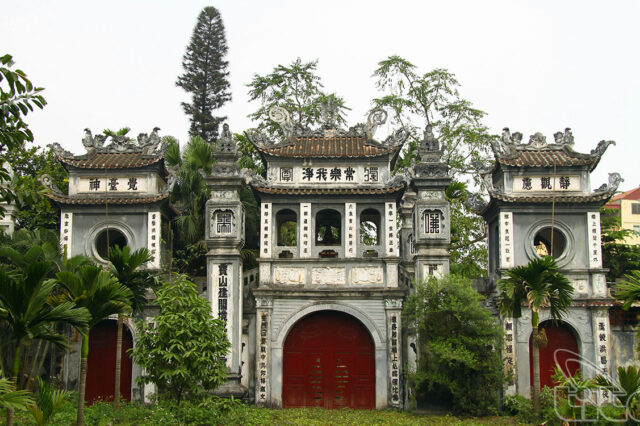


Tên gọi và vị trí địa lý
Chùa Bát Tháp (tên chữ Bát Tháp tự) tọa lạc tại số 209 phố Đội Cấn, Ba Đình, Hà Nội.
Chùa được xây dựng trên ngọn núi Vạn Bảo ở kinh thành Thăng Long vào thời Lý Trần, vì vậy, xưa kia, chùa còn có tên chùa Vạn Bảo.
Lịch sử và nhân vật
Tấm bia đá gắn trên tường chùa dựng năm Thành Thái thứ 9 (1897) cho hay: Chùa Núi Voi, trại Vạn Phúc, tổng Nội, huyện Vĩnh Thuận là một danh lam cổ tích đã được nhập vào chùa Bát Tháp vào năm dựng bia. Chùa Núi Voi chính là chùa Chân Giáo xây trên đỉnh Voi Phục, núi Vạn Bảo mà sách Tây Hồ chí đã tả, dựng năm Thuận Thiên 15 (1024) để vua Lý ngự xem tụng kinh. Vị vua của triều Lý là Huệ Tông nhường ngôi cho con gái là Chiêu Hoàng, ra tu ở chùa này.
Về cái tên Bát Tháp, tác giả Lưu Minh Trị cho biết:
Năm 1893, Pháp mua núi Voi cạnh đường thành Thăng Long xây nhà máy bia, chùa Chân Giáo trên đỉnh núi Voi phải di dời hợp chung với chùa Vạn Bảo lấy tên là Bát Tháp.(1)
Trong đó, Bát Tháp được giải thích vì chùa có “ngọn tháp đế hình bát”.
Kiến trúc cảnh quan
Nằm trong khu vực phân bố gồm nhiều di tích văn hoá có liên quan đến thành cổ và vùng “Thập tam trại” xưa, sự tồn tại cùng quá trình lịch sử lâu đời của chùa Bát Tháp là vật chứng quan trọng, góp phần không nhỏ vào việc tìm hiểu lịch sử của Thủ đô. Đó còn là một di tích kiến trúc nghệ thuật bề thế, hài hoà và có những vẻ đẹp ít thấy trong các di tích tôn giáo ở Hà Nội cũng như cả nước.
Chùa Bát Tháp nằm trên một khu đất cao theo hướng nam, có tam quan, tòa tam bảo, nhà tổ và khu vườn phía sau. Tòa tam bảo nằm trên vị trí cao nhất của ngọn Vạn Bảo Sơn, có mặt bằng hình chuôi vồ, gồm tiền đường 7 gian, 2 dĩ và hậu cung 3 gian.
Hiện vật
Hệ thống tượng tròn trong di tích gồm hai loại khác nhau: tượng Phật và tượng Mẫu, được làm bằng chất liệu gỗ và đồng. Niên đại tạo tác cũng không đồng nhất, một số ít ra đời vào cuối thời Lê, còn đa phần là những tác phẩm thuộc thời Nguyễn. Có thể thấy, trong các pho tượng của chùa, nổi bật hơn cả vẫn là bộ Tam thế gồm ba pho tượng tương đối giống nhau cả về kích thước và hình thức thể hiện. Những pho tượng này mang nhiều nét dân gian với cụm tóc kết hình ốc theo hàng ngang, mặt tượng có tính khái quát tượng trưng với đôi mắt khép hờ, sống mũi thẳng, nhân trung sâu. Tai tượng lớn, ngực nở và trên thân phủ áo hai lớp với những nếp chảy mềm mại, mang tính nghệ thuật cao.
Ngoài ra, di tích chùa Bát Tháp còn giữ gìn được khá nhiều di vật có giá trị như: đôi hạc đồng, bát hương, chuông đồng “Bát Tháp tự chung” đúc năm Gia Long thứ 2 (1803)… góp phần làm cho di tích thêm sống động, phong phú.
Xếp hạng
Chùa Bát Tháp đã được Bộ Văn hoá và Thông tin (nay là Bộ văn hóa, Thể thao và Du lịch) ra quyết định số 1570/VH-QĐ ngày 5 tháng 9 năm 1989 công nhận là “di tích kiến trúc nghệ thuật” do Thứ trưởng Nông Quốc Tuấn ký.
Chú thích
Tham khảo
- Lưu Minh Trị, Hà Nội, danh thắng và di tích, tập 2, Nxb Hà Nội, 2011.
__________________________________________________________
Các ngôn ngữ khác
Tiếng Anh (English)
Name and Geographical Location
Bat Thap Pagoda (formal name: Bat Thap Tu) is located at 209 Doi Can Street, Ba Dinh District, Hanoi.
The pagoda was built on Van Bao Mountain in Thang Long Citadel during the Ly–Tran dynasties, hence in the past it was also called Van Bao Pagoda.
History and Figures
An inscription carved on a stone stele mounted on the pagoda wall, erected in the 9th year of Thanh Thai (1897), states that Nui Voi Pagoda, belonging to Van Phuc Hamlet, Noi Commune, Vinh Thuan District, an ancient scenic relic, was incorporated into Bat Thap Pagoda in the year the stele was set up. Nui Voi Pagoda was originally Chan Giao Pagoda, built on the top of Voi Phuc, Van Bao Mountain, described in Tay Ho Chi, and erected in the 15th year of Thuan Thien (1024) for King Ly to reside and listen to Buddhist sutras. King Ly Hue Tong of the Ly dynasty abdicated in favor of his daughter, Empress Chieu Hoang, and retired to live in this pagoda.
Regarding the name Bat Thap, scholar Luu Minh Tri explained:
In 1893, the French purchased Voi Mountain near Thang Long Citadel to build a brewery; Chan Giao Pagoda on the top of Voi Mountain had to be relocated and merged with Van Bao Pagoda under the new name Bat Thap.
The name Bat Thap (Eight Bowl Pagoda) derives from its stupa with a “bowl-shaped base.”
Architecture and Landscape
Situated in an area with numerous cultural relics connected to the ancient citadel and the former “Thap Tam Trai” hamlets, Bat Thap Pagoda, with its long-standing historical presence, serves as important evidence contributing to the study of the capital’s history. It is also a grand architectural and artistic monument, harmoniously built, bearing aesthetic values rarely found in other religious sites in Hanoi or across the country.
Bat Thap Pagoda stands on elevated ground facing south, with a triple-gate entrance, the main sanctuary, ancestral hall, and a rear garden. The main sanctuary, located on the highest point of Van Bao Mountain, has a hammer-handle-shaped floor plan, consisting of a seven-compartment front hall with two side chambers, and a three-compartment rear sanctuary.
Artefacts
The pagoda preserves two categories of sculptures: Buddha statues and Mother Goddess statues, made of wood and bronze. Their dates of creation vary: a few from the late Le dynasty, but the majority belong to the Nguyen dynasty. Among them, the most notable is the set of Tam The (Three Buddhas), three nearly identical statues in size and form. These statues bear strong folk characteristics, with snail-shaped hair curls arranged horizontally, abstract symbolic faces with half-closed eyes, straight noses, deep philtrums, large ears, broad chests, and bodies draped in double-layered robes with soft, flowing folds, reflecting high artistic value.
In addition, Bat Thap Pagoda houses many valuable relics such as a pair of bronze cranes, incense burners, and the bronze bell “Bat Thap Tu Chung” cast in the 2nd year of Gia Long (1803), enriching the site’s historical and artistic significance.
Recognition
Bat Thap Pagoda was officially recognized as an “Architectural and Artistic Monument” by the Ministry of Culture and Information (now the Ministry of Culture, Sports and Tourism) under Decision No. 1570/VH-QD dated September 5, 1989, signed by Deputy Minister Nong Quoc Tuan.
2. Tiếng Pháp (French)
Nom et situation géographique
La pagode Bat Thap (nom officiel : Bat Thap Tu) se situe au 209, rue Doi Can, arrondissement de Ba Dinh, Hanoï.
Construite sur la montagne Van Bao, dans la citadelle de Thang Long sous les dynasties Ly–Tran, la pagode portait autrefois le nom de pagode Van Bao.
Histoire et personnages
Une inscription gravée sur une stèle en pierre, fixée au mur de la pagode et érigée en la neuvième année du règne de Thanh Thai (1897), rapporte que la pagode Nui Voi, relevant du hameau Van Phuc, commune Noi, district de Vinh Thuan, classée ancien site pittoresque, fut rattachée à la pagode Bat Thap à l’année de l’érection de la stèle. La pagode Nui Voi était en réalité la pagode Chan Giao, construite sur le sommet Voi Phuc, montagne Van Bao, décrite dans le Tay Ho Chi, et fondée en la quinzième année de Thuan Thien (1024) afin que le roi Ly puisse y résider pour assister à la récitation des sutras. Le roi Ly Hue Tong de la dynastie Ly abdiqua en faveur de sa fille, l’impératrice Chieu Hoang, et se retira dans cette pagode.
Concernant le nom Bat Thap, l’érudit Luu Minh Tri précisa :
En 1893, les Français achetèrent la montagne Voi, près de la citadelle de Thang Long, pour y construire une brasserie ; la pagode Chan Giao, située au sommet de la montagne, dut être déplacée et fusionnée avec la pagode Van Bao sous le nom de Bat Thap.
L’appellation Bat Thap (pagode des Huit Bols) vient de sa tour au “socle en forme de bol.”
Architecture et paysage
Située dans une zone riche en vestiges culturels liés à l’ancienne citadelle et aux “Treize hameaux” d’autrefois, la pagode Bat Thap, par son histoire séculaire, constitue un témoignage essentiel contribuant à l’étude de l’histoire de la capitale. C’est également un monument architectural et artistique d’envergure, harmonieux et doté de qualités esthétiques rarement rencontrées dans d’autres sites religieux de Hanoï ou du pays.
La pagode Bat Thap s’élève sur un terrain dominant, orienté vers le sud, avec un triple-portique, un sanctuaire principal, une maison des ancêtres et un jardin arrière. Le sanctuaire principal, situé au point culminant de la montagne Van Bao, adopte un plan en forme de manche de marteau, comprenant un avant-hall de sept travées flanqué de deux ailes, et un sanctuaire arrière de trois travées.
Objets conservés
Le site conserve deux catégories de sculptures : statues bouddhiques et statues de la Mère déesse, réalisées en bois et en bronze. Les époques de création varient : quelques-unes datent de la fin de la dynastie Le, mais la majorité appartient à l’époque Nguyen. Parmi elles, se distingue l’ensemble des Tam The (Trois Bouddhas), trois statues presque identiques par leurs dimensions et leur forme. Ces statues portent de forts traits populaires : cheveux en spirales disposées horizontalement, visages stylisés aux yeux mi-clos, nez droit, philtrum marqué, oreilles larges, poitrine ample, corps vêtu de deux tuniques superposées aux plis souples et harmonieux, révélant une haute valeur artistique.
En outre, la pagode Bat Thap conserve de nombreux objets précieux tels qu’une paire de grues en bronze, des brûle-parfums, et la cloche de bronze “Bat Thap Tu Chung” coulée en la deuxième année de Gia Long (1803), enrichissant le caractère vivant et diversifié du site.
Classement
La pagode Bat Thap a été officiellement reconnue comme “monument architectural et artistique” par le Ministère de la Culture et de l’Information (aujourd’hui Ministère de la Culture, des Sports et du Tourisme), par la décision n° 1570/VH-QD du 5 septembre 1989, signée par le vice-ministre Nong Quoc Tuan.
3. Tiếng Trung (Chinese)
名称与地理位置
八塔寺(汉名:八塔寺)位于河内市巴亭区队艮街209号。
此寺建于李、陈王朝时期的升龙皇城万保山上,因此昔日又称为万保寺。
历史与人物
寺墙上镶嵌的一块石碑,立于成泰九年(1897),记载:位于永顺县内总万福寨的象山寺,这一古老名胜,于立碑之年并入八塔寺。象山寺即是真教寺,建在万保山象伏峰顶,《西湖志》中有记载,始建于顺天十五年(1024),供李朝皇帝驻跸听经。李朝惠宗皇帝将帝位让于其女昭皇,便出家修行于此寺。
关于“八塔”之名,学者劉明治指出:
1893年,法国人在升龙皇城旁购得象山兴建啤酒厂,象山顶的真教寺被迫迁移,并入万保寺,合称八塔寺。
“八塔”之名源于寺内有一座“塔基呈钵形”的佛塔。
建筑与景观
八塔寺位于与古城及昔日“十三寨”有关的多处文化遗迹之区,其悠久历史的存在,是研究首都历史的重要见证。同时,它还是一处规模宏大、布局和谐、在河内乃至全国宗教遗迹中少见的建筑艺术古迹。
八塔寺坐落于朝南的高地,拥有三门、三宝殿、祖堂及后花园。三宝殿位于万保山之巅,平面呈槌柄形,包括前殿七间,两侧厢房,以及后殿三间。
文物
寺中保存着两类圆雕:佛像与圣母像,材质为木与铜。其造像年代不一,少数为后黎时期作品,大多数属阮朝时期。在诸多造像中,以“三世佛”三尊最为突出,其尺寸与造型大体一致,具浓厚民间特色:发髻作水平螺纹,面庞简练象征,双眼微合,鼻梁挺直,人中深刻,耳朵宽大,胸膛饱满,身着双层法衣,衣纹柔和流畅,艺术价值极高。
此外,八塔寺还保存着许多珍贵文物,如一对铜鹤、香炉、嘉隆二年(1803)铸造的铜钟“八塔寺钟”等,使遗迹更加生动丰富。
定级
1989年9月5日,越南文化信息部(今文化体育旅游部)发布第1570/VH-QĐ号决定,由副部长农国俊签署,正式认定八塔寺为“建筑艺术遗迹”。