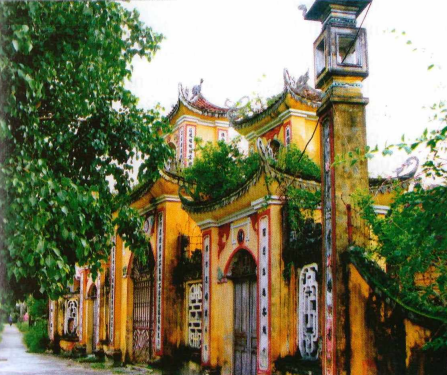


Vị trí và vị trí địa lý
Chùa Đại Trà, tên chữ là Đại Linh tự, toạ lạc trên một khu đất rộng, tương đối bằng phẳng, nằm về phía Tây Bắc của thôn Đại Trà, xã Đông Phương, huyên Kiến Thụy. Xã Đông Phương nằm về phía Bắc huyện Kiến Thụy, phía Bắc giáp phường Anh Dũng, Hưng Đạo (quận Dương Kinh), phía Đông giáp phường Hoà Nghĩa, phía Nam giáp xã Đại Đồng, phía Tây giáp sông Đa Độ.
Lịch sử và nhân vật
Cách đây 700 năm, vào thế kỷ XIII, trong kế sách “Ngụ binh sư nông” của Vương triều Trần, các vua chúa nhà Trần có chủ trương khuyến khích các vương hầu, công chúa đứng ra lập các điền trang thái ấp, mở mang các làng xóm, chiêu mộ dân chúng đến thái ấp của mình, khai khẩn đất hoang hoá để cày cấy. Vị Phò mã Tôn Thất nhà Trần là Trần Quốc Thi (Văn Nhượng hầu) giữ chức Đô úy Văn Định Vương – Lạng Giang – Đô Thống Chế, là người có công đầu trong việc chiêu dân xiêu tán cùng với dân sở tại lập ra Đại Trà trang. Nhân dân trang Đại Trà đã đóng góp nhiều nhân tài, vật lực cho cuộc kháng chiến chống quân Nguyên ở thế kỉ XIII.
Trên tấm Đại Trà bia kí, được tạc vào đời vua Lê Kính Tông, niên hiệu Hoằng Định thứ 10 (1612), cho biết, chùa Đại Trà được xây dựng khang trang, to lớn bắt đầu từ thời nhà Mạc. Chùa gồm nhiều toà ngang dọc, tổng cộng gần 50 gian bằng gỗ lim, mái lợp ngói mũi, trong đó có nhà bia chứa gần 60 chiếc bia lớn nhỏ khác nhau. Ruộng chùa xấp xỉ 30 mẫu Bắc Bộ. Vị sư trụ trì chùa là Hoà thượng họ Đào được mời làm quân sư về quân sự và chính trị cho triều Mạc. Nhiều vị hoàng đế thân vương nhà Mạc đã tìm đến chùa đàm đạo với nhà sư. Chùa Vọng Hải, xã Hưng Đạo là trạm dừng chân của quan khách trước khi vào thăm chùa Đại Trà.
Chùa Đại Trà được tu bổ lớn vào năm Vĩnh Trị thứ 2 Hoằng Định (1677) và các năm 1695, 1711, 1846, 1980, 2000. Diện tích nội tự của chùa là 2618m2. Nhiều thiền sư trụ trì và có công lớn trong việc trùng tu, tôn tạo nhà chùa hư Hoà thượng Đào Đức Nghị tự Phổ Trấn Bồ Tát, kị ngày 11/10 đòi vua Lê Hy Tông; thiền sư Thích Thanh Huyên tự Giáo Linh hoá thân Bồ Tát, sinh năm 1857, mất năm 1946, hưởng thọ 89 tuổi; thiền sư Phả Tự Tâm Vượng, sinh năm Đinh Dậu, mất năm 1966, hưởng thọ 69 tuổi; Sư cụ Thích Đàm Huy về trụ trì chùa năm 1980, sư già lâm đại hạn, qua đời vào ngày 26/2 âm lịch năm 1997.
Hiện vật
Hệ thống các di tượng Phật, bia kí chứa đựng những giá trị lịch sử, văn hoá to lớn như hai pho tượng thân vương nhà Mạc, tượng Quán Âm Tọa Sơn, tượng Quán Âm Tống Tử…Tượng thân vương nhà Mạc gồm tượng Thái Tổ Mạc Đăng Dung (được tạc trong tư thế thiết triều, ngồi trên ngai rồng, trên khuôn mặt thể hiện sự mạnh mẽ, cương quyết và tràn đầy niềm tin, cao 1,05m) và tượng Hoàng Thái hậu Vũ Thị Ngọc Toàn, vợ vua Mạc Thái Tổ.
Tượng Quán Âm Tống Tử được tạc bằng gỗ, ngồi trên giả sơn (còn gọi là Quán Âm Thị Kính), cao 75cm, nên tính cả bệ thì cao 1,3 m. Tượng Quán Âm Tọa Sơn được tạc bằng đá vôi xám và được sơn son thếp vàng. Tượng cao 67 cm, được các nhà nghiên cứu đánh giá là một trong những pho tượng có niên đại sớm ở nước ta.
Chùa hiện còn lưu giữ 7 tấm bia đá, trong đó có 5 bia niên đại thời Lê Trung Hưng thế kỉ XVII nhưng vẫn kế thừa được phong cách nghệ thuật thời Mạc:
- Đại Trà bia kí: Niên hiệu Hoằng Định thứ 12, đời vua Lê Kính Tông (1612)
- Đại Linh tự bia kí: Niên hiệu Cảnh Trị thứ 8 (1670), triều vua Lê Huyền Tông
- Đại Trà xã (Đại Linh tự) bia kí: Niên hiệu Vĩnh Trị thứ 3 (1678), đời vua Lê Hy Tông
Ngoài ra còn một số tấm bia Hậu Phật niên hiệu Vĩnh Thịnh năm thứ 7 (1712), triều vua Lê Dụ Tông; Chính Hoà (1680 – 1705), đời vua Lê Hy Tông và 3 tấm bia triều Nguyễn niên hiệu Thiệu Trị, Thành Thái. Chùa Đại Trà còn lưu giữ một chuông đồng có niên hiệu Cảnh Thịnh (triều đại Tây Sơn); vườn mộ tháp các thiền sư đã trụ trì và có công lớn trong việc xây dựng và tu bổ chùa.
Xếp hạng
Với những giá trị lịch sử – văn hoá như vậy, năm 1994, chùa Đại Trà được Nhà nước công nhận là Di tích Lịch sử – Văn hóa cấp Quốc gia.
___________________
Các ngôn ngữ khác
1. English
Name and Geographical Location
Dai Tra Pagoda, formally named Dai Linh Tu, stands on a spacious, relatively level plot to the northwest of Dai Tra Hamlet, Dong Phuong Commune, Kien Thuy District. Dong Phuong Commune lies in the north of Kien Thuy District, bordering Anh Dung Ward and Hung Dao Ward (Duong Kinh District) to the north, Hoa Nghia Ward to the east, Dai Dong Commune to the south, and the Da Do River to the west.
History and Figures
Seven hundred years ago, in the 13th century, under the Tran Dynasty’s policy of “Ngu binh su nong” (soldiers living as farmers), the royal court encouraged princes and princesses to establish feudal estates (dien trang, thai ap), open new settlements, recruit inhabitants, and reclaim wasteland for cultivation. Tran Quoc Thi (posthumous title: Van Nhuong Marquis), a royal son-in-law who served as Commander (Do uy) under Prince Van Dinh, in charge of Lang Giang and acting as Supreme Military Commissioner, played the leading role in gathering displaced people and the local populace to found Dai Tra Estate. The people of Dai Tra contributed considerable manpower and resources to the wars against the Mongol-Yuan in the 13th century.
The stele titled Dai Tra Stele Inscription, carved in the 10th year of Hoang Dinh under King Le Kinh Tong (1612), records that Dai Tra Pagoda began to be built on a grand and dignified scale in the Mac period. The complex comprised numerous halls laid out lengthwise and crosswise, totaling nearly 50 bays in ironwood, roofed with beak tiles; there was also a stele house storing nearly 60 steles of various sizes. Temple fields measured roughly 30 mau (northern measure). The abbot, a Venerable of the Dao family, was invited as a military and political advisor to the Mac court. Many Mac emperors and princes visited the pagoda to converse with the abbot. Vong Hai Pagoda in Hung Dao Commune served as a stopping place for guests before visiting Dai Tra Pagoda.
Major restorations took place in Vinh Tri 2 – Hoang Dinh (1677), and in 1695, 1711, 1846, 1980, and 2000. The inner precinct covers 2,618 m². Many abbots were instrumental in restorations, including Venerable Dao Duc Nghi (Dharma name Pho Tran, venerated as a Bodhisattva; memorial day lunar 11/10, during King Le Hy Tong), Venerable Thich Thanh Huyen (Dharma name Giao Linh; b. 1857 – d. 1946, aged 89), Venerable Pha Tu Tam Vuong (b. Year of the Rooster – d. 1966, aged 69), and Elder Nun Thich Dam Huy, who became abbot in 1980 and passed away on the 26th day of the 2nd lunar month, 1997.
Artifacts
The system of Buddhist images and stele inscriptions bears great historical and cultural value, notably two statues of Mac princes, the Guanyin Seated on the Mountain and Guanyin Bestowing Children (Songzi Guanyin).
The Mac princely statues include the image of Mac Dang Dung, the Founding Emperor (depicted in court audience, seated on a dragon throne, with a resolute face full of confidence; height 1.05 m), and the statue of Empress Dowager Vu Thi Ngoc Toan, consort of Emperor Mac Thai To.
The Guanyin Bestowing Children statue is carved in wood, seated on a faux rock (also called Quan Am Thi Kinh), 75 cm high (about 1.3 m including the base). The Guanyin Seated on the Mountain is carved in gray limestone and finished with red lacquer and gold leaf, standing 67 cm high; researchers consider it among the earlier extant statues of its type in Vietnam.
The pagoda preserves seven stone steles, including five from the Later Le (Restored Le) period in the 17th century that retain Mac stylistic features:
- Dai Tra Stele Inscription: Hoang Dinh 12, King Le Kinh Tong (1612).
- Dai Linh Tu Stele Inscription: Canh Tri 8 (1670), King Le Huyen Tong.
- Dai Tra Commune (Dai Linh Tu) Stele Inscription: Vinh Tri 3 (1678), King Le Hy Tong.
There are also hậu Phật (donor) steles dated Vinh Thinh 7 (1712, King Le Du Tong), steles from Chinh Hoa (1680–1705, King Le Hy Tong), and three Nguyen-Dynasty steles dated Thieu Tri and Thanh Thai. The pagoda keeps a bronze bell dated Canh Thinh (Tay Son period), and a stupa garden for abbots who contributed to its construction and restoration.
Classification
In 1994, due to its historical and cultural value, Dai Tra Pagoda was recognized by the State as a National Historical and Cultural Site.
2. Français
Nom et localisation géographique
La pagode Dai Tra, dont le nom officiel est Dai Linh Tu, se situe sur un terrain vaste et relativement plat, au nord-ouest du hameau de Dai Tra, commune de Dong Phuong, district de Kien Thuy. La commune de Dong Phuong se trouve au nord du district de Kien Thuy, limitrophe au nord des quartiers d’Anh Dung et de Hung Dao (district de Duong Kinh), à l’est du quartier de Hoa Nghia, au sud de la commune de Dai Dong, et à l’ouest de la rivière Da Do.
Histoire et personnages
Il y a sept siècles, au XIIIe siècle, la dynastie Tran mit en œuvre la politique « Ngu binh su nong » (soldats-paysans), encourageant princes et princesses à fonder des domaines (dien trang, thai ap), ouvrir des villages, recruter des habitants et mettre en culture les terres vierges. Tran Quoc Thi (marquis Van Nhuong), gendre impérial, exerça les fonctions de commandant sous le prince Van Dinh, responsable de Lang Giang et commissaire militaire suprême ; il joua un rôle majeur en rassemblant populations déplacées et riverains pour créer le domaine de Dai Tra. Les habitants de Dai Tra apportèrent hommes et ressources aux guerres contre les Mongols-Yuan au XIIIe siècle.
La stèle intitulée Inscription de Dai Tra, gravée sous le roi Le Kinh Tong, 10e année de Hoang Dinh (1612), indique que la pagode Dai Tra fut édifiée à grande échelle dès l’époque Mac. Le complexe comptait de nombreuses salles, près de 50 travées en bois de fer, couvertes de tuiles « bec », ainsi qu’un pavillon des stèles abritant près de 60 stèles de tailles diverses. Le domaine foncier du temple atteignait environ 30 mau (mesure du Nord). L’abbé, un vénérable de la famille Dao, fut invité comme conseiller politico-militaire par la cour Mac. Plusieurs empereurs et princes Mac vinrent converser avec le maître. La pagode Vong Hai (commune de Hung Dao) servait de relais pour les visiteurs avant l’entrée à Dai Tra.
De grands travaux eurent lieu en Vinh Tri 2 – Hoang Dinh (1677), puis en 1695, 1711, 1846, 1980 et 2000. L’enceinte intérieure couvre 2 618 m². Parmi les abbés qui œuvrèrent aux restaurations : le vénérable Dao Duc Nghi (nom de Dharma Pho Tran, vénéré comme bodhisattva ; jour d’anniversaire lunaire 11/10, sous Le Hy Tong), le vénérable Thich Thanh Huyen (nom de Dharma Giao Linh ; 1857–1946, 89 ans), le vénérable Pha Tu Tam Vuong (né en année du Coq – 1966, 69 ans), et la vénérable Thich Dam Huy, abbesse à partir de 1980, décédée le 26 du 2e mois lunaire 1997.
Objets et reliques
Le corpus d’images bouddhiques et d’inscriptions renferme de grandes valeurs historiques et culturelles : deux statues de princes Mac, Guanyin assise sur la montagne et Guanyin dispensant des enfants (Songzi Guanyin).
Les statues princières comprennent celle de Mac Dang Dung, fondateur de la dynastie (représenté en audience, assis sur un trône dragon, visage ferme et confiant ; h. 1,05 m), et celle de l’impératrice douairière Vu Thi Ngoc Toan, épouse de l’empereur Mac Thai To.
La statue Guanyin dispensant des enfants est en bois, assise sur un rocher factice (dite aussi Quan Am Thi Kinh), h. 75 cm (env. 1,30 m avec le socle). Guanyin assise sur la montagne est en calcaire gris, laquée et dorée, h. 67 cm ; les chercheurs la considèrent comme l’une des œuvres les plus anciennes de ce type au Vietnam.
La pagode conserve sept stèles de pierre, dont cinq de l’époque Le restaurée (XVIIe siècle) qui perpétuent le style Mac :
- Inscription de Dai Tra : Hoang Dinh 12, roi Le Kinh Tong (1612).
- Inscription de la pagode Dai Linh Tu : Canh Tri 8 (1670), roi Le Huyen Tong.
- Inscription de la commune de Dai Tra (Dai Linh Tu) : Vinh Tri 3 (1678), roi Le Hy Tong.
S’y ajoutent des stèles « hậu Phật » datées Vinh Thinh 7 (1712, roi Le Du Tong), des stèles de Chinh Hoa (1680–1705, roi Le Hy Tong) et trois stèles Nguyen (Thieu Tri, Thanh Thai). La pagode possède une cloche en bronze datée Canh Thinh (période Tay Son) et un jardin de stupas des abbés méritants.
Classement
En 1994, au regard de ses valeurs historiques et culturelles, la pagode Dai Tra a été reconnue par l’État comme site historique et culturel national.
3. 中文(繁體)
名稱與地理位置
大茶寺,字「大靈寺」,坐落於大茶村西北之寬闊平坦地帶,屬東芳社、建瑞縣。東芳社位於建瑞縣北部,北接陽勇坊、興道坊(陽京區),東鄰和義坊,南界大同社,西緣多度河。
歷史與人物
自十三世紀陳朝推行「寓兵於農」之策,王室倡導諸王公主開設田莊采邑,招民墾荒、拓建聚落。陳國施(諡文讓侯),為駙馬宗室,任文定王麾下都尉、領掌諸軍,首倡招集流離與土著,創置大茶莊。大茶莊之民,於十三世紀抗元戰事中,出人出力,貢獻卓著。
刻於黎敬宗弘定十年(1612)之《大茶碑記》載:大茶寺於莫代始大規模興建。寺院橫縱相接,幾近五十楹,皆鐵力木為材,覆鱗形瓦,並設碑亭,藏大小碑刻近六十方。寺田約三十畝(北部畝制)。住持為道姓和尚,曾奉聘為莫朝軍政謀主。莫朝帝王、宗親多至寺與師論道。興道社之望海寺為賓客入寺之前站。
寺於永治二年(弘定,1677)及1695、1711、1846、1980、2000等年大加修葺。內院面積2,618平方米。歷任住持中,貢獻卓著者有:道德誼和尚(法號普鎮,菩薩格;忌辰農曆十月十一,時在黎熙宗)、釋清暉和尚(法號教靈,1857–1946,享年89)、破自心旺和尚(生於丁酉,卒於1966,享年69)、以及1980年入寺住持之老尼釋曇徽,於1997年農曆二月二十六示寂。
文物
寺中佛像與碑刻具重大歷史文化價值:有莫朝王族二像、觀音坐山像、送子觀音像等。
莫王族像包括:莫登庸(太祖)石像——朝見姿態,盤坐龍座,面容剛毅自信,高1.05米;及皇太后武氏玉全像,乃莫太祖之后。
送子觀音像為木雕,坐於假山(亦稱「觀音氏敬」),像高75釐米(連座約1.3米)。觀音坐山像以灰色石灰岩雕成,施以髹金彩繪,高67釐米,被學界視為國內同類造像中年代較早者。
今存石碑七方,其中五方為十七世紀黎中興時期,然仍承莫代風格:
- 《大茶碑記》:弘定十二年(1612),黎敬宗。
- 《大靈寺碑記》:景治八年(1670),黎玄宗。
- 《大茶社(大靈寺)碑記》:永治三年(1678),黎熙宗。
另有永盛七年(1712,黎裕宗)「後佛」類碑、正和(1680–1705,黎熙宗)碑若干,及阮朝紹治、成泰年款之三碑。寺藏景盛年(西山時期)銅鐘一口,並有歷任住持之塔林。
等級與認定
1994年,因其歷史與文化價值,大茶寺獲國家認定為全國性歷史文化遺跡。