

Lịch sử
Theo truyền thuyết ở địa phương, xưa kia chùa Lạng Côn có quy mô khá lớn và từng là một tụ điểm Phật giáo quan trọng trong vùng. Ngày nay, chùa chỉ còn là một cổ tự có quy mô vừa phải. Chứng tích duy nhất của ngôi chùa rộng lớn, khang trang xưa kia là ở những bia đá đặt ngay ở cổng chùa. Mặc dù không có (hay không còn) nhà bia và cũng không rõ bia bị dầm mưa dãi nắng đã bao lâu, nhưng chữ và hoa văn trên những tấm bia đá màu xanh xám vẫn còn khá rõ. Bia đá chùa Lạng Côn có giá trị về văn bản học, nghệ thuật học… và là bản “lý lịch tự thuật” đáng tin cậy của ngôi chùa. Những tấm bia này có lai lịch rõ ràng, được khắc ghi trong dòng lạc khoản như: “Sùng Khánh tự bi ký” được tạo năm Chính Hòa tứ niên (1683), “Thạch Thiên đài trụ” ra đời năm Vĩnh Thịnh nhị niên (1706) và “Hậu phật bi ký” được dựng vào năm Gia Long nguyên niên (1802).
Chùa Lạng Côn tên chữ là Sùng Khánh tự, vốn là chùa làng. Dưới thời Trần (1226 – 1400), thời Mạc (1527-1592), chùa nổi danh là “phong cảnh Phật” đẹp của xứ Đông. Lạng Côn xưa là một xã thuộc tổng Đại Trà, nay là một thôn của xã Đông Phương, huyện Kiến Thụy. Tương truyền, chùa được khởi dựng từ thời Lý (1010-1226), sang thời Trần, phò mã Trần Quốc Thi được phong thái ấp điền trang ở đây đã bỏ tiền của tu bổ cảnh Phật, vườn thiền. Tư liệu văn bia cho biết, chùa đã qua những lần sửa chữa lớn vào các năm 1683, 1802 và 1925.
Kiến trúc
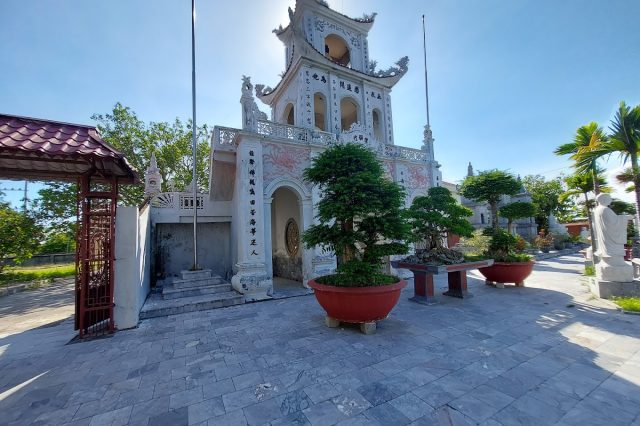
Chùa và đình Lạng Côn vốn cùng được xây dựng trong cùng một khuôn viên theo lối “tiền thánh, hậu Phật” rất khang trang, bề thế, được xếp vào loại đẹp của phủ Kiến Thụy xưa. Chùa là một cụm kiến trúc đăng đối, quay hướng chính Tây, nhìn ra sông Cửu Biều, phủ Kiến Thụy xưa. Trước chùa có ao sen hình chữ nhật, cổng chùa nhất môn trông như một lầu nhỏ, có hai tầng tám mái đao cong. Hai bên cổng là đôi câu đối:
Cửa từ bi đông khách siêu phương
Đức trí tuệ soi đường bác ái
Hoa bốn mùa chào đón Phật đài
Cây trăm thước dựng nên thiền cảnh.
Nối tiếp với ao sen là vườn thiền khoáng đạt. Những bồn hoa, chậu cảnh nhiều hình dáng, kích thước, tượng hạc, rùa, đỉnh hương trầm nghi ngút, hòn non tạo dáng sơn trang hùng vĩ… Tất cả được sắp xếp theo một trật tự tạo nên vẻ trang nghiêm của cổ tự, cõi linh. Trung tâm vườn thiền đặt đài tượng Quán Thế Âm Bồ Tát trong tư thế đứng, cao xấp xỉ 5m, tay phải cầm cành dương liễu giơ ngang vai, tay trái đặt trước ngực nâng bình nước cam lồ. Tượng có khuôn mặt nữ dịu hiền, thon thả thường gặp trong các ngôichùa ở nước ta. Về bình đồ kiến trúc chùa Lạng Côn được xây dựng theo kiểu hướng tâm: Gồm một tòa Phật điện hình chữ “Đinh” với 5 gian tiền đường và 3 gian hậu cung, ở giữa và các kiến trúc phụ (5 gian nhà Tổ, 5 gian nhà khách, 5 gian tăng phòng, 3 ngôi tháp mộ). Nghệ thuật kiến trúc vãn giữ được dáng vẻ cổ kính.
Hiện vật
Hệ thống tượng pháp ở chùa khá phong phú, đầy đủ lúa một Phật điện Đại thừa gồm bộ Tam Thế, Tam Thánh Tây phương, tượng Thích Ca Niêm Hoa, tượng Ca Diếp, A Nan Đà, Ngọc Hoàng, Nam Tào, Bắc Đẩu, Cửu Long và Thích Ca Sơ Sinh, Hộ Pháp, tượng Tổ… Theo các nhà nghiên cứu mỹ thuật tạo hình Phật giáo, tòa Cửu Long và lượng Tổ Bồ Đề Đạt Ma là những tác phẩm điêu khắc độc đáo, mang phong cách nghệ thuật thếkỷ XVII. Tòa Cửu Long tạo dáng hình đóa sen gồm hai phần: Phần đế là đài sen ngửa gồm 3 lớp cánh úp trên một đế trụ hình bát giác; phần trên tạo dáng nụ sen múp phồng, chính diện chạm thủng rồng trong tư thế phun nước tắm gội cho đức Phật Thích Ca lúc chào đời, mặt sau để trơn.
Tượng Thích Ca Sơ Sinh được đặt trong “nụ sen” và Ngài liên hệ với thế giới bên ngoài bằng các ô cửa hình lá hoa ở mặt sau và ô cửa hình lá cỏ linh chi ở mặt trước. Hình thức tạo dáng tòa Cửu Long hình nụ sen trên một đóa sen mãn khai là biểu hiện của bản thể chân như, khó tìm thấy ở các chùa khác.
Tượng Bồ Đề Đạt Ma – sư Tổ của dòng Thiền được đặt ở nơi cao nhất, trang trọng trên ban thờ Tổ của chùa. Tượng ngồi trên bệ gỗ, tóc nổi rõ gọn gàng, ốp sát đầu, chùm hết gáy và xòe sang hai vai, quăn từng cụm hình dấu hỏi (?) lớp lang như sấy. Mặt tượng hao hao gầy, thể hiện rõ các quý tướng: tai to, dái tai dầy, trán cao với ba vòng nếp nhăn nhấn mạnh nỗi suy tư cao độ; lông mày rậm, mắt nhỏ hơi u buồn. Tượng mang vẻ mặt của các nhà thông thái thuộc các tộc người miền Trung Á. Tượng khoác áo cà sa để lộ vai phải, biểu thị lòng kính trọng bề trên. Bệ tượng ngồi hình lục giác giật tam cấp, mặt cắt dọc hình chữ công. Diềm trang trí cánh sen vuông ngửa, hoa cúc, hoa sen, lá đề. Dòng chữ Hán khắc chìm trên bệ tượng cho biết niên đại hoàn thành là năm Cảnh Trị thứ 6 (1668).
__________________
Các ngôn ngữ khác
1. English
History
According to local legend, Lang Con Pagoda once had a large scale and was an important Buddhist center of the region. Today, it remains a modest ancient temple. The only surviving evidence of its former grandeur are the stone steles standing at the pagoda gate. Although no stele pavilion exists and the stones have long endured sun and rain, the blue-gray inscriptions and motifs remain clear. These steles possess great value for epigraphy and art history, serving as a reliable “autobiography” of the pagoda.
They include clearly dated inscriptions such as: Stele of Sung Khanh Tu created in the 4th year of Chinh Hoa (1683), Thach Thien Dai Tru erected in the 2nd year of Vinh Thinh (1706), and Hau Phat Stele dated to the 1st year of Gia Long (1802).
Lang Con Pagoda, formally Sung Khanh Tu, was originally the village pagoda. Under the Tran (1226–1400) and Mac (1527–1592) dynasties, it was famous as one of the most beautiful “Buddhist landscapes” of the Eastern region. Lang Con, formerly a commune of Dai Tra Canton, is now a hamlet of Dong Phuong Commune, Kien Thuy District. Legend states the pagoda was founded during the Ly Dynasty (1010–1226); in the Tran era, Prince Consort Tran Quoc Thi, who held estates here, financed the restoration of the pagoda and its gardens. Stele inscriptions indicate major renovations in 1683, 1802, and 1925.
Architecture
Lang Con Pagoda and communal house were originally built within the same compound, following the “Front Saint – Rear Buddha” layout, considered one of the finest complexes of Kien Thuy Prefecture. The pagoda ensemble is symmetrical, facing west toward the Cuu Bieu River. In front lies a rectangular lotus pond. The main gate resembles a small two-story tower with eight curved roofs, flanked by couplets:
The door of compassion welcomes countless souls;
Wisdom and virtue illuminate the path of love;
Four-season flowers greet the Buddha’s terrace;
A hundred-foot tree marks the meditation realm.
Beyond the pond lies an open meditation garden adorned with bonsai, incense burners, cranes, turtles, and miniature mountains arranged harmoniously, evoking serenity. At its center stands a 5-meter-tall statue of Avalokiteśvara Bodhisattva, right hand holding a willow branch, left hand lifting a vase of nectar. The gentle feminine face is characteristic of Vietnamese Buddhist sculpture.
Architecturally, Lang Con Pagoda follows a concentric plan. The main Buddha Hall is in the “Dinh” (丁) shape with five front and three rear bays, flanked by auxiliary buildings—five-bay Patriarch House, five-bay Guest Hall, five-bay Monk Quarters, and three stupas. The overall design retains ancient elegance and balance.
Artifacts
The pagoda houses a rich array of Mahayana Buddhist statues: the Three Buddhas, the Western Trinity, Shakyamuni “Holding the Flower”, Kāśyapa, Ānanda, the Jade Emperor, Nam Tao, Bac Dau, the Nine Dragons, Infant Shakyamuni, Dharma Protectors, and Patriarchs.
According to art historians, the Nine Dragons Platform (Cuu Long) and the Bodhidharma Patriarch statue are masterpieces of 17th-century Vietnamese Buddhist sculpture. The Nine Dragons pedestal resembles a lotus blossom with a triple-layered lotus base and a bulbous lotus bud above. The front is pierced with dragons spouting water over the newborn Buddha; the back is plain. The Infant Shakyamuni stands within the lotus bud, visible through apertures shaped as leaves and lingzhi mushrooms—symbolizing the revelation of true suchness (tathatā).
The Bodhidharma statue, founder of the Zen lineage, occupies the uppermost altar. Seated on a hexagonal wooden base, his tightly curled hair frames his head and neck. The face is gaunt yet noble, with large ears, high forehead, and three wrinkles denoting deep contemplation. The brows are thick, eyes small and meditative, bearing Central Asian features. He wears a robe exposing the right shoulder, symbolizing reverence. The base is ornamented with lotus petals, chrysanthemums, and Bodhi leaves. The incised inscription dates the statue to the 6th year of Canh Tri (1668).
2. Français
Histoire
Selon la tradition locale, la pagode Lang Con fut autrefois un vaste ensemble et un important centre bouddhique de la région. Aujourd’hui, elle n’est plus qu’un ancien temple de taille moyenne. Les seules traces de son ancienne grandeur sont les stèles en pierre placées à l’entrée. Bien que dépourvues de pavillon et exposées aux intempéries, les inscriptions bleu-gris et les motifs demeurent étonnamment nets. Ces stèles présentent un grand intérêt pour l’épigraphie et l’histoire de l’art, constituant une véritable « autobiographie » du sanctuaire.
Elles portent des mentions précises : Stèle du temple Sung Khanh, datée de la 4e année de Chinh Hoa (1683) ; Thach Thien Dai Tru, de la 2e année de Vinh Thinh (1706) ; et Stèle hậu Phật, de la 1re année de Gia Long (1802).
La pagode Lang Con, sous son nom officiel Sung Khanh Tu, était à l’origine la pagode du village. Sous les dynasties Tran (1226–1400) et Mac (1527–1592), elle était réputée comme l’un des plus beaux « paysages bouddhiques » de la région orientale. Lang Con, autrefois commune du canton Dai Tra, est aujourd’hui un hameau de la commune de Dong Phuong, district de Kien Thuy. La tradition rapporte que le temple fut fondé sous la dynastie Ly (1010–1226) ; au temps des Tran, le prince Tran Quoc Thi, détenteur d’un domaine ici, finança la restauration des bâtiments et des jardins. Les inscriptions indiquent de grandes réparations en 1683, 1802 et 1925.
Architecture
La pagode et le đình de Lang Con furent bâtis dans la même enceinte, selon le plan « devant le Saint, derrière le Bouddha », typique et harmonieux, considéré comme l’un des plus beaux ensembles de l’ancien phủ Kien Thuy. L’ensemble est symétrique, orienté plein ouest vers la rivière Cuu Bieu. Devant s’étend un étang rectangulaire de lotus ; la porte principale, à deux étages et huit toits recourbés, est flanquée de distiques :
Porte de compassion accueillant l’âme égarée,
Sagesse éclairant le chemin de bonté,
Fleurs des quatre saisons saluant l’autel du Bouddha,
Arbre centenaire dressé en jardin de méditation.
Derrière l’étang s’ouvre un jardin de méditation agrémenté de bonsaïs, brûle-parfums, grues, tortues et rochers miniatures disposés avec équilibre, créant une atmosphère sereine. Au centre s’élève une statue de Guanyin debout, haute de cinq mètres, la main droite tenant un rameau de saule, la gauche un vase de nectar. Le visage féminin, doux et gracieux, reflète le style vietnamien.
Le plan architectural est concentrique : un hall du Bouddha en forme de « Dinh » (丁) avec cinq travées avant et trois arrière, entouré d’ailes secondaires (maison des Patriarches, maison des invités, cellules des moines et trois stupas). L’ensemble conserve son élégance ancienne.
Objets et reliques
La pagode abrite un riche ensemble de statues bouddhiques mahāyāna : la triade des Bouddhas, la triade de l’Ouest, Shakyamuni tenant la fleur, Kāśyapa, Ānanda, l’Empereur de jade, Nam Tao, Bac Dau, les Neuf Dragons, le Bouddha nouveau-né, les gardiens du Dharma et les Patriarches.
Selon les chercheurs en art bouddhique, le piédestal des Neuf Dragons et la statue du patriarche Bodhidharma sont des chefs-d’œuvre du XVIIe siècle. Le piédestal en forme de lotus comprend trois rangs de pétales superposés sur une base octogonale. La partie supérieure, en forme de bourgeon, montre des dragons ajourés crachant l’eau pour laver le Bouddha naissant. La statue de l’Enfant Bouddha est placée à l’intérieur du bourgeon, visible à travers des ouvertures en forme de feuille et de lingzhi – symbole de la vérité absolue.
La statue de Bodhidharma, fondateur du zen, occupe l’autel supérieur. Assis sur une base hexagonale, cheveux bouclés, visage allongé, grandes oreilles, front haut, sourcils épais et regard méditatif, il exprime la sagesse austère d’un sage d’Asie centrale. Il porte la robe monastique découvrant l’épaule droite, signe de respect. La base est décorée de pétales de lotus, de chrysanthèmes et de feuilles de bodhi. L’inscription gravée date l’œuvre de la 6e année de Canh Tri (1668).
3. 中文(繁體)
歷史
據地方傳說,朗昆寺昔規模宏大,為一方佛教重鎮。今僅存中型古剎。昔日壯觀之證,唯存寺門前諸石碑。雖無碑亭,碑久受風雨侵蝕,然青灰石上之字紋仍清晰可辨。此諸碑具文獻、藝術價值,實為寺之「自述履歷」。
碑刻所載明確:〈崇慶寺碑記〉創於正和四年(1683),〈石天臺柱〉立於永盛二年(1706),〈後佛碑記〉建於嘉隆元年(1802)。
朗昆寺,字崇慶寺,本為村寺。陳朝(1226–1400)、莫朝(1527–1592)時,以「東域勝景」聞名。朗昆舊屬大茶總,今為東芳社之一村。傳云寺創於李朝(1010–1226),陳朝駙馬陳國施封采邑於此,出資修繕佛境禪園。碑文記載寺曾於1683、1802、1925歷次重修。
建築
朗昆寺與社廟同築於一院,依「前聖後佛」之制,宏麗雄偉,為昔日建瑞府名勝。寺軸對稱,朝西向九瓢河。寺前有長方蓮池,山門為兩層八脊飛檐之樓閣,聯云:
慈門東迎眾生渡,
慧德西照博愛心。
四時花放迎佛座,
百尺高樹立禪境。
池後為禪苑,花木盆景錯落,鶴龜香鼎,假山疊翠,布局嚴整,古寺肅穆。中央立觀世音菩薩像,高約五米,右手持楊枝,左手托淨瓶,面容柔和嫻靜,具越南佛像之風。
建築平面為向心式:「丁」字形佛殿,前五後三楹,兩側附建祖堂、客舍、僧寮各五楹,塔三座,古樸典雅。
文物
寺藏大乘佛像體系完備:三世佛、西方三聖、釋迦拈花、迦葉、阿難、玉皇、南斗、北斗、九龍、釋迦初生、護法、祖師諸像。
據藝術史家考證,九龍座與菩提達摩祖師像為十七世紀雕塑代表。九龍座如蓮花,三層蓮瓣疊於八角臺,頂作蓮蕾,中刻龍吐水浴佛,後面素面。初生釋迦立於蓮蕾中,後有葉窗、前有靈芝窗,象徵真如法性。
菩提達摩像居祖壇之上,結跏趺坐於六角木座,髮卷貼頭,鬚眉濃密,面削形長,耳大額高三紋顯智,目深含思,具中亞相。披袈裟露右肩,示尊敬。座飾方蓮瓣、菊花、蓮葉、菩提葉,陰刻銘文記年景治六年(1668)。