

Giới thiệu
Tên của ngôi chùa là Nghiêm Thắng Tự, được xây dựng vào năm 1622, với tên chữ là “Nghiêm Thắng Tự.” Lịch sử của chùa liên quan đến làng Nam Dư Thượng, trước đây thuộc xã Trần Phú, huyện Thanh Trì, nay thuộc phường Lĩnh Nam, quận Hoàng Mai, thành phố Hà Nội. Chùa được xây dựng vào đầu thời kỳ Lê Trung Hưng, theo thông tin trên tấm bia đá niên đại Vĩnh Tộ thứ 10 (tức năm 1628 dương lịch).
Thờ tự
Chùa Nghiêm Thắng Tự thờ Phật và hai nữ thần có công lớn với địa phương, đó là Hoàng thái hậu Trương Thị Niếu và vương phi chánh cung Nguyễn Thị Ngọc Tú. Chúng đã có những đóng góp quan trọng, như việc xây dựng chùa và lấn bãi sông Hồng để tạo ruộng cho dân cày cấy.
Kiến trúc
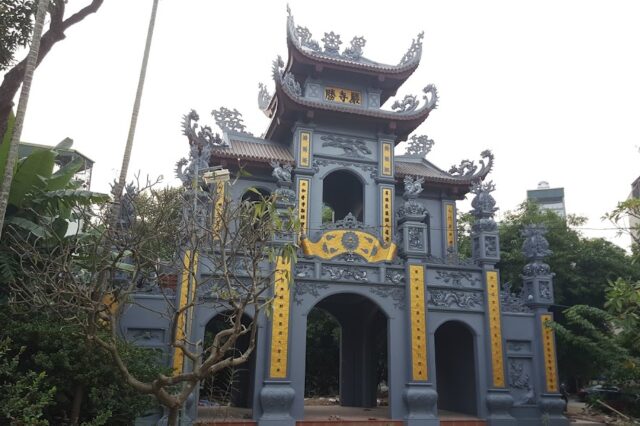
Kiến trúc của chùa Nghiêm Thắng Tự là một tác phẩm nghệ thuật độc đáo. Khuôn viên rộng lớn, tam quan cổ với ngũ môn và cổng chính ba tầng mái cong tạo nên bức tranh kiến trúc thời Nguyễn. Trong khuôn viên, tòa tiền đường truyền thống và các công trình phụ như miếu, nhà Mẫu, nhà Tổ, tháp mộ cổ và ao sen tạo nên một không gian linh thiêng và trấn an.
Di vật
Chùa giữ nhiều di vật quý giá, bao gồm hơn 30 pho tượng tròn được bày trí theo hệ phái Bắc tông. Ngoài ra, còn có nhiều tác phẩm nghệ thuật khác như bức hoành phi, câu đối, sắc phong, chuỳ đồng, khánh đá, chuông đồng và nhiều vật phẩm khác. Chùa Nghiêm Thắng Tự được xếp hạng là Di tích kiến trúc, nghệ thuật vào ngày 31.1.1992 bởi Bộ Văn hóa và Thông tin.
_______________________________
Các ngôn ngữ khác
Tiếng Anh (English)
The name of the temple is “Nghiem Thang Tu,” built in 1622, with the given name being “Nghiem Thang Tu.” The history of the temple is associated with the village of Nam Du Thuong, formerly part of Tran Phu commune, Thanh Tri district, and now belonging to Linh Nam ward, Hoang Mai district, Hanoi. The temple was constructed at the beginning of the Le Trung Hung era, according to information on a stone stele dating back to the 10th year of Vinh To (equivalent to 1628 in the Gregorian calendar).
Nghiem Thang Tu Temple worships Buddha and two goddesses who made significant contributions to the local community: Queen Truong Thi Nieu and the principal consort Nguyen Thi Ngoc Tu. They played crucial roles in the construction of the temple and the land reclamation along the Hong River for agricultural purposes.
The architecture of Nghiem Thang Tu Temple is a unique work of art. The spacious compound, ancient triple gate with five main entrances, and the central three-story arched roof create a picturesque architectural setting reminiscent of the Nguyen dynasty. Within the compound, the traditional main hall and auxiliary structures such as shrines, ancestral halls, ancient tomb tower, and lotus pond contribute to a sacred and tranquil space.
The temple houses numerous precious artifacts, including over 30 rounded sculptures arranged according to the Northern Buddhism sect. Additionally, there are various artworks such as horizontal lacquered boards, couplets, official seals, bronze chains, stone steles, bronze bells, and other items. Nghiem Thang Tu Temple was designated as an architectural and artistic relic on January 31, 1992, by the Ministry of Culture and Information.
Tiếng Trung (Chinese)
这座寺庙的名字是“严峻寺”,建于1622年,别名是“严峻寺”。该寺庙的历史与南疏村有关,以前属于清池区的陈普社区,现在属于河内市黄麦区临南区。该庙始建于黎忠宏时期初期,根据石碑上的信息,该碑刻有公元1628年的永寿十年。
严峻寺供奉佛祖和两位为当地做出重大贡献的女神:张氏娘娘和主妃阮氏玉素。她们在修建寺庙和沿红河填海造田方面发挥了关键作用。
严峻寺的建筑是一件独特的艺术品。宽敞的院子,具有五个主要入口的古老三门和中央的三层拱形屋顶,创造了一幅风景如画的建筑背景,让人联想到阮朝。在院子里,传统的主殿和辅助建筑,如神社、祖堂、古老的墓塔和荷花池,共同营造出一片神圣而宁静的空间。
寺庙收藏了许多珍贵的文物,包括根据北传佛教教派排列的30多尊圆雕塑。此外,还有各种艺术品,如横幅、对联、官方印章、青铜链、石碑、青铜钟等。严峻寺于1992年1月31日被文化和信息部指定为建筑和艺术遗址。
Tiếng Pháp (French)
Le nom du temple est “Nghiem Thang Tu,” construit en 1622, avec le nom donné étant “Nghiem Thang Tu.” L’histoire du temple est liée au village de Nam Du Thuong, autrefois partie de la commune de Tran Phu, du district de Thanh Tri, et maintenant faisant partie du quartier Linh Nam, du district de Hoang Mai, à Hanoï. Le temple a été construit au début de l’ère Le Trung Hung, selon les informations sur une stèle de pierre datant de la 10e année de Vinh To (équivalent à 1628 dans le calendrier grégorien).
Le temple Nghiem Thang Tu vénère le Bouddha et deux déesses qui ont fait d’importantes contributions à la communauté locale : la reine Truong Thi Nieu et la consort principale Nguyen Thi Ngoc Tu. Elles ont joué des rôles cruciaux dans la construction du temple et dans la remise en état des terres le long du fleuve Hong à des fins agricoles.
L’architecture du temple Nghiem Thang Tu est une œuvre d’art unique. La cour spacieuse, la triple porte ancienne avec cinq entrées principales, et le toit voûté central de trois étages créent un cadre architectural pittoresque rappelant la dynastie Nguyen. Dans la cour, la salle principale traditionnelle et les structures auxiliaires telles que des sanctuaires, des salles ancestrales, une ancienne tour de tombe et un étang de lotus contribuent à un espace sacré et tranquille.
Le temple abrite de nombreux objets précieux, dont plus de 30 sculptures rondes disposées selon la secte du bouddhisme du Nord. De plus, il existe diverses œuvres d’art telles que des planches laquées horizontales, des vers, des sceaux officiels, des chaînes en bronze, des stèles en pierre, des cloches en bronze et d’autres objets. Le temple Nghiem Thang Tu a été désigné comme un site architectural et artistique le 31 janvier 1992 par le ministère de la Culture et de l’Information.