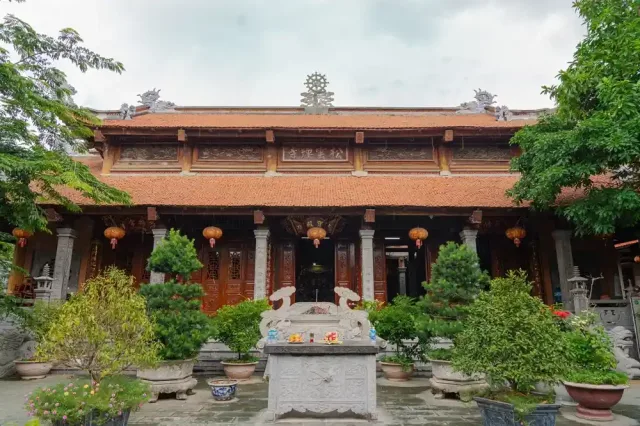


Tên gọi và vị trí địa lý
Chùa Tùng Vân nằm tại xã Thổ Tang, tỉnh Phú Thọ, chùa Tùng Vân không chỉ là một di tích văn hóa cấp quốc gia mà còn là điểm tựa tâm linh vững chãi của người dân nơi đây. Với lịch sử hơn 300 năm, ngôi chùa cổ kính này đã chứng kiến bao thăng trầm của lịch sử, nhưng vẫn kiên cường gìn giữ những giá trị văn hóa và kiến trúc độc đáo, trở thành một điểm đến không thể bỏ qua cho những ai yêu mến vẻ đẹp truyền thống của Phật giáo Việt Nam.
Lịch sử và nhân vật
Kiến trúc cảnh quan
Chùa có bố cục kiểu chữ “Quốc” với các hạng mục: Tam quan, tiền đường, thiêu hương, thượng điện, nhà tổ, hành lang, nhà mẫu. Chùa gồm 7 gian 2 dĩ, với hệ thống kết cấu hàng trăm cột gỗ và đá. Đây là kiểu kiến trúc hình chuôi vồ, 3 gian hậu cung, 7 gian tiền đường; là một trong những kiến trúc phật giáo tiêu biểu của vùng Đồng bằng Bắc Bộ.
Chùa Tùng Vân xưa xây theo kiểu cửa cuốn, có những đường nước chảy xuống hai mái hai bên tựa như giếng trời; xưa các sư trong chùa dùng nước này để sinh hoạt, trong chiến tranh Việt, Mỹ đã bị mai một đi. Ngày nay, chùa đã khôi phục lại theo lối tứ trụ trồng cột; khác với vẻ rêu phong của chùa trước đây, chùa Tùng Vân ngày nay có lối kiến trúc đẹp hơn với nhiều hoa văn, hoạ tiết tinh xảo hơn. Mái chùa lợp ngói mũ hài, uốn cong bốn góc, trên nóc có bàn tay vươn ra từ hoa sen đỡ bánh xe pháp luân của nhà phật.
Tam quan ngôi chùa dựng theo lối cổ xưa với trên đỉnh có bánh xe pháp luân, ở giữa là chữ vạn, ở trên các đầu mái uốn cong của các góc đều là những linh vật gắn với bầu trời như: Rồng, Phượng, Mây.
Qua cổng tam quan khuôn viên sân chùa với lầu quan âm toạ lạc ở góc bên trái. Quanh sân trồng nhiều cây cau cao vút tạo cho phật tử và du khách đến đây cảm thấy sự gần gũi với cuộc sống hàng ngày của người dân.
Qua năm bậc thềm từ sân lên đến tiền đường là khu vực chính của chùa, trước cửa vào là bức bình phong lớn để tránh mọi điều xấu du nhập từ bên ngoài vào chùa. Một trong nhưng nét độc đáo của chùa Tùng Vân là hàng cột đá ngay trước tiền đường. Trên mỗi cột đá đều được chạm khắc những hoa văn mang hình tượng tứ linh: Long, Ly, Quy, phụng và tứ quý: Tùng, Cúc, Trúc, Mai thể hiện sự sinh sôi của bốn mùa. Điều đặc biệt nữa là toàn bộ gỗ trong chùa đều là gỗ lim.
Nối tiếp giữa thềm và chính điện là bộ cánh cửa bức bàn bằng gỗ lim, chạm trổ rất công phu, phía trên cửa đặt chấn song con tiện, bên dưới tạc phù điêu tứ quý cách điệu.
Theo con đường nhất chính đạo đi vào bên trong tiền đường, phía bên phải lối vào là tượng ông Khuyến Thiện, đầu đội kim khôi, tay cầm đại đao nhưng gương mặt hiền từ, với ý nghĩa khuyên mọi người nên làm những điều thiện (chánh tâm). Phía bên trái lối vào là tượng ông Trừng ác, cũng mặc khôi giáp, nhưng gương mặt dữ dằn, một tay cầm búa, một tay cầm Ngọc ấn tỷ phù, với ý nghĩa nhắc nhở người làm điều ác sẽ bị trừng phạt (vọng tâm). Nhà thờ tổ là nơi lưu giữ nhiều pho tượng bằng đất nung có giá trị (trong đó có pho tượng Phật Thích Ca Mâu Ni bằng đất nung, có niên đại cách đây gần 300 năm), được bài trí theo phong cách của dòng Phật giáo Đại Thừa – Bắc Tông. Ngoài ra chùa còn lưu giữ nguyên vẹn nhiều hiện vật quý như chuông đồng, khánh đồng. ở gian hậu cung có khán thờ về đức Khổng Tử cho thấy ở nơi đây có truyền thống hiếu học lâu đời. Cũng ở khán thờ này, còn tạc hai thị nữ hai bên cánh cửa rất mềm mại, thể hiện sự khéo léo trong nghệ thuật tạc tượng từ xưa. Không chỉ vậy, chùa Tùng Vân còn lưu giữ được hệ thống văn bia cổ, đây là những tài liệu quý có giá trị nghiên cứu lịch sử, văn hóa.
Hiện vật
Xếp hạng
Với giá trị lịch sử, kiến trúc và tư liệu văn bia, chùa Tùng Vân được xếp hạng di tích văn hóa cấp quốc gia từ năm 1964 cùng với đình Thổ Tang, và được cấp bằng công nhận di tích quốc gia năm 1992. Năm 2008, chùa tiếp tục được tu bổ nhằm bảo tồn không gian kiến trúc và hệ thống di vật cổ còn lại.
Tài liệu tham khảo
- Tiến Anh, 2022, Chùa Tùng Vân và làng Thổ Tang, Kỷ lục, truy cập tại: https://kyluc.vn/tin-tuc/ky-luc-viet-nam/chua-tung-van-va-lang-tho-tang
- Ngọc Thắng, 2025, Tùng Vân cổ tự – Nơi thời gian và tâm linh hòa quyện, Báo Phú Thọ, https://baophutho.vn/tung-van-co-tu-noi-thoi-gian-va-tam-linh-hoa-quyen-237960.htm
Ngôn ngữ khác
Tiếng Anh
Tung Van Pagoda (Tho Tang, Phu Tho)
Name and Geographical Location
Tung Van Pagoda is located in Tho Tang Commune, Phu Tho. The pagoda is not only a national cultural heritage site but also an important spiritual center for local residents. With a history spanning more than 300 years, this ancient pagoda has witnessed many historical changes while continuing to preserve its distinctive cultural and architectural values, making it an important destination for those interested in the traditional beauty of Vietnamese Buddhism.
History and Historical Figures
Tung Van Pagoda is a large ancient pagoda of the Tho Tang region, formerly belonging to Vinh Tuong District. According to surviving inscriptions and artifacts, the pagoda was originally established in the late seventeenth century during the reign of King Le Hy Tong. Several stone steles preserved at the pagoda indicate that the complex was constructed during the Chinh Hoa era, around the year Binh Ty (1696). This was a period when Buddhism and village religious practices flourished throughout the Northern Delta, associated with the expansion of population centers and commercial activities in Tho Tang.
Throughout more than three centuries of existence, the pagoda underwent numerous restorations and repairs. The surviving artifacts demonstrate the continuous maintenance of religious activities through different historical periods. In the pagoda courtyard today remain a stone incense pillar and many stone steles bearing the reign titles Chinh Hoa, Tu Duc, and later periods.
Particularly significant is the stele entitled “Tung Van tu hau Phat bi ky,” dated the eighteenth day of the twelfth lunar month of the year Tan Dau, Bao Hung year 1 (1801). This is a rare document from the Tay Son period. Although the stele has been chipped and its inscriptions partially eroded due to irregular preservation, the remaining content still reflects the role of the pagoda in local religious life and the practice of donating property for Buddhist worship by local inhabitants in the early nineteenth century.
In addition to the stele system, the pagoda preserves many ritual objects of historical value. In the Front Hall there remains a large bell inscribed “Dia Tang xa tao chu hong chung, Tung Van tu ky” together with a large bronze “khanh” inscribed “Tung Van tu ky.” Both were cast in the month of Manh Ha in the year Ky Mui, Canh Thinh year 7 (1799), during the Tay Son dynasty. These artifacts demonstrate that Buddhist activities in Tho Tang at the end of the eighteenth century remained active and stable, while also reflecting local bronze-casting techniques and communal traditions of religious donation.
Architectural Landscape
The pagoda follows the layout of the Chinese character “Quoc” and includes the following structures: Tam Quan gate, Front Hall, Thieu Huong hall, Upper Sanctuary, ancestral house, side corridors, and Mau shrine.
The pagoda consists of seven compartments and two side bays, supported by a structural system of hundreds of wooden and stone columns. It follows the “chuoi vo” architectural form, with a three-compartment rear sanctuary and a seven-compartment front hall, representing one of the characteristic Buddhist architectural styles of the Northern Delta region.
Historically, Tung Van Pagoda was constructed with vaulted entrances and water channels descending along the two side roofs in a manner resembling skylights. In earlier times, monks used this water source for daily activities, though these features deteriorated during the Vietnam War. Today, the pagoda has been restored in the “tu tru trong cot” style. Unlike the moss-covered appearance of the former structure, the present pagoda displays more elaborate decorative motifs and refined ornamentation.
The roof is covered with “mu hai” tiles, with four corners curving upward. At the ridge appears a hand emerging from a lotus blossom supporting the Buddhist Dharma wheel.
Tam Quan Gate
The Tam Quan gate was constructed in the traditional style. At its summit is the Dharma wheel, with the Buddhist swastika symbol at the center. At the curved roof corners are sacred creatures associated with the heavens, including dragons, phoenixes, and cloud motifs.
Passing through the Tam Quan gate leads into the pagoda courtyard, where a Quan Am pavilion stands at the left corner. Around the courtyard are rows of tall areca palms, creating a familiar and peaceful atmosphere for Buddhist devotees and visitors alike.
Front Hall and Main Sanctuary
Ascending five stone steps from the courtyard leads to the Front Hall, the principal area of the pagoda. Before the entrance stands a large screen wall intended to prevent negative influences from entering the sacred space.
One of the distinctive features of Tung Van Pagoda is the row of stone columns positioned before the Front Hall. Each column is carved with decorative motifs representing the Four Sacred Creatures—dragon, qilin, turtle, and phoenix—as well as the Four Seasonal Plants—pine, chrysanthemum, bamboo, and apricot blossom—symbolizing prosperity through the four seasons.
Another remarkable characteristic is that all timber within the pagoda is made from ironwood.
Connecting the steps to the main sanctuary is a set of wooden “buc ban” doors made from ironwood and elaborately carved. Above the doors are turned baluster railings, while below are stylized relief carvings of the Four Seasonal Plants.
Following the central pathway into the Front Hall, on the right side stands the statue of Khuyen Thien. He wears armor and a golden helmet and holds a large saber, yet his face appears gentle, symbolizing encouragement toward virtuous conduct and righteous intention. On the left side stands the statue of Trung Ac, also armored, but with a fierce expression, holding an axe in one hand and a jade seal in the other, symbolizing punishment for evil actions and wrongful intentions.
Ancestral Hall and Interior Decorations
The ancestral hall preserves many valuable terracotta statues, including a terracotta statue of Shakyamuni Buddha dating back nearly 300 years. These statues are arranged according to the style of Mahayana Buddhism of the Northern tradition.
The pagoda also preserves many important artifacts such as bronze bells and bronze “khanh” instruments. Within the rear sanctuary is an altar dedicated to Confucius, indicating the long-standing scholarly traditions of the locality. Beside this altar are two delicately carved female attendants flanking the doorway, demonstrating the skill of traditional sculptural craftsmanship.
Tung Van Pagoda also preserves a system of ancient stone inscriptions, which constitute valuable documents for the study of local history and culture.
Artifacts
Tung Van Pagoda is especially famous for its statue of Shakyamuni Buddha located in the Front Hall. The statue was carved from a single block of green jade weighing more than ten tons, measuring 3.3 meters high, 2.1 meters wide, and 1.2 meters thick. This is considered the largest and rarest green jade block discovered in Vietnam.
The statue was completed during the nationwide celebration of the 1,000th anniversary of Thang Long. Its polished green surface conveys a cool and peaceful beauty closely associated with the Vietnamese aspiration for harmony and tranquility.
After the completion of the Shakyamuni statue, the remaining green jade was used by artisans to carve a statue of Bodhisattva Quan Am weighing approximately five tons. This statue was also executed with exceptional craftsmanship and artistic devotion, enabling worshippers to perceive its spiritual vitality during veneration.
The pagoda also displays statues of the Three Buddhas of the Three Times, the Infant Buddha, and a painting depicting the pilgrimage of Duong Tam Tang in search of Buddhist scriptures.
On September 16, 2011, the Vietnam Record Book officially recognized the statue as “The Largest Green Semi-Precious Stone Buddha Statue in Vietnam.”
Classification
Because of its historical, architectural, and epigraphic value, Tung Van Pagoda was classified as a National Cultural Monument in 1964 together with the Tho Tang communal house, and officially received national heritage recognition in 1992. In 2008, the pagoda underwent further restoration to preserve its architectural space and surviving ancient artifacts.
References
- Tiến Anh, 2022, Chùa Tùng Vân và làng Thổ Tang, Kỷ lục, truy cập tại: https://kyluc.vn/tin-tuc/ky-luc-viet-nam/chua-tung-van-va-lang-tho-tang
- Ngọc Thắng, 2025, Tùng Vân cổ tự – Nơi thời gian và tâm linh hòa quyện, Báo Phú Thọ, https://baophutho.vn/tung-van-co-tu-noi-thoi-gian-va-tam-linh-hoa-quyen-237960.htm
Tiếng Pháp
Temple Tung Van (Tho Tang, Phu Tho)
Nom et situation géographique
Le temple Tung Van est situé dans la commune de Tho Tang, province de Phu Tho. Il ne constitue pas seulement un monument culturel classé au niveau national, mais aussi un important centre spirituel pour les habitants de la région. Avec plus de trois siècles d’histoire, ce temple ancien a traversé de nombreuses périodes de bouleversements tout en préservant les valeurs culturelles et architecturales propres au bouddhisme vietnamien traditionnel. Il demeure aujourd’hui un lieu incontournable pour ceux qui s’intéressent au patrimoine religieux du Viet Nam.
Histoire et personnages
Le temple Tung Van est l’un des grands temples anciens de la région de Tho Tang, anciennement dans le district de Vinh Tuong. Selon les stèles et les objets conservés sur place, le temple fut fondé à la fin du XVIIe siècle sous le règne du roi Le Hy Tong. Plusieurs inscriptions indiquent que l’édifice fut construit durant l’ère Chinh Hoa, vers l’année Binh Ty (1696). Cette période correspond à un essor du bouddhisme et des cultes communautaires dans le delta du Nord, lié au développement des centres de peuplement et des activités commerciales de Tho Tang.
Au cours de ses plus de trois cents ans d’existence, le temple fut restauré et réparé à plusieurs reprises. Les objets encore conservés témoignent de la continuité des pratiques religieuses à travers différentes périodes historiques. Dans la cour subsistent encore un brûle-parfum en pierre ainsi que plusieurs stèles datant des ères Chinh Hoa, Tu Duc et d’autres périodes ultérieures.
La stèle intitulée « Tung Van tu hau Phat bi ky », gravée le 18e jour du douzième mois de l’année Tan Dau, première année de l’ère Bao Hung (1801), constitue un document rare datant de l’époque Tay Son. Bien qu’elle soit aujourd’hui partiellement brisée et ses inscriptions effacées par une conservation irrégulière, son contenu reflète encore le rôle du temple dans la vie religieuse locale et les donations effectuées pour le culte bouddhique au début du XIXe siècle.
Outre les stèles, le temple conserve plusieurs instruments rituels de grande valeur historique. Dans le Tien duong se trouvent encore une grande cloche portant l’inscription « Dia Tang xa tao chu hong chung, Tung Van tu ky » ainsi qu’un grand khanh en bronze intitulé « Tung Van tu ky ». Les deux furent fondus au cours du premier mois d’été de l’année Ky Mui, septième année de l’ère Canh Thinh (1799), sous la dynastie Tay Son. Ces objets témoignent de la vitalité du bouddhisme à Tho Tang à la fin du XVIIIe siècle, ainsi que du savoir-faire local dans la fonte du bronze et de la tradition des donations communautaires.
Architecture et paysage
Le temple adopte un plan en forme du caractère chinois « Quoc » (國), comprenant plusieurs bâtiments : tam quan, tien duong, thieu huong, thuong dien, maison des patriarches, galeries latérales et maison de la Mère divine. L’ensemble comprend sept travées principales et deux annexes latérales, soutenues par un système de centaines de colonnes en bois et en pierre. Il s’agit d’une architecture dite « hình chuôi vồ », caractéristique des temples bouddhiques du delta du Nord, avec trois travées de sanctuaire arrière et sept travées de salle antérieure.
Autrefois, le temple Tung Van possédait une architecture à voûtes avec des conduits d’écoulement d’eau descendant des deux versants du toit, semblables à des puits de lumière. Les moines utilisaient autrefois cette eau dans leur vie quotidienne, mais ce système disparut durant la guerre du Viet Nam. Aujourd’hui, le temple a été restauré selon un style à quatre piliers. Contrairement à l’aspect ancien et couvert de mousse du passé, le temple actuel présente une architecture plus ornementée avec de nombreux motifs décoratifs raffinés.
La toiture est couverte de tuiles « mui hai » et ses quatre angles sont recourbés. Au sommet se dresse une main surgissant d’une fleur de lotus soutenant la roue du Dharma bouddhique.
Le tam quan a été construit selon le style traditionnel ancien. Son sommet est orné de la roue du Dharma, tandis qu’au centre figure le symbole bouddhique en forme de svastika. Aux extrémités relevées des toitures apparaissent des créatures célestes telles que dragons, phénix et nuages.
Après avoir franchi le tam quan, on accède à la cour du temple, où se trouve un pavillon de Quan Am dans l’angle gauche. De nombreux aréquiers élevés entourent la cour et créent une atmosphère familière rappelant la vie quotidienne des habitants.
Cinq marches conduisent de la cour au Tien duong, partie principale du temple. Devant l’entrée se dresse un grand écran destiné à empêcher les influences néfastes de pénétrer dans le sanctuaire. L’un des traits les plus remarquables du temple Tung Van est la rangée de colonnes de pierre située devant le Tien duong. Chaque colonne est sculptée de motifs représentant les quatre créatures sacrées — Long, Ly, Quy, Phung — ainsi que les quatre plantes symboliques — Tung, Cuc, Truc, Mai — évoquant la prospérité des quatre saisons. Tous les éléments en bois du temple sont réalisés en bois de lim.
Entre les marches et le sanctuaire principal se trouve une porte à panneaux en bois de lim richement sculptée. Au-dessus figurent des balustres tournés, tandis qu’au-dessous apparaissent des bas-reliefs stylisés des quatre plantes symboliques.
En suivant l’axe principal à l’intérieur du Tien duong, on voit à droite la statue de Khuyen Thien, coiffé d’un casque doré et tenant une grande hallebarde, mais avec un visage bienveillant symbolisant l’encouragement au bien. À gauche se trouve la statue de Trung Ac, également vêtu d’une armure mais au visage sévère, tenant une hache et un sceau sacré, rappelant que les mauvaises actions seront punies.
La maison des patriarches conserve plusieurs statues en terre cuite de grande valeur, notamment une statue du Bouddha Shakyamuni datant de près de trois cents ans. Ces œuvres sont disposées selon la tradition du bouddhisme Mahayana du Nord. Le temple conserve également des objets précieux tels que cloches et khanh en bronze. Dans le sanctuaire arrière se trouve un autel dédié à Confucius, témoignant de l’ancienne tradition d’étude et d’érudition de la région. Deux statues de servantes, sculptées de manière très souple et élégante de part et d’autre des portes, illustrent la finesse de l’art sculptural ancien. Le temple conserve également un important ensemble de stèles anciennes constituant de précieux documents pour la recherche historique et culturelle.
Objets conserves
Le temple Tung Van est particulièrement célèbre pour sa statue du Bouddha Shakyamuni placée dans le Tien duong. Sculptée dans un bloc de jade vert pesant plus de dix tonnes, elle mesure 3,3 m de haut, 2,1 m de large et 1,2 m d’épaisseur. Il s’agit du plus grand bloc de jade précieux découvert au Viet Nam. La statue fut achevée à l’occasion du millénaire de Thang Long. Sa couleur verte douce et lumineuse évoque l’aspiration du peuple vietnamien à la paix et à la sérénité.
Le reste du bloc de jade servit ensuite à sculpter une statue de Quan Am pesant environ cinq tonnes. Cette œuvre, exécutée avec une grande finesse, reflète le talent et le dévouement des artisans, permettant aux fidèles de ressentir pleinement le caractère sacré de la statue lors de leur contemplation.
Le temple expose également plusieurs statues telles que les Trois Bouddhas des Temps, le Bouddha enfant, ainsi qu’une peinture représentant le voyage de Duong Tam Tang en quête des écritures sacrées. Le 16 septembre 2011, cette statue fut reconnue par le Livre des records du Viet Nam comme « la plus grande statue bouddhique du Viet Nam réalisée en pierre semi-précieuse de couleur jade verte ».
Classement
En raison de ses valeurs historiques, architecturales et épigraphiques, le temple Tung Van fut classé monument culturel national dès 1964, conjointement avec le đình Tho Tang, puis reçut officiellement son certificat de classement national en 1992. En 2008, le temple fit l’objet d’une nouvelle campagne de restauration destinée à préserver son architecture et ses objets anciens.
Bibliographie
- Tiến Anh, 2022, Chùa Tùng Vân và làng Thổ Tang, Kỷ lục, truy cập tại: https://kyluc.vn/tin-tuc/ky-luc-viet-nam/chua-tung-van-va-lang-tho-tang
- Ngọc Thắng, 2025, Tùng Vân cổ tự – Nơi thời gian và tâm linh hòa quyện, Báo Phú Thọ, https://baophutho.vn/tung-van-co-tu-noi-thoi-gian-va-tam-linh-hoa-quyen-237960.htm
Tiếng Trung
松云寺(土汤,富寿)
名称与地理位置
松云寺位于富寿省土汤社。作为国家级文化遗迹,松云寺不仅是当地居民重要的精神信仰中心,也是一座拥有三百余年历史的古刹。历经时代变迁与历史动荡,寺庙仍保存着独特的传统文化与建筑价值,成为越南北部佛教建筑的重要代表之一。
历史与人物
松云寺是土汤地区规模较大的古寺,旧属永祥县。根据现存碑刻与遗物资料,寺庙始建于十七世纪末黎熙宗时期。部分寺内碑文记载,工程始建于正和年间丙子年(1696)。这一时期正值北部平原地区佛教与乡村信仰迅速发展的阶段,也与土汤地区居民聚落扩展及商业活动繁荣密切相关。
在三百余年的历史中,寺庙曾多次修缮重建。现存遗物显示,当地信仰活动在不同历史时期始终延续不断。寺院前庭至今仍保存石香柱及多块刻有正和、嗣德等年号的石碑。
其中尤以《松云寺后佛碑记》最为珍贵。该碑刻于保兴元年辛酉岁十二月十八日(1801),属于西山时期罕见文献。尽管碑体现已残缺、字迹漫漶,但仍可反映十九世纪初当地居民“后佛”供奉与寺庙在社区信仰生活中的重要地位。
除碑刻系统外,寺内还保存多件具有历史价值的法器。前堂现存一口大铜钟,铭文为《地藏社造铸洪钟·松云寺记》,另有一件大型铜磬《松云寺记》。二者皆铸于景盛七年己未岁孟夏(1799),属西山时期遗物。这些法器反映出十八世纪末土汤地区佛教活动依然稳定繁荣,同时也体现当地社区的铸铜工艺与功德传统。
建筑与景观
寺庙整体布局呈“国”字形,包括三关门、前堂、烧香殿、上殿、祖堂、廊房与圣母殿等建筑。
主体建筑为七间两耳结构,拥有数百根木柱与石柱,是北部平原地区典型的“槌柄式”佛教建筑,即前堂七间、后三间后宫布局。
松云寺旧时采用拱券式建筑结构,两侧屋顶设有排水沟,形似天井。过去寺僧曾利用雨水日常生活,但在越美战争期间已逐渐毁坏。今日寺庙已按“四柱植柱式”重新修复。与昔日古朴斑驳的风貌相比,如今寺庙建筑更为华丽,装饰纹样亦更加精细繁复。
寺顶覆履形瓦,四角翘起,正脊之上塑有莲花托举佛教法轮之造型。
三关门沿袭古制,顶部设法轮,中间为“卍”字纹。各屋角翘檐上则装饰与天空相关的瑞兽,如龙、凤与祥云。
穿过三关门后,可见寺院庭院,左侧建有观音阁。庭院周围种植高耸槟榔树,使香客与游客感受到浓厚的乡村生活气息。
由庭院登五级石阶可达前堂主体区域。入口前设大型照壁,用以阻隔外界邪秽之气进入寺内。
松云寺最独特之处之一,是前堂前排列整齐的石柱。每根石柱皆雕刻“四灵”纹样:龙、麟、龟、凤,以及“四贵”植物:松、菊、竹、梅,象征四季生生不息。
此外,寺内全部木构均采用铁木(lim木)建造。
连接台阶与正殿的是一组铁木制“板门”,雕刻极其精细。门上设栏杆式花棂,下方浮雕“四贵”纹饰。
沿“一本道”进入前堂,右侧立有“劝善”像:头戴金盔,手持大刀,面容慈祥,寓意劝人行善、端正本心。左侧则为“惩恶”像,同样披甲执兵,神情威严,一手持斧,一手执玉玺符印,寓意警示作恶者终将受罚。
祖堂内保存多尊珍贵陶塑佛像,其中包括一尊距今近三百年的释迦牟尼陶像,整体陈设遵循大乘佛教北宗风格。
此外,寺内还完整保存铜钟、铜磬等珍贵法器。
后宫中设有孔子龛位,显示当地自古崇尚儒学、重视教育。龛门两侧还雕有两位侍女像,姿态柔美,体现古代雕塑工艺之精巧。
松云寺同时还保存一套完整古碑系统,是研究地方历史与文化的重要文献资料。
遗物
松云寺最著名的遗物,是安置于前堂中的释迦牟尼佛像。该佛像以整块绿色玉石雕成,重逾十吨,高3.3米、宽2.1米、厚1.2米,为越南目前发现最大之绿色半宝石玉料。
佛像于全国庆祝升龙千年大典期间完成。其温润明净的绿色光泽,象征越南人民追求和平安宁的精神愿望。
雕刻释迦佛后,剩余玉石又被雕成一尊约五吨重的观音像。观音像工艺精湛,凝聚工匠心血与艺术精华,使信众于瞻礼时能感受到佛像之“神韵”。
寺内还陈列三世佛、佛诞像以及《唐三藏取经图》等佛教艺术作品。
2011年9月16日,该释迦佛像获《越南纪录大全》认证为“越南最大绿色半宝石佛像”。
等级认定
凭借其历史、建筑及碑刻文献价值,松云寺于1964年与土汤亭一同被列为国家级文化遗迹,并于1992年正式获得国家遗迹证书。2008年,寺庙再次进行修缮,以保存其建筑空间与古代遗物系统。
参考文献
- Tiến Anh, 2022, Chùa Tùng Vân và làng Thổ Tang, Kỷ lục, truy cập tại: https://kyluc.vn/tin-tuc/ky-luc-viet-nam/chua-tung-van-va-lang-tho-tang
- Ngọc Thắng, 2025, Tùng Vân cổ tự – Nơi thời gian và tâm linh hòa quyện, Báo Phú Thọ, https://baophutho.vn/tung-van-co-tu-noi-thoi-gian-va-tam-linh-hoa-quyen-237960.htm