

Khái quát
Lễ hội Đua bò Bảy Núi là một lễ hội truyền thống đặc sắc của đồng bào Khmer vùng Bảy Núi thuộc hai huyện Tri Tôn và Tịnh Biên, tỉnh An Giang. Lễ hội thường diễn ra vào dịp lễ Sene Dolta của người Khmer, khoảng cuối tháng Tám âm lịch, tức trung tuần tháng 10 dương lịch. Đây là thời điểm vụ hè thu đã thu hoạch xong, những cánh đồng vừa được nghỉ ngơi sau mùa vụ, đồng thời cũng là lúc người dân chuẩn bị bước vào mùa sản xuất mới. Trong không khí ấy, cộng đồng Khmer tạm gác công việc đồng áng để tổ chức các hoạt động tín ngưỡng, vui chơi và sinh hoạt cộng đồng, trong đó nổi bật nhất là hội đua bò.
Lễ hội Đua bò Bảy Núi không chỉ là một hoạt động thể thao dân gian mà còn là biểu tượng văn hóa đặc trưng của cư dân nông nghiệp Khmer Nam Bộ. Qua nhiều thế hệ, lễ hội đã trở thành nơi thể hiện tinh thần đoàn kết cộng đồng, sức mạnh lao động và khát vọng về cuộc sống no đủ, mùa màng bội thu. Đồng thời, đây cũng là dịp để người dân gặp gỡ, giao lưu, gắn kết tình làng nghĩa xóm sau những tháng ngày lao động vất vả trên đồng ruộng.
Ngày nay, lễ hội không chỉ thu hút đồng bào Khmer mà còn hấp dẫn đông đảo người Kinh, người Hoa cùng du khách trong và ngoài nước. Với không khí náo nhiệt, những cuộc tranh tài kịch tính cùng bản sắc văn hóa độc đáo, lễ hội đã trở thành một điểm nhấn văn hóa – du lịch tiêu biểu của tỉnh An Giang và vùng Đồng bằng sông Cửu Long.
Nguồn gốc và ý nghĩa
Lễ hội Đua bò Bảy Núi gắn liền với lễ Sene Dolta – lễ báo hiếu và tưởng nhớ ông bà tổ tiên của đồng bào Khmer Nam Bộ. Lễ Dolta kéo dài suốt tháng Tám âm lịch, là dịp để con cháu đến chùa cầu phước cho ông bà, cha mẹ, cầu mong mưa thuận gió hòa, mùa màng thắng lợi và cuộc sống bình an. Đồng bào Khmer vốn rất sùng kính Phật giáo Nam tông, vì vậy trong dịp này, người dân thường đưa bò đến cày ruộng cho chùa như một cách tạo phước cho tổ tiên.
Từ hoạt động lao động mang tính nghi lễ ấy, những cuộc thi tài giữa các đôi bò dần xuất hiện rồi phát triển thành hội đua bò truyền thống. Ban đầu, hội đua chỉ mang tính dân gian, là cuộc tranh tài vui chơi giữa các chùa, các phum sóc sau mùa vụ. Tuy nhiên, theo thời gian, lễ hội ngày càng phát triển, quy mô ngày càng lớn và trở thành một sinh hoạt văn hóa quan trọng của đồng bào Khmer vùng Bảy Núi.
Hội đua bò không chỉ phản ánh đời sống nông nghiệp lúa nước mà còn thể hiện tinh thần lao động hăng say, sự khéo léo và lòng dũng cảm của người nông dân Khmer. Đó cũng là dịp để cộng đồng cùng nhau vui mừng sau mùa vụ thành công, hướng tới một năm mới nhiều thuận lợi hơn. Vì thế, dù thắng hay thua, mọi người đều cùng chia sẻ niềm vui chung của ngày hội.
Không gian và thời gian tổ chức
Lễ hội đua bò được tổ chức cùng lễ hội Đôn ta (lễ cúng ông bà), 29-8 đến mùng 1-9 âm lịch (nếu tháng thiếu thì từ 29-8 đến mùng 2-9 âm lịch).
Từ năm 1975 trở về trước, Hội đua bò vẫn được người dân tổ chức hàng năm nhưng ở quy mô, phạm vi ở mức độ nhỏ.
Lễ hội thường được tổ chức tại các sân đua thuộc vùng Bảy Núi, chủ yếu ở Tri Tôn và Tịnh Biên. Các sân đua thường là những thửa ruộng lớn đã thu hoạch xong, được cải tạo thành đường đua hình chữ nhật dài khoảng 100 mét, rộng khoảng 6 mét, diện tích từ 3.000 đến 5.000m². Mặt sân được nạo sâu khoảng 10 cm và bơm nước ngập từ 5 đến 10 cm để tạo độ sình lầy, giúp cuộc đua thêm phần gay cấn và đúng với đặc trưng truyền thống.
Một trong những địa điểm tổ chức nổi tiếng hiện nay là sân đua tại Khu Liên hợp Thể thao – Du lịch Tà Pạ – Soài Chek ở Tri Tôn. Vào mỗi mùa lễ hội, nơi đây trở thành điểm hội tụ của hàng vạn người dân và du khách đến xem, cổ vũ và trải nghiệm không khí văn hóa đặc trưng của vùng Bảy Núi.
Công tác chuẩn bị
Để tham gia lễ hội, các chủ bò phải chuẩn bị từ rất sớm. Ngay sau khi kết thúc vụ gieo cấy, những đôi bò được chọn sẽ được nghỉ ngơi, chăm sóc và bồi dưỡng kỹ lưỡng. Người nuôi áp dụng nhiều bí quyết riêng trong việc cho ăn, luyện sức bền và tập phản xạ nhằm giúp bò có thể đạt tốc độ cao và phối hợp ăn ý khi thi đấu.
Những đôi bò tham gia hội đua chủ yếu là giống “Bò Bảy Núi” nổi tiếng khỏe mạnh và dẻo dai. Trước khi bước vào vòng chung kết, các đôi bò phải trải qua nhiều vòng tuyển chọn ở xã và liên xã để tìm ra những đại diện xuất sắc nhất.
Ngoài bò khỏe, người điều khiển bò – gọi là “nài bò” – cũng đóng vai trò vô cùng quan trọng. Các nài bò phải có sức khỏe, sự nhanh nhẹn, gan dạ và nhiều kinh nghiệm. Họ thường tập luyện trong nhiều tháng để có thể giữ thăng bằng trên giàn bừa và điều khiển đôi bò tăng tốc đúng thời điểm.
Phần lễ
Phần lễ của hội đua bò gắn chặt với tín ngưỡng Phật giáo Nam tông và lễ Sene Dolta của người Khmer. Trong những ngày diễn ra lễ hội, đồng bào Khmer tập trung tại chùa để dâng lễ, cầu phước cho tổ tiên, ông bà và cầu mong cuộc sống an lành, mùa màng thuận lợi.
Không khí lễ hội mang tính thiêng liêng và cộng đồng rất rõ nét. Người dân xem việc tổ chức đua bò không chỉ là hoạt động vui chơi mà còn là cách bày tỏ lòng biết ơn với tổ tiên, thần linh và thiên nhiên đã ban cho họ cuộc sống no đủ. Chính vì vậy, ngày hội luôn mang ý nghĩa tâm linh sâu sắc, gắn với phong tục cầu mong “mưa thuận gió hòa”, “trúng mùa vụ” và đời sống sung túc.
Phần hội
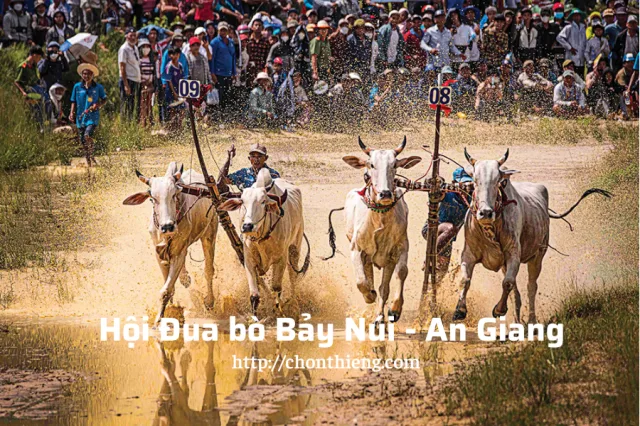
Phần hội là phần sôi động và hấp dẫn nhất của lễ hội Đua bò Bảy Núi. Vào ngày thi đấu, hàng chục đôi bò từ nhiều địa phương tập trung tại sân đua để bốc thăm, sắp xếp lượt thi và nghe phổ biến luật thi đấu. Theo thể thức truyền thống, mỗi cuộc đua gồm vòng “hô” và vòng “thả”. Ở vòng hô, các đôi bò chạy chậm để giữ đúng đường đua và không phạm luật. Đây là vòng thể hiện sự khéo léo của các nài bò. Nếu đôi bò nào chạy lệch đường hoặc vi phạm quy định sẽ bị xử thua.
Sau vòng hô là vòng thả, phần hấp dẫn nhất của cuộc đua. Khi có hiệu lệnh của trọng tài, các nài bò dùng cây “xà-lul” để kích thích bò tăng tốc lao về đích với tốc độ có thể đạt từ 40 đến 60 km/giờ. Trong vòng này, các đôi bò được phép vượt lên và đôi bò phía sau có thể giẫm lên giàn bừa của đôi phía trước để giành chiến thắng.
Những cuộc rượt đuổi quyết liệt trên mặt ruộng sình lầy tạo nên khung cảnh vô cùng ngoạn mục. Tiếng reo hò, tiếng trống, tiếng cổ vũ hòa cùng tiếng nước bắn tung tóe làm cho bầu không khí lễ hội trở nên cực kỳ sôi động. Càng vào các vòng trong, đặc biệt từ vòng 16 đội đến chung kết, các màn tranh tài càng gay cấn với những cú bứt tốc ngoạn mục khiến người xem vô cùng phấn khích.
Ngoài đua bò, lễ hội còn có nhiều hoạt động văn hóa khác như biểu diễn văn nghệ Khmer, trò chơi dân gian, triển lãm hình ảnh địa phương và giới thiệu đặc sản vùng Bảy Núi như đường thốt nốt, gạo sữa Bảy Núi, gà đốt Ô Thum, bánh bò thốt nốt, chè thốt nốt, bò nướng, đu đủ đâm…
Giá trị văn hóa và du lịch
Lễ hội Đua bò Bảy Núi mang đậm dấu ấn văn hóa nông nghiệp lúa nước của đồng bào Khmer Nam Bộ. Đây không chỉ là một môn thể thao dân gian mà còn là không gian bảo tồn các giá trị văn hóa truyền thống, thể hiện tinh thần đoàn kết cộng đồng và bản sắc riêng của vùng Bảy Núi.
Theo thời gian, lễ hội đã vượt khỏi phạm vi sinh hoạt địa phương để trở thành sự kiện văn hóa – du lịch lớn của An Giang. Hàng năm, lễ hội thu hút hàng vạn du khách, nhiếp ảnh gia, phóng viên trong và ngoài nước đến tham dự. Những khoảnh khắc bò tăng tốc trên đường đua bùn lầy đã trở thành đề tài nổi bật trong nhiều tác phẩm nhiếp ảnh nghệ thuật.
Tỉnh An Giang hiện xem hội đua bò là một sản phẩm du lịch đặc sắc. Chính quyền địa phương đã đầu tư cải tạo sân đua, hỗ trợ các đội thi và quảng bá hình ảnh lễ hội rộng rãi nhằm phát triển du lịch văn hóa cộng đồng. Đồng thời, lễ hội cũng góp phần thúc đẩy kinh tế địa phương thông qua các hoạt động dịch vụ, ẩm thực và du lịch sinh thái.
Công nhận di sản văn hóa phi vật thể quốc gia
Trải qua quá trình hình thành và phát triển lâu dài, lễ hội Đua bò Bảy Núi ngày càng khẳng định giá trị văn hóa đặc sắc của mình. Năm 2004, UBND tỉnh An Giang nâng cấp hội đua bò thành lễ hội văn hóa truyền thống cấp tỉnh. Đến năm 2009, lễ hội được đổi tên thành “Hội đua bò Bảy Núi tranh Cúp Truyền hình An Giang”.
Ngày 19/01/2016, Bộ Văn hóa, Thể thao và Du lịch chính thức công nhận Hội Đua bò Bảy Núi là Di sản văn hóa phi vật thể quốc gia. Đây là dấu mốc quan trọng khẳng định giá trị lịch sử, văn hóa và tinh thần độc đáo của lễ hội trong đời sống cộng đồng Khmer ở An Giang.
Tiếp đó, ngày 27/02/2020, UBND tỉnh An Giang ban hành đề án bảo tồn và phát huy giá trị di sản Hội đua bò Bảy Núi giai đoạn 2020 – 2025. Nội dung đề án tập trung vào việc nghiên cứu, sưu tầm, số hóa tư liệu; phục hồi các nghi lễ truyền thống; xây dựng tiêu chí bảo tồn giống bò đua, kỹ thuật chăm sóc và kỹ năng điều khiển bò.
Ngày nay, lễ hội không chỉ là niềm tự hào của đồng bào Khmer mà còn là di sản văn hóa chung của cộng đồng các dân tộc ở Nam Bộ, góp phần làm phong phú thêm kho tàng lễ hội truyền thống Việt Nam.
Tài liệu tham khảo
- Nguyễn Thụy An (Biên soạn), 2015, Lễ hội Việt Nam, Nxb Thanh niên.
- Vân Khánh – Hạ Long, Lễ hội Đua bò Bảy Núi- Lễ hội truyền thống độc đáo của đồng bào Khmer, trang bvhttdl.gov.vn, ngày 12/11/2025.
- Hội Đua bò Bảy Núi: Nét đẹp văn hóa truyền thống của đồng bào Khmer ở An Giang, trang www.vietnamplus.vn, ngày 18/09/2025.
- Lễ hội đua bò Bảy Núi, Wikipedia.
- Như Ngọc, An Giang tưng bừng Hội Đua bò Bảy Núi, trang angiang.gov.vn, ngày 20/09/2025.
Ngôn ngữ khác
Tiếng Anh (English)
Overview
The Bay Nui Ox Racing Festival is a distinctive traditional festival of the Khmer community living in the Bay Nui (Seven Mountains) region of Tri Ton and Tinh Bien districts, An Giang Province. The festival is usually held during the Khmer Sene Dolta Festival, around the end of the eighth lunar month, corresponding to mid-October in the Gregorian calendar. This is the period when the summer–autumn rice crop has been harvested, the fields are resting after the farming season, and local people are preparing for a new agricultural cycle. During this time, the Khmer community temporarily sets aside agricultural work to participate in religious ceremonies, recreational activities, and community gatherings, among which ox racing is the most prominent event.
The Bay Nui Ox Racing Festival is not only a traditional folk sport but also a cultural symbol of the Khmer agricultural communities in Southern Vietnam. Through many generations, the festival has become a venue for expressing community solidarity, labor strength, and aspirations for prosperity and abundant harvests. It also provides an opportunity for villagers to meet, socialize, and strengthen neighborhood ties after months of hard work in the fields.
Today, the festival attracts not only Khmer people but also Kinh, Hoa (Chinese-Vietnamese), and numerous domestic and international visitors. With its vibrant atmosphere, thrilling competitions, and unique cultural identity, the festival has become one of the most representative cultural and tourism highlights of An Giang Province and the Mekong Delta region.
Origins and Significance
The Bay Nui Ox Racing Festival is closely associated with Sene Dolta, the Khmer festival dedicated to honoring and remembering ancestors. Dolta takes place throughout the eighth lunar month and is a time when descendants visit temples to pray for the well-being of their grandparents and parents, seek favorable weather, successful harvests, and peaceful lives.
As devout followers of Theravada Buddhism, Khmer people traditionally bring their oxen to plow temple fields as a meritorious act dedicated to their ancestors. From this ritual labor activity, friendly competitions between pairs of oxen gradually emerged and eventually developed into the traditional ox-racing festival.
Initially, the races were informal folk competitions among temples and villages (phum, sóc) after the harvest season. Over time, however, the festival expanded in scale and became an important cultural event for the Khmer community of the Seven Mountains region.
The festival not only reflects the wet-rice agricultural lifestyle but also demonstrates the industrious spirit, skillfulness, and courage of Khmer farmers. It is a joyful occasion for the community to celebrate a successful harvest and look forward to a more prosperous year ahead. Therefore, regardless of victory or defeat, everyone shares in the collective joy of the festival.
Festival Space and Time
The festival is typically held at racing grounds in the Bay Nui region, mainly in Tri Ton and Tinh Bien districts. The racecourses are usually large rice fields that have already been harvested and are transformed into rectangular tracks approximately 100 meters long and 6 meters wide, covering an area of 3,000–5,000 square meters.
The track surface is dug to a depth of about 10 centimeters and flooded with 5–10 centimeters of water to create muddy conditions, making the races more challenging and preserving their traditional character.
One of the best-known venues today is the racecourse at the Ta Pa – Soai Chek Sports and Tourism Complex in Tri Ton District. During the festival season, this location becomes a gathering place for tens of thousands of residents and visitors who come to watch, cheer, and experience the unique cultural atmosphere of the Seven Mountains region.
Preparations
Preparation for the festival begins long before race day. Immediately after the planting season ends, selected oxen are rested, carefully cared for, and specially nourished. Owners apply various traditional techniques in feeding, endurance training, and reflex development to ensure that their oxen can achieve high speeds and maintain good coordination during races.
Most racing pairs belong to the famous “Bay Nui Ox” breed, known for its strength and endurance. Before reaching the final competition, the oxen must pass through selection rounds at commune and inter-commune levels to identify the strongest representatives.
Besides strong oxen, the driver—known as the “nai bo” (ox jockey)—plays a crucial role. Jockeys must possess physical strength, agility, courage, and extensive experience. They often train for months in order to maintain balance on the harrow platform and control their oxen effectively during the race.
Rituals
The ceremonial aspect of the festival is closely connected to Theravada Buddhist beliefs and the Khmer Sene Dolta Festival. During the festival period, Khmer people gather at temples to make offerings, pray for their ancestors, and seek blessings for peaceful lives and successful harvests.
The atmosphere is deeply spiritual and strongly community-oriented. Local people regard the ox race not merely as entertainment but also as a way to express gratitude toward ancestors, deities, and nature for providing them with a prosperous life.
For this reason, the festival carries profound spiritual significance, reflecting traditional wishes for favorable weather, abundant harvests, and prosperity.
Festive Activities
The festive section is the most exciting and attractive part of the Bay Nui Ox Racing Festival. On race day, dozens of pairs of oxen from various localities gather at the racecourse to draw lots, determine racing order, and receive instructions on competition rules.
According to traditional regulations, each race consists of two stages: the “Ho” round and the “Tha” round.
In the Ho round, the oxen move at a controlled pace to remain within their designated lane and avoid penalties. This stage showcases the jockey’s skill and control. Any pair that leaves its lane or violates regulations is disqualified.
The Tha round follows and is considered the most thrilling stage. At the referee’s signal, jockeys use a stick called a “xa-lul” to urge their oxen forward. The animals then sprint toward the finish line at speeds ranging from 40 to 60 kilometers per hour.
During this stage, overtaking is permitted, and the trailing pair may even step onto the harrow platform of the leading pair in an attempt to gain advantage. These intense chases across muddy fields create spectacular scenes.
The cheers of spectators, drumbeats, encouraging shouts, and splashing water combine to create an electrifying atmosphere. As the competition progresses—especially from the round of sixteen to the final—the races become increasingly dramatic, featuring remarkable bursts of speed that captivate the audience.
In addition to ox racing, the festival also includes many cultural activities such as Khmer musical performances, folk games, local exhibitions, and the introduction of regional specialties from the Seven Mountains area, including palm sugar, Bay Nui milk rice, O Thum roasted chicken, palm-sugar sponge cake, palm-sugar sweet soup, grilled beef, and papaya salad.
Cultural and Tourism Value
The Bay Nui Ox Racing Festival embodies the agricultural culture of the Khmer people in Southern Vietnam. It is not merely a folk sporting event but also a cultural space that preserves traditional values while expressing community solidarity and the unique identity of the Seven Mountains region.
Over time, the festival has expanded beyond a local community event to become a major cultural and tourism attraction in An Giang Province. Every year, it draws tens of thousands of visitors, photographers, journalists, and researchers from Vietnam and abroad.
The dramatic images of racing oxen charging through muddy tracks have become iconic subjects in many artistic photography works.
Today, An Giang Province considers the festival one of its signature tourism products. Local authorities have invested in upgrading racecourses, supporting participating teams, and promoting the festival widely as part of community-based cultural tourism development. The festival also contributes to the local economy through tourism, culinary services, and eco-tourism activities.
Recognition as National Intangible Cultural Heritage
After a long process of formation and development, the Bay Nui Ox Racing Festival has increasingly affirmed its distinctive cultural value.
In 2004, the People’s Committee of An Giang Province upgraded the event into a provincial-level traditional cultural festival. In 2009, it was officially renamed the “Bay Nui Ox Racing Festival for the An Giang Television Cup.”
On January 19, 2016, the Ministry of Culture, Sports and Tourism officially recognized the Bay Nui Ox Racing Festival as a National Intangible Cultural Heritage. This milestone affirmed the festival’s unique historical, cultural, and spiritual significance within the Khmer community of An Giang.
Subsequently, on February 27, 2020, the People’s Committee of An Giang Province issued a project for the preservation and promotion of the Bay Nui Ox Racing Festival Heritage for the period 2020–2025. The project focuses on research, documentation, digital archiving, restoration of traditional rituals, and the establishment of preservation criteria for racing ox breeds, husbandry techniques, and jockey skills.
Today, the festival is not only a source of pride for the Khmer community but also a shared cultural heritage of the peoples of Southern Vietnam, enriching the diverse treasury of traditional Vietnamese festivals.
References
- Nguyễn Thụy An (Biên soạn), 2015, Lễ hội Việt Nam, Nxb Thanh niên.
- Vân Khánh – Hạ Long, Lễ hội Đua bò Bảy Núi- Lễ hội truyền thống độc đáo của đồng bào Khmer, trang bvhttdl.gov.vn, ngày 12/11/2025.
- Hội Đua bò Bảy Núi: Nét đẹp văn hóa truyền thống của đồng bào Khmer ở An Giang, trang www.vietnamplus.vn, ngày 18/09/2025.
- Lễ hội đua bò Bảy Núi, Wikipedia.
- Như Ngọc, An Giang tưng bừng Hội Đua bò Bảy Núi, trang angiang.gov.vn, ngày 20/09/2025.
Tiếng Trung (中文)
概述
七山赛牛节是越南安江省知尊县(Tri Tôn)和静边县(Tịnh Biên)七山地区高棉族同胞最具特色的传统节庆之一。该节日通常在高棉族的“塞涅多尔塔节”(Sene Dolta)期间举行,即农历八月底左右,相当于公历十月中旬。
此时夏秋稻作已经收割完毕,田野经过一个农忙季节后暂时休整,人们也开始为新的生产季节做准备。在这样的时节里,高棉族同胞暂时放下农事劳动,举行各种宗教仪式、娱乐活动和社区聚会,其中最引人注目的便是赛牛活动。
七山赛牛节不仅是一项民间体育竞技活动,更是越南南部高棉族农业文化的重要象征。经过长期的发展与传承,这项节庆已成为展现社区团结精神、劳动力量以及丰收愿望的重要文化活动。同时,它也是乡亲们在辛勤劳作之后相聚交流、增进邻里情谊的重要时刻。
如今,赛牛节不仅吸引高棉族群众参与,也吸引了京族、华族以及国内外游客前来观赏。热闹非凡的节庆气氛、紧张激烈的比赛场面以及浓厚的民族文化特色,使其成为安江省乃至九龙江三角洲地区最具代表性的文化旅游活动之一。
起源与意义
七山赛牛节与高棉族传统节日——塞涅多尔塔节密切相关。该节日是高棉族祭祖和孝亲的重要节庆,持续整个农历八月。期间,人们前往寺庙为祖先、父母祈福,祈求风调雨顺、五谷丰登和生活平安。
高棉族人民虔诚信奉南传佛教,因此在节日期间,人们常将自家的耕牛带到寺庙田地里耕作,以此积德行善、回向祖先。
正是在这种具有宗教意义的劳动活动基础上,人们逐渐开始比较各家牛只的力量与速度,最终演变为传统赛牛节。最初,这只是寺庙之间、村寨之间庆祝丰收后的娱乐活动;后来规模不断扩大,逐渐成为七山地区高棉族最重要的文化盛会之一。
赛牛节不仅反映了高棉族稻作农业的生产生活,也展现了农民勤劳勇敢、技艺娴熟的精神风貌。无论比赛胜负如何,人们共同分享节庆带来的喜悦与欢乐。
举办时间与空间
赛牛节主要在七山地区举行,集中于知尊县和静边县。
比赛场地通常选择已经完成收割的大型稻田,经过整理后形成长约100米、宽约6米的长方形赛道,总面积约3000至5000平方米。赛道表层会挖低约10厘米,并注入5至10厘米深的积水,使地面保持泥泞状态,从而保留传统赛牛比赛的特色。
目前较著名的比赛场地之一是知尊县塔帕—梭艾切克(Tà Pạ – Soài Chek)体育旅游综合区赛场。每逢赛牛节,这里都会吸引数万名观众和游客前来观看比赛,体验七山地区独特的文化氛围。
赛前准备
为了参加比赛,各地牛主往往提前数月开始准备。
播种季结束后,被选中的牛对将获得充分休息,并接受精心照料和营养补充。饲养者会采用各种经验和方法,提高牛只的耐力、爆发力以及协同配合能力。
参赛牛大多属于著名的“七山牛”品种,以体格健壮、耐力强而闻名。在进入决赛前,各对赛牛还需通过乡级和跨乡级选拔赛,才能获得正式参赛资格。
除了牛只本身,负责驾驭赛牛的人——“牛骑手”(Nài bò)同样至关重要。他们必须具备良好的体能、敏捷的反应能力和丰富的经验,并经过长时间训练,才能在比赛中稳稳站立于耙架之上,准确控制牛只的速度与方向。
仪式部分
赛牛节的仪式活动与高棉族南传佛教信仰以及塞涅多尔塔节紧密相连。
节日期间,高棉族群众聚集于寺庙之中,供奉祭品,为祖先和亲人祈福,同时祈求来年生活平安、风调雨顺、农业丰收。
整个节庆充满浓厚的神圣感与社区凝聚力。人们认为举办赛牛活动不仅是娱乐竞技,更是表达对祖先、神灵和大自然感恩之情的重要方式。因此,这一节日始终承载着祈求“五谷丰登”“风调雨顺”和“生活富足”的深刻精神内涵。
娱乐活动部分
赛牛比赛是整个节庆中最精彩、最受关注的环节。
比赛当天,来自各地的数十对赛牛齐聚赛场,通过抽签确定比赛顺序,并接受赛事规则说明。
按照传统规则,每场比赛分为“呼赛”(Vòng hô)和“放赛”(Vòng thả)两个阶段。
呼赛阶段
在这一阶段,赛牛以较慢速度前进,主要考验骑手控制牛只沿赛道行进的能力。
如果牛只偏离赛道或违反比赛规则,将被直接判负。
放赛阶段
这是比赛最激烈、最精彩的部分。
当裁判发出信号后,骑手会使用一种名为“Xà-lul”的工具刺激牛只加速冲刺。此时牛只速度可达到每小时40至60公里。
在这一阶段,后方赛牛可以超越前方赛牛,甚至允许后方耙架压上前方耙架,以争夺领先位置。
泥水飞溅的赛场上,一对对赛牛高速追逐,形成壮观而震撼的场面。观众的欢呼声、鼓声和呐喊声此起彼伏,使整个赛场气氛达到高潮。
随着比赛进入十六强、八强、半决赛和决赛阶段,竞争愈发激烈,各种惊险刺激的反超场面不断出现,令观众兴奋不已。
除了赛牛活动之外,节庆期间还举办丰富多彩的文化活动,包括:
高棉族文艺演出;
民间游戏;
地方文化图片展览;
七山地区特色农产品展示。
游客还可以品尝当地著名美食,例如:
棕糖;
七山香米;
乌吞烤鸡(Gà đốt Ô Thum);
棕糖发糕;
棕糖甜品;
烤牛肉;
木瓜沙拉等。
文化与旅游价值
七山赛牛节充分体现了南部高棉族稻作农业文化的特色。
它不仅是一项传统民间体育活动,更是保护和传承民族文化的重要空间,展现了社区团结精神以及七山地区独特的文化认同。
随着时代发展,赛牛节已超越地方节庆的范围,成为安江省重要的文化旅游品牌。
每年都有数万名游客、摄影师和媒体记者前来观赏。赛牛在泥泞赛道上高速奔驰的瞬间,也成为众多摄影艺术作品的重要题材。
目前,安江省已将赛牛节列为重点文化旅游产品,持续投入资源改善赛场设施、支持参赛队伍,并加强对节庆形象的宣传推广,以促进社区文化旅游的发展。
同时,节庆还带动了当地餐饮、服务业和生态旅游的发展,对地方经济产生积极影响。
国家级非物质文化遗产认定
经过长期的发展与传承,七山赛牛节的文化价值日益受到重视。
2004年,安江省人民委员会将赛牛节提升为省级传统文化节庆。
2009年,赛事正式更名为“安江电视杯七山赛牛大会”。
2016年1月19日,越南文化、体育与旅游部正式将七山赛牛节列入国家级非物质文化遗产名录,充分肯定了其在安江高棉族社区中的历史价值、文化价值和精神价值。
随后,2020年2月27日,安江省人民委员会颁布《2020—2025年七山赛牛节遗产保护与价值发挥方案》。方案重点包括:
研究、收集和数字化相关资料;
恢复传统仪式;
建立赛牛品种保护标准;
传承饲养技术与训练经验;
保存骑手驾驭赛牛的传统技能。
如今,七山赛牛节不仅是高棉族人民引以为豪的文化遗产,也已成为越南南部各民族共同珍视的重要文化财富,为越南传统节庆文化增添了独特而鲜明的色彩。
参考资料
- Nguyễn Thụy An (Biên soạn), 2015, Lễ hội Việt Nam, Nxb Thanh niên.
- Vân Khánh – Hạ Long, Lễ hội Đua bò Bảy Núi- Lễ hội truyền thống độc đáo của đồng bào Khmer, trang bvhttdl.gov.vn, ngày 12/11/2025.
- Hội Đua bò Bảy Núi: Nét đẹp văn hóa truyền thống của đồng bào Khmer ở An Giang, trang www.vietnamplus.vn, ngày 18/09/2025.
- Lễ hội đua bò Bảy Núi, Wikipedia.
- Như Ngọc, An Giang tưng bừng Hội Đua bò Bảy Núi, trang angiang.gov.vn, ngày 20/09/2025.
Tiếng Pháp (Français’)
Aperçu general
La fete des courses de boeufs des Sept Montagnes (Bay Nui) est une fete traditionnelle remarquable de la communaute khmere vivant dans la region des Sept Montagnes, situee dans les districts de Tri Ton et de Tinh Bien, dans la province d’An Giang. Elle se deroule generalement a l’occasion de la fete Sene Dolta des Khmers, vers la fin du huitieme mois lunaire, correspondant approximativement a la mi-octobre du calendrier gregorien.
Cette periode marque la fin de la recolte de la saison ete-automne. Les champs viennent d’achever leur cycle agricole et les habitants se preparent a une nouvelle saison de culture. Dans cette atmosphere, la population khmere suspend temporairement les travaux agricoles afin d’organiser des ceremonies religieuses, des activites recreatives et des rassemblements communautaires, dont la course de boeufs constitue l’evenement le plus important.
La fete des courses de boeufs des Sept Montagnes n’est pas seulement une competition sportive populaire ; elle est egalement un symbole culturel representatif des communautes agricoles khmeres du Sud du Vietnam. Transmise de generation en generation, elle exprime l’esprit de solidarite, la force du travail agricole et l’aspiration a une vie prospere et a des recoltes abondantes.
Aujourd’hui, la fete attire non seulement les Khmers mais aussi les Vietnamiens, les Chinois et de nombreux visiteurs vietnamiens et etrangers. Grace a son ambiance animee, a ses competitions spectaculaires et a son identite culturelle unique, elle est devenue l’un des principaux attraits culturels et touristiques de la province d’An Giang et du delta du Mekong.
Origines et signification
La fete est etroitement liee a la celebration de Sene Dolta, la fete du souvenir et de la gratitude envers les ancetres chez les Khmers du Sud. Cette fete dure tout le huitieme mois lunaire et permet aux descendants de se rendre aux pagodes pour prier en faveur de leurs ancetres, demander des recoltes abondantes, des pluies favorables et une vie paisible.
Profondement attaches au bouddhisme theravada, les Khmers ont pour coutume d’amener leurs boeufs labourer les terres des pagodes afin d’accumuler des merites pour leurs ancetres.
De cette activite agricole a caractere rituel sont progressivement nees des competitions entre paires de boeufs, qui ont ensuite evolue vers la course traditionnelle. A l’origine, ces courses n’etaient que des divertissements populaires entre villages et pagodes apres la saison agricole. Avec le temps, elles ont pris de l’ampleur et sont devenues un evenement culturel majeur.
La course de boeufs reflete non seulement la civilisation rizicole, mais aussi l’ardeur au travail, l’habilete et le courage des agriculteurs khmers. Elle constitue egalement une occasion de celebrer collectivement les succes de la saison ecoulee et d’esperer une annee encore plus favorable.
Lieu et periode d’organisation
La fete se deroule principalement dans les districts de Tri Ton et de Tinh Bien, au coeur de la region des Sept Montagnes.
Les pistes sont amenagees sur d’anciens champs de riz recoltes. Elles prennent la forme de rectangles d’environ 100 metres de longueur sur 6 metres de largeur, couvrant une superficie comprise entre 3 000 et 5 000 metres carres. Le sol est creuse sur une dizaine de centimetres puis inonde afin de creer une surface boueuse caracteristique des courses traditionnelles.
L’un des sites les plus celebres est celui du complexe sportif et touristique de Ta Pa – Soai Chek, dans le district de Tri Ton. Chaque annee, des dizaines de milliers de spectateurs s’y reunissent pour assister aux epreuves.
Preparatifs
Les preparatifs commencent tres tot. Apres les semailles, les paires de boeufs selectionnees beneficient d’un repos particulier ainsi que d’un entrainement adapte.
Les proprietaires appliquent diverses methodes traditionnelles concernant l’alimentation, le developpement de l’endurance et les reflexes afin de preparer les animaux a la competition.
Les concurrents appartiennent principalement a la race locale dite « Bo Bay Nui », reputee pour sa robustesse et son endurance.
Avant la finale, les equipes doivent franchir plusieurs phases eliminatoires organisees au niveau communal et intercommunal.
Le conducteur de boeufs, appele « nai bo », joue egalement un role essentiel. Il doit posseder force physique, agilite, courage et experience. Son entrainement dure souvent plusieurs mois.
Partie ceremonielle
La partie rituelle est intimement liee au bouddhisme theravada et a la fete Sene Dolta.
Pendant les festivites, les Khmers se rendent a la pagode pour faire des offrandes, prier pour leurs ancetres et demander prosperite, paix et bonnes recoltes.
L’ensemble de la celebration revet une dimension spirituelle profonde. La course de boeufs n’est pas seulement un divertissement, mais aussi une expression de gratitude envers les ancetres, les divinites et la nature qui assurent la subsistance de la communaute.
Ainsi, la fete porte les voeux traditionnels de « pluies favorables et vents cléments », de recoltes abondantes et de prosperite.
Partie festive
La partie festive constitue le moment le plus spectaculaire de la celebration.
Le jour des competitions, des dizaines de paires de boeufs venues de nombreuses localites se rassemblent sur la piste. Un tirage au sort determine l’ordre des courses et les regles sont rappelees aux participants.
Chaque course comprend traditionnellement deux phases : la phase dite « ho » et la phase dite « tha ».
Durant la phase « ho », les boeufs avancent a allure moderee afin de respecter leur couloir. Cette etape met en valeur l’habilete du conducteur. Toute sortie de piste ou infraction entraine l’elimination.
Vient ensuite la phase « tha », la plus spectaculaire. Au signal de l’arbitre, les conducteurs utilisent un instrument appele « xa-lul » pour stimuler leurs boeufs qui s’elancent vers l’arrivee a une vitesse pouvant atteindre 40 a 60 km/h.
Durant cette phase, les depassements sont autorises et l’attelage poursuivant peut meme monter sur la herse de celui qui le precede pour tenter de le depasser.
Ces poursuites impressionnantes dans la boue offrent un spectacle exceptionnel. Les cris des spectateurs, les tambours et les gerbes d’eau projetees dans toutes les directions creent une ambiance particulierement intense.
Les manches finales, notamment a partir des huitiemes de finale jusqu’a la finale, sont les plus attendues et donnent souvent lieu a des accelerations spectaculaires.
Parallelement aux courses, de nombreuses activites culturelles sont organisees : spectacles artistiques khmers, jeux traditionnels, expositions photographiques et presentation de specialites regionales telles que le sucre de palmier, le riz lacte des Sept Montagnes, le poulet grille d’O Thum, les gateaux au palmier, les desserts au palmier, le boeuf grille ou encore la salade de papaye.
Valeur culturelle et touristique
La fete des courses de boeufs des Sept Montagnes constitue une expression remarquable de la culture rizicole des Khmers du Sud.
Elle represente un espace privilegie de conservation des traditions, de renforcement de la cohesion sociale et d’affirmation de l’identite culturelle de la region des Sept Montagnes.
Au fil du temps, la fete a depasse le cadre local pour devenir un evenement culturel et touristique majeur de la province d’An Giang. Chaque annee, elle attire des milliers de visiteurs, photographes et journalistes vietnamiens et etrangers.
Les images des boeufs lancés a pleine vitesse sur les pistes boueuses sont devenues des sujets emblematiques de la photographie artistique vietnamienne.
Les autorites provinciales considerent aujourd’hui cette fete comme un produit touristique majeur. Elles investissent dans l’amelioration des infrastructures, le soutien aux equipes et la promotion de l’evenement.
La fete contribue egalement au developpement economique local grace aux activites de restauration, de commerce et de tourisme.
Reconnaissance comme patrimoine culturel immateriel national
Au fil de son histoire, la fete a confirme son importance culturelle exceptionnelle.
En 2004, le Comite populaire de la province d’An Giang a eleve la course de boeufs au rang de fete culturelle traditionnelle provinciale.
En 2009, l’evenement a pris le nom officiel de « Course de boeufs des Sept Montagnes – Coupe de la Television d’An Giang ».
Le 19 janvier 2016, le Ministere de la Culture, des Sports et du Tourisme du Vietnam a inscrit officiellement la fete des courses de boeufs des Sept Montagnes sur la Liste nationale du patrimoine culturel immateriel.
Cette reconnaissance confirme la valeur historique, culturelle et spirituelle unique de cette tradition au sein de la communaute khmere d’An Giang.
Le 27 fevrier 2020, la province d’An Giang a adopte un programme de sauvegarde et de valorisation du patrimoine de la course de boeufs pour la periode 2020-2025. Ce programme comprend la recherche, la collecte et la numerisation des archives, la restauration des rites traditionnels, ainsi que la preservation des races de boeufs de course et des savoir-faire associes.
Aujourd’hui, cette fete constitue non seulement une source de fierte pour la communaute khmere, mais egalement un patrimoine culturel partage par l’ensemble des populations du Sud du Vietnam, enrichissant le patrimoine festif traditionnel du pays.
References
- Nguyễn Thụy An (Biên soạn), 2015, Lễ hội Việt Nam, Nxb Thanh niên.
- Vân Khánh – Hạ Long, Lễ hội Đua bò Bảy Núi- Lễ hội truyền thống độc đáo của đồng bào Khmer, trang bvhttdl.gov.vn, ngày 12/11/2025.
- Hội Đua bò Bảy Núi: Nét đẹp văn hóa truyền thống của đồng bào Khmer ở An Giang, trang www.vietnamplus.vn, ngày 18/09/2025.
- Lễ hội đua bò Bảy Núi, Wikipedia.
- Như Ngọc, An Giang tưng bừng Hội Đua bò Bảy Núi, trang angiang.gov.vn, ngày 20/09/2025.