

Thời gian
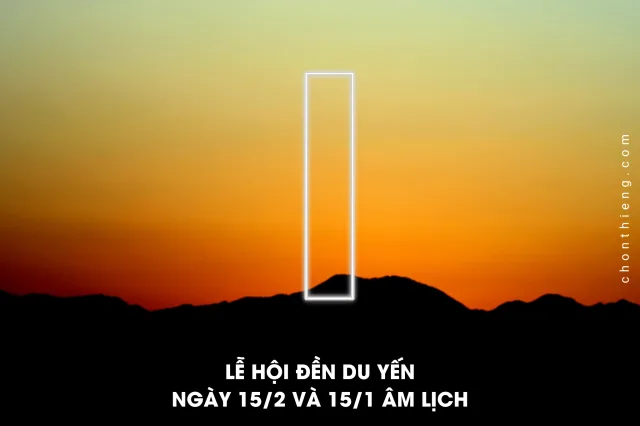
Lễ hội đền Du Yến trong một năm có 03 kỳ tiệc lệ chính:
Ngày 10 tháng Giêng – ngày mất của thần;
Ngày 15 tháng Giêng – ngày hội quân;
Ngày 15 tháng Hai – ngày sinh thần.
Trong đó ngày 15 tháng Giêng là ngày đại tiệc.
Địa điểm
Đền Du Yến hay còn có tên gọi khác là Đền Mẫu hiện đền thuộc khu Bổng Châu Thượng, nay thuộc khu 2, xã Chí Tiên, huyện Thanh Ba, tỉnh Phú Thọ.
Lịch sử và di vật
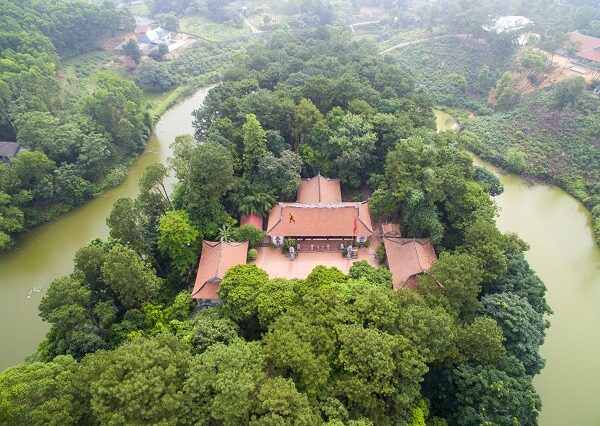
Đền Du Yến (xã Chí Tiên, huyện Thanh Ba) tọa lạc trên vùng đất địa linh, lưng tựa đồi cao cây cối xanh tốt, phía trước là hồ nước trong xanh, hướng ra sông Thao – con sông bồi đắp phù sa quanh năm. Con đê chạy dọc chân đền cũng chính là tuyến tỉnh lộ, giữ vai trò huyết mạch giao thông của địa phương.
Năm 1993, đền Du Yến được xếp hạng Di tích lịch sử cấp quốc gia. Đến năm 2003, di tích được trùng tu với quy mô gồm tòa tiền tế 5 gian và hậu cung 3 gian như hiện nay. Đền còn lưu giữ nhiều hiện vật quý như ngai thờ, kiệu bát cống, đồ chấp kích, bát bửu, bản thẻ đồng khắc chữ Nôm hai mặt; các pho tượng đều được tạc bằng gỗ. Đặc biệt, bên cạnh các sắc phong từ các triều Đinh, Lý, Trần, Lê, đền Du Yến còn bảo tồn được gia phả ghi chép quá trình gần hai nghìn năm phát triển của một dòng họ trên đất Thanh Ba – một tư liệu hiếm có.
Đền Du Yến, xã Chí Tiên thờ nữ tướng Nguyễn Thị Hạnh – trưởng lĩnh tiền quân của Hai Bà Trưng.. Theo Ngọc phả, tại trang Bổng Châu xưa (nay là thôn Tiên Châu), có gia đình họ Nguyễn nổi tiếng hiền đức, sinh được người con gái tên Hạnh Nương. Bà thông minh, xinh đẹp, tinh thông văn võ, tính tình đoan trang, không màng hôn sự, sớm dựng cờ tụ nghĩa, luyện tập binh mã, tiếng tăm vang xa. Vào những năm 40 sau Công nguyên, khi giặc Đông Hán do Tô Định cầm đầu sang xâm lược, hưởng ứng cuộc khởi nghĩa của Hai Bà Trưng, Hạnh Nương đã tuyển chọn 92 nghĩa binh theo về Mê Linh.
Nhận thấy bà là người tài sắc vẹn toàn, chỉ huy quân sĩ lập nhiều chiến công, Hai Bà Trưng phong cho bà tước hiệu Ngọc Loan công chúa, giữ chức Trưởng lĩnh Tiền quân. Sau khi khởi nghĩa thắng lợi, bà trở về quê, mở yến tiệc khao quân, ban thưởng cho dân làng tại một mỏm đất ven sông Thao. Nhân dân sau đó lập đền thờ, gọi là hành cung Du Yến, nay chính là đền Du Yến xã Chí Tiên. Hằng năm, vào rằm tháng Giêng, dân làng mở hội tế lễ để tưởng nhớ công lao của bà và cầu cho mưa thuận gió hòa, cuộc sống ấm no.
Lúc mới khởi dựng, đền chỉ là một ngôi miếu thờ nhỏ. Sau khi bà Nguyễn Thị Hạnh mất, bà được các triều đại phong kiến Việt Nam phong sắc. Có sắc truy phong bà là “Truy Đẳng Nữ Thần”; đời vua Lê Hiển Tông phong cho bà là ” Quốc Mẫu Thanh Kỳ, Nhã Ái Đại vương”, vua Lê Chiêu Thống có sắc phong bà là “Thanh Kỳ Nhã Ái, Ôn Hầu Khoan Hồng Đại vương”, các triều đình nhà Nguyễn phong cho bà là “Nhàn Uyển Dực Bảo Trung Hưng Ngọc Loan Phúc Trầu”, đồng thời xuống chiếu cho dân làng Tiên Châu, xã Chí Tiên phải phụng thờ hương khói, việc thờ cúng được ghi vào lễ tiết Quốc Khánh và chép vào sử sách thờ chung của cả nước.
Lễ hội đền Du Yến là hoạt động văn hóa tiêu biểu của huyện Thanh Ba, thu hút đông đảo du khách mỗi năm. Phần lễ được tổ chức trang nghiêm, lễ vật dâng Mẫu chủ yếu là bánh chay và hoa quả, chia theo các giáp để tiến tế. Trong nghi lễ có các tiết mục múa tiên, múa sinh tiền mang tính biểu trưng.
Theo truyền thuyết, ngày Mẫu ra đời có tiên nữ giáng trần múa hát, vì vậy trong lễ tế bắt buộc phải có đội múa tiên gồm các thiếu nữ trẻ, biểu diễn những điệu múa mềm mại, thanh thoát. Nghi thức này hiện đã được phục dựng, điều chỉnh phù hợp với không gian lễ hội ngày nay. Phần hội tiếp nối với nghi thức rước kiệu trang trọng, gồm đội cờ, phường bát âm, đội bát biểu, múa sư tử, múa tiên và kiệu thờ, tạo nên không khí linh thiêng và giàu bản sắc truyền thống.
Lễ hội Đền Du Yến
Hằng năm, tại đền Du Yến diễn ra ba kỳ tiệc lệ chính. Kỳ tiệc lệ thứ nhất là Lễ hội đền Du Yến, tổ chức vào ngày 15 tháng Giêng âm lịch – ngày đại lễ tưởng niệm và tri ân Thánh Mẫu Hạnh Nương. Theo truyền thuyết, đây là ngày xưa kia nữ tướng mở hội quân, khao thưởng binh sĩ trước khi theo Hai Bà Trưng khởi nghĩa. Kỳ tiệc lệ thứ hai được tổ chức vào ngày 15 tháng Hai âm lịch, là ngày sinh của Thánh Mẫu. Kỳ tiệc lệ thứ ba diễn ra vào ngày 10 tháng Giêng âm lịch, là ngày hóa của Mẫu. Trong ba kỳ tiệc lệ, ngày 15 tháng Giêng giữ vai trò quan trọng nhất và là trung tâm của các hoạt động lễ hội.
Lễ hội đền Du Yến thường diễn ra trong ba ngày, từ ngày 13 đến ngày 15 tháng Giêng âm lịch, gồm hai phần chính là phần lễ và phần hội.
Phần lễ được tổ chức trang nghiêm, mang đậm yếu tố tâm linh và truyền thống, bao gồm các nghi thức tiêu biểu như: lễ rước nước từ sông Thao về đền để thanh tẩy không gian thờ tự; lễ mộc dục nhằm tắm rửa, làm sạch tượng thờ Thánh Mẫu; lễ cáo yết báo với thần linh và tổ tiên về việc mở hội; lễ rước kiệu Thánh Mẫu quanh khu vực làng xã trong không khí linh thiêng; cùng các nghi lễ dâng hương và tế thần được cử hành theo đúng nghi thức cổ truyền.
Phần hội diễn ra sau các nghi lễ, tạo nên không khí vui tươi, sôi nổi, phản ánh sinh hoạt văn hóa truyền thống của cư dân địa phương. Nhiều trò chơi và hoạt động dân gian được tổ chức, tiêu biểu là thi giã bánh giầy – một hoạt động mang ý nghĩa cầu mùa, tưởng nhớ nguồn gốc nông nghiệp và tinh thần đoàn kết cộng đồng. Các chương trình biểu diễn văn nghệ quần chúng với những làn điệu dân ca, hát múa truyền thống được dàn dựng công phu, góp phần tôn vinh giá trị văn hóa bản địa.
Bên cạnh đó, lễ hội còn có các hoạt động thể thao và thi tài như chọi gà, thi đấu bóng chuyền, cờ tướng, thu hút đông đảo người dân và du khách tham gia cổ vũ. Xen kẽ là nhiều trò chơi dân gian quen thuộc như kéo co, đánh đu, đi cà kheo…, tạo nên không gian lễ hội náo nhiệt, gắn kết các thế hệ trong cộng đồng.
Phần hội không chỉ mang tính giải trí mà còn là dịp để nhân dân địa phương giao lưu, thắt chặt tình làng nghĩa xóm, đồng thời góp phần bảo tồn và phát huy các giá trị văn hóa truyền thống gắn liền với di tích đền Du Yến.
Ý nghĩa
Lễ hội đền Du Yến là dịp để nhân dân địa phương bày tỏ lòng tri ân, tưởng nhớ công lao của Thánh Mẫu Hạnh Nương – nữ tướng tài ba đã góp sức cùng Hai Bà Trưng trong buổi đầu chống ách đô hộ phương Bắc. Thông qua các nghi lễ truyền thống, lễ hội thể hiện đạo lý “uống nước nhớ nguồn”, tôn vinh tinh thần yêu nước, ý chí quật cường và vai trò của người phụ nữ trong lịch sử dân tộc.
Bên cạnh ý nghĩa lịch sử, lễ hội còn mang đậm giá trị tâm linh và tín ngưỡng dân gian. Các nghi thức tế lễ, dâng hương thể hiện ước nguyện của cộng đồng về mưa thuận gió hòa, mùa màng bội thu, cuộc sống bình an, no đủ. Đây cũng là dịp để con cháu trong vùng tưởng nhớ tổ tiên, gìn giữ sự gắn kết giữa con người với thần linh và thiên nhiên.
Về phương diện văn hóa – xã hội, lễ hội đền Du Yến là môi trường bảo tồn và phát huy các giá trị văn hóa truyền thống của địa phương thông qua hệ thống nghi lễ, trò chơi dân gian, sinh hoạt văn nghệ cộng đồng. Lễ hội góp phần tăng cường tinh thần đoàn kết, gắn bó làng xã, tạo không gian giao lưu giữa các thế hệ, đồng thời giáo dục truyền thống lịch sử, lòng tự hào dân tộc cho thế hệ trẻ.
Tài liệu tham khảo
- Đặng Đình Thuận, 2014, Lễ hội truyền thống vùng đất tổ, Nxb Văn hóa Thông tin
- Phạm Bá Khiêm, 2018, Về miền Lễ Hội cội nguồn dân tộc Việt Nam, Nxb Hội nhà văn.
- Thanh Thủy, 2023, Lễ hội đền Du Yến, xã Chí Tiên, huyện Thanh Ba, tỉnh Phú Thọ, Sở Văn hóa Thể thao và Du lịch tỉnh Phú Thọ, truy cập tại: http://svhttdl.phutho.gov.vn/tin/le-hoi-den-du-yen-xa-chi-tien-huyen-thanh-ba-tinh-phu-tho_2567.html
Ngôn ngữ khác
Tiếng Anh
Du Yen Temple Festival
Time
Each year, the Du Yen Temple Festival includes three main ceremonial occasions:
- The 10th day of the First Lunar Month – the death anniversary of the deity;
- The 15th day of the First Lunar Month – the day of troop assembly;
- The 15th day of the Second Lunar Month – the birth anniversary of the deity.
Among these, the 15th day of the First Lunar Month is the principal festival day.
Location
Du Yen Temple, also known as Mau Temple, is located in the former Bong Chau Thuong area, now Zone 2, Chi Tien Commune, Thanh Ba District, Phu Tho Province.
History and Relics
Du Yen Temple (Chi Tien Commune, Thanh Ba District) is situated on a site considered spiritually auspicious. The temple backs onto a high, tree-covered hill and faces a clear lake, opening toward the Thao River, which deposits fertile alluvium year-round. The dyke running along the foot of the temple also serves as a provincial road, functioning as a vital local transportation artery.
In 1993, Du Yen Temple was recognized as a National Historical Monument. In 2003, the site was restored to its current scale, consisting of a five-bay front hall and a three-bay main sanctuary. The temple preserves many valuable artifacts, including a worship throne, an eight-carrying palanquin, ceremonial weapons, sets of ritual objects, and a bronze tablet engraved with Nom characters on both sides; all statues are carved from wood. Notably, in addition to imperial edicts issued during the Dinh, Ly, Tran, and Le dynasties, Du Yen Temple also preserves a genealogy documenting nearly two thousand years of development of a single lineage in Thanh Ba—an exceptionally rare historical source.
Du Yen Temple in Chi Tien Commune worships the female general Nguyen Thi Hanh, commander of the vanguard forces under the Trung Sisters. According to genealogical records, in the former Bong Chau area (now Tien Chau Hamlet), there lived a virtuous Nguyen family who had a daughter named Hanh Nuong. She was intelligent, beautiful, well-versed in both civil and martial arts, modest in character, and indifferent to marriage. At an early age, she raised a banner of righteousness, trained troops, and gained widespread renown. In the 40s CE, when the Eastern Han invaders led by To Dinh occupied the region, responding to the uprising of the Trung Sisters, Hanh Nuong selected 92 volunteers to follow her to Me Linh.
Recognizing her outstanding talent and achievements in commanding troops, the Trung Sisters conferred upon her the title Ngoc Loan Princess and appointed her Commander of the Vanguard. After the successful uprising, she returned to her homeland, held a banquet to reward her soldiers, and distributed gifts to villagers at a riverside promontory along the Thao River. The people later built a temple there, known as the Du Yen Royal Pavilion, which is today’s Du Yen Temple in Chi Tien Commune. Every year on the full moon of the First Lunar Month, villagers hold ceremonies to commemorate her merits and pray for favorable weather and a prosperous life.
Initially, the temple was only a small shrine. After Nguyen Thi Hanh passed away, she was posthumously honored by successive Vietnamese feudal dynasties. One edict conferred upon her the title “Truy Dang Nu Than.” During the reign of King Le Hien Tong, she was titled “Quoc Mau Thanh Ky, Nha Ai Dai Vuong”; King Le Chieu Thong granted her the title “Thanh Ky Nha Ai, On Hau Khoan Hong Dai Vuong.” Under the Nguyen dynasty, she was honored as “Nhan Uyen Duc Bao Trung Hung Ngoc Loan Phuc Trau,” and an imperial decree ordered the people of Tien Chau Hamlet, Chi Tien Commune, to maintain incense offerings to her. Her worship was incorporated into national ceremonial regulations and recorded in state ritual chronicles.
The Du Yen Temple Festival is a major cultural event of Thanh Ba District, attracting large numbers of visitors each year. The ritual section is conducted solemnly, with offerings to the Holy Mother consisting mainly of vegetarian cakes and fruits, presented by different village groups in turn. The ceremonies include symbolic performances such as fairy dances and coin-dance rituals.
According to legend, on the day the Holy Mother was born, celestial maidens descended to earth to sing and dance; therefore, the ritual must include a fairy dance troupe composed of young women performing graceful and flowing movements. This ritual has now been restored and adapted to suit the contemporary festival setting. The festive section continues with a solemn palanquin procession, including flag teams, bat am musical ensembles, ritual standard bearers, lion dances, fairy dances, and the sacred palanquin, creating a sacred and richly traditional atmosphere.
Du Yen Temple Festival
Each year, Du Yen Temple hosts three main ceremonial occasions. The first is the Du Yen Temple Festival held on the 15th day of the First Lunar Month—the grand ceremony commemorating and honoring Holy Mother Hanh Nuong. According to legend, this was the day when the female general once assembled her troops and rewarded them before joining the uprising of the Trung Sisters. The second occasion takes place on the 15th day of the Second Lunar Month, marking the birth anniversary of the Holy Mother. The third occurs on the 10th day of the First Lunar Month, commemorating her passing. Among these three occasions, the 15th day of the First Lunar Month is the most important and serves as the focal point of all festival activities.
The Du Yen Temple Festival usually lasts three days, from the 13th to the 15th day of the First Lunar Month, and consists of two main parts: the ritual section and the festive section.
The ritual section is conducted solemnly, imbued with spiritual and traditional elements, and includes key ceremonies such as: fetching sacred water from the Thao River to purify the worship space; the bathing ritual to cleanse the statue of the Holy Mother; the announcement ceremony informing deities and ancestors of the festival’s opening; the procession of the Holy Mother’s palanquin around the village area in a sacred atmosphere; and incense offering and sacrificial rites conducted strictly according to traditional protocols.
The festive section follows the rituals, creating a lively and joyful atmosphere that reflects the traditional cultural life of local residents. Many folk games and activities are organized, notably the pounding of banh giay, an activity symbolizing prayers for good harvests, remembrance of agricultural origins, and community solidarity. Community art performances featuring folk songs and traditional dances are carefully staged, contributing to the celebration of local cultural values.
In addition, the festival includes sports and competitions such as cockfighting, volleyball matches, and Chinese chess, attracting large numbers of residents and visitors. Interwoven are familiar folk games such as tug-of-war, swinging, and stilt walking, creating a vibrant festival space that connects different generations within the community.
The festive section is not only entertaining but also an opportunity for local people to socialize, strengthen neighborhood bonds, and contribute to the preservation and promotion of traditional cultural values associated with Du Yen Temple.
Significance
The Du Yen Temple Festival is an occasion for local people to express gratitude and remembrance for Holy Mother Hanh Nuong, a talented female general who contributed to the early resistance against northern domination alongside the Trung Sisters. Through traditional rituals, the festival embodies the moral principle of “remembering the source,” honoring patriotism, indomitable spirit, and the role of women in national history.
Beyond its historical significance, the festival also holds strong spiritual and folk-belief values. Rituals of sacrifice and incense offering reflect the community’s wishes for favorable weather, abundant harvests, peace, and prosperity. It is also a time for descendants in the region to honor their ancestors, maintaining the bond between humans, deities, and nature.
From a cultural and social perspective, the Du Yen Temple Festival serves as a setting for preserving and promoting local traditional cultural values through rituals, folk games, and community artistic activities. The festival strengthens solidarity and village cohesion, creates spaces for intergenerational interaction, and educates younger generations about history and national pride.
References
- Đặng Đình Thuận, 2014, Lễ hội truyền thống vùng đất tổ, Nxb Văn hóa Thông tin
- Phạm Bá Khiêm, 2018, Về miền Lễ Hội cội nguồn dân tộc Việt Nam, Nxb Hội nhà văn.
- Thanh Thủy, 2023, Lễ hội đền Du Yến, xã Chí Tiên, huyện Thanh Ba, tỉnh Phú Thọ, Sở Văn hóa Thể thao và Du lịch tỉnh Phú Thọ, truy cập tại: http://svhttdl.phutho.gov.vn/tin/le-hoi-den-du-yen-xa-chi-tien-huyen-thanh-ba-tinh-phu-tho_2567.html
Tiếng Pháp
Fête du temple Du Yen
Période
Chaque année, la fête du temple Du Yen comprend trois grandes cérémonies rituelles :
- le 10e jour du premier mois lunaire : date du décès de la divinité ;
- le 15e jour du premier mois lunaire : jour de la revue des troupes ;
- le 15e jour du deuxième mois lunaire : anniversaire de naissance de la divinité.
Parmi ces dates, le 15e jour du premier mois lunaire constitue la célébration principale.
Lieu
Le temple Du Yen, également appelé temple de la Mère (Den Mau), est situé dans l’ancien hameau de Bong Chau Thuong, aujourd’hui quartier 2 de la commune de Chi Tien, district de Thanh Ba, province de Phu Tho.
Histoire et vestiges
Le temple Du Yen (commune de Chi Tien, district de Thanh Ba) est implanté sur un site considéré comme propice et sacré : adossé à une colline verdoyante, il fait face à un lac aux eaux claires et s’ouvre sur la riviere Thao, cours d’eau riche en alluvions. La digue longeant le pied du temple correspond également à une route provinciale, jouant un rôle essentiel dans les échanges locaux.
En 1993, le temple Du Yen a été classé monument historique national. En 2003, le site a fait l’objet d’une restauration d’envergure, comprenant un bâtiment de culte antérieur de cinq travées et un sanctuaire postérieur de trois travées, tels qu’ils se présentent aujourd’hui. Le temple conserve de nombreux objets précieux : trône cultuel, palanquin à huit porteurs, armes d’apparat, ensembles de symboles rituels, ainsi qu’une tablette en bronze gravée de caractères nom sur ses deux faces ; toutes les statues sont sculptées en bois. En particulier, outre les édits royaux émis sous les dynasties Dinh, Ly, Tran, Le, le temple Du Yen préserve également une généalogie retraçant près de deux mille ans d’histoire d’une lignée implantée à Thanh Ba, un document patrimonial d’une grande rareté.
Le temple Du Yen, commune de Chi Tien, est dédié à la générale Nguyen Thi Hanh, commandante en chef de l’avant-garde de l’armée des Hai Ba Trung. Selon le registre hagiographique, dans l’ancien hameau de Bong Chau (aujourd’hui hameau de Tien Chau), vivait une famille Nguyen réputée pour sa vertu, qui donna naissance à une fille nommée Hanh Nuong. Intelligente, belle, versée aussi bien dans les lettres que dans les arts martiaux, d’un caractère droit et réservé, elle refusa le mariage, leva très tôt l’étendard de la justice et entraîna des troupes, acquérant une grande renommée. Vers les années 40 de notre ère, lorsque les envahisseurs Han orientaux dirigés par To Dinh occupèrent le territoire, elle répondit à l’appel du soulèvement des Hai Ba Trung et recruta 92 volontaires pour rejoindre Me Linh.
Reconnaissant son talent et ses exploits militaires, les Hai Ba Trung lui conférèrent le titre de princesse Ngoc Loan et la nommèrent commandante de l’avant-garde. Après la victoire de l’insurrection, elle retourna dans sa région natale, offrit un grand banquet pour récompenser les soldats et distribua des présents aux villageois sur un promontoire au bord de la riviere Thao. La population érigea ensuite un lieu de culte, appelé pavillon royal de Du Yen, qui correspond à l’actuel temple Du Yen de la commune de Chi Tien. Chaque année, à la pleine lune du premier mois lunaire, les habitants organisent une fête rituelle pour commémorer ses mérites et prier pour des pluies favorables, des vents cléments et une vie prospère.
À l’origine, le temple n’était qu’un petit sanctuaire. Après le décès de Nguyen Thi Hanh, elle fut honorée par des édits successifs des dynasties féodales vietnamiennes. Un édit la proclama « Divinite feminine posthume de rang supérieur » ; sous le règne de Le Hien Tong, elle reçut le titre de « Quoc Mau Thanh Ky, Nha Ai Dai Vuong » ; sous Le Chieu Thong, celui de « Thanh Ky Nha Ai, On Hau Khoan Hong Dai Vuong » ; et sous la dynastie Nguyen, elle fut honorée comme « Nhan Uyen Duc Bao Trung Hung Ngoc Loan Phuc Trau ». Les souverains ordonnèrent également aux habitants du hameau de Tien Chau, commune de Chi Tien, d’assurer le culte perpétuel, lequel fut inscrit dans les rites nationaux et consigné dans les annales officielles.
La fête du temple Du Yen constitue aujourd’hui une activité culturelle majeure du district de Thanh Ba, attirant chaque année un grand nombre de visiteurs. La partie rituelle se déroule avec solennité ; les offrandes présentées à la Mère sont principalement composées de gateaux de riz gluant et de fruits, réparties par groupes lignagers pour les cérémonies. Les rituels comprennent notamment des danses célestes et des danses au sinh tien, à forte valeur symbolique.
Selon la légende, le jour de la naissance de la Mère, des fées descendirent sur terre pour danser et chanter ; c’est pourquoi la cérémonie exige la présence d’une troupe de danse céleste composée de jeunes filles, exécutant des mouvements gracieux et aériens. Ce rite a aujourd’hui été restauré et adapté aux conditions contemporaines. La partie festive se poursuit par une procession solennelle de palanquins, avec bannières, musique traditionnelle, emblèmes rituels, danses du lion, danses célestes et palanquin cultuel, créant une atmosphère à la fois sacrée et riche en identité traditionnelle.
La fête du temple Du Yen
Chaque année, trois grandes cérémonies rituelles ont lieu au temple Du Yen. La première, la fête principale du temple, se tient le 15e jour du premier mois lunaire, grande célébration commémorative dédiée à la Sainte Mère Hanh Nuong. Selon la tradition, il s’agit du jour où la générale ouvrit autrefois un banquet militaire pour récompenser ses troupes avant de rejoindre l’insurrection des Hai Ba Trung. La deuxième cérémonie a lieu le 15e jour du deuxième mois lunaire, correspondant à l’anniversaire de naissance de la Sainte Mère. La troisième se déroule le 10e jour du premier mois lunaire, date de son décès. Parmi ces trois célébrations, celle du 15e jour du premier mois lunaire occupe une place centrale et constitue le cœur des activités festives.
La fête se déroule généralement sur trois jours, du 13 au 15 du premier mois lunaire, et comprend deux parties principales : la partie rituelle et la partie festive.
La partie rituelle, empreinte de spiritualité et de tradition, comprend des cérémonies telles que : le rituel de puisage de l’eau de la riviere Thao pour purifier l’espace cultuel ; la cérémonie du bain rituel visant à nettoyer la statue de la Sainte Mère ; le rite d’annonce solennelle aux divinités et aux ancêtres de l’ouverture de la fête ; la procession du palanquin de la Sainte Mère à travers le village dans une atmosphère sacrée ; ainsi que les cérémonies d’offrandes d’encens et de sacrifices exécutées selon les rites anciens.
La partie festive, qui suit les rites, crée une ambiance joyeuse et animée, reflétant la vie culturelle traditionnelle de la communauté locale. De nombreux jeux et activités populaires sont organisés, parmi lesquels le concours de pilage de gateaux de riz gluant, porteur de significations agraires et symbolisant l’esprit de solidarité communautaire. Des spectacles artistiques amateurs, mettant en scène des chants et danses traditionnels, sont soigneusement préparés afin de valoriser la culture locale.
Par ailleurs, la fête comprend également des compétitions sportives et des épreuves telles que les combats de coqs, les tournois de volley-ball et les parties d’échecs chinois, attirant un large public. S’y ajoutent divers jeux traditionnels comme le tir à la corde, la balançoire ou la marche sur échasses, contribuant à créer un espace festif animé et intergénérationnel.
La partie festive ne se limite pas au divertissement : elle constitue aussi une occasion pour les habitants de renforcer les liens communautaires, de favoriser les échanges sociaux et de préserver les valeurs culturelles traditionnelles associées au temple Du Yen.
Signification
La fête du temple Du Yen est l’occasion pour la population locale d’exprimer sa gratitude et de commémorer les mérites de la Sainte Mère Hanh Nuong, brillante générale ayant contribué, aux côtés des Hai Ba Trung, aux premières luttes contre la domination étrangère venue du Nord. À travers les rites traditionnels, la fête illustre la morale du « souvenir de la source », rend hommage à l’esprit patriotique, à la volonté indomptable et au rôle des femmes dans l’histoire nationale.
Au-delà de sa dimension historique, la fête revêt une forte valeur spirituelle et relève des croyances populaires. Les cérémonies sacrificielles et les offrandes d’encens traduisent les aspirations de la communauté à des pluies favorables, des récoltes abondantes et une vie paisible et prospère. Elles constituent également un moment de recueillement pour honorer les ancêtres et maintenir le lien entre les êtres humains, le monde spirituel et la nature.
Sur le plan culturel et social, la fête du temple Du Yen contribue à la préservation et à la transmission des valeurs culturelles traditionnelles locales à travers les rites, les jeux populaires et les activités artistiques communautaires. Elle renforce la cohésion villageoise, favorise les échanges entre générations et joue un rôle éducatif important en transmettant l’histoire et la fierté nationale aux jeunes générations.
Références
- Đặng Đình Thuận, 2014, Lễ hội truyền thống vùng đất tổ, Nxb Văn hóa Thông tin
- Phạm Bá Khiêm, 2018, Về miền Lễ Hội cội nguồn dân tộc Việt Nam, Nxb Hội nhà văn.
- Thanh Thủy, 2023, Lễ hội đền Du Yến, xã Chí Tiên, huyện Thanh Ba, tỉnh Phú Thọ, Sở Văn hóa Thể thao và Du lịch tỉnh Phú Thọ, truy cập tại: http://svhttdl.phutho.gov.vn/tin/le-hoi-den-du-yen-xa-chi-tien-huyen-thanh-ba-tinh-phu-tho_2567.html
Tiếng Trung
都燕庙节(Le hoi Den Du Yen)
时间
都燕庙一年共有三次主要例祭:
- 农历正月初十:神诞忌日;
- 农历正月十五:会军日;
- 农历二月十五:神诞日。
其中,农历正月十五为大祭日。
地点
都燕庙,又称母庙,原属奉洲上区(Bong Chau Thuong),今属富寿省(Phu Tho)清巴县(Thanh Ba)志仙乡(Chi Tien)第二区。
历史与遗存
都燕庙(志仙乡,清巴县)坐落于一处风水宝地:背倚林木葱茏的高丘,前临碧波澄澈的湖水,朝向终年淤积沃土的沱江(Song Thao)。庙前沿堤而行的道路亦为省道,构成当地重要的交通动脉。
1993年,都燕庙被列为国家级历史遗迹。2003年,遗址按现规模修缮,形成五间前祭殿与三间后宫的格局。庙内保存有多件珍贵文物,如:神座、八贡轿、执戟器、八宝器具、双面刻有喃字(Nom)的铜牌等;各尊神像均为木雕。尤为珍贵的是,庙中还保存了一部家谱,系统记录了清巴地区某一氏族近两千年的发展历程,属罕见史料。
都燕庙供奉的是阮氏幸(Nguyen Thi Hanh)女将——征侧、征贰二位女王(Hai Ba Trung)麾下的前军统领。
据《玉谱》记载,古奉洲(今仙洲村)阮氏一族素以德行闻名,生有一女,名幸娘(Hanh Nuong)。其人聪慧秀丽,文武兼通,性情端庄,不慕婚嫁,早年举义旗、练兵马,声名远播。公元40年前后,东汉太守苏定(To Dinh)率兵侵略,幸娘响应二征女王起义,精选92名义兵奔赴麋泠(Me Linh)。
因其才貌出众、统军有方、屡建战功,二征女王封其为玉鸾公主(Ngoc Loan Cong Chua),授前军统领之职。起义胜利后,她返回故里,于沱江畔一处高地设宴犒军、赐福乡民。百姓遂建庙奉祀,称为都燕行宫,即今之都燕庙。每年正月十五,乡民举行祭会,以纪念其功绩,并祈求风调雨顺、民生富足。
初建之时,都燕庙仅为一座小祠。阮氏幸去世后,历代王朝相继加封:
- 追封为“追等女神”;
- 黎显宗(Le Hien Tong)敕封为“国母清祺雅爱大王”;
- 黎昭统(Le Chieu Thong)加封“清祺雅爱温侯宽洪大王”;
- 阮朝封号为 “闲苑翼保中兴玉鸾福绸”,并诏令仙洲村世代奉祀,将其祭典列入国家节序,载入全国通祀史册。
都燕庙节
都燕庙节是清巴县的重要文化活动,每年吸引众多游客。
祭礼庄严肃穆,供奉母神的祭品以清饼与果品为主,按各甲轮流进祭。仪式中配有仙舞与生钱舞等象征性舞蹈。
传说母神诞生之日,有仙女下凡歌舞,因此祭礼中必须设仙舞队,由年轻少女表演柔美飘逸的舞姿。该仪式现已复原,并根据当代节会空间作出适度调整。
会节随后展开,举行隆重的神轿巡游,队伍包括旗队、八音班、八表仪仗、狮舞、仙舞与神轿,营造出神圣而富有传统特色的节日氛围。
节会流程(正月大祭)
每年都燕庙举行三次主要例祭:
- 正月十五:都燕庙节暨母神幸娘大祭日(相传为当年女将会军、犒赏兵士之日);
- 二月十五:母神诞辰;
- 正月初十:母神化日。
其中,正月十五为节会核心。
节会一般持续三天(正月十三至十五),分为礼与会两部分。
礼仪包括:
- 自沱江取水入庙的迎水礼;
- 为母神像沐浴净身的沐浴礼;
- 告谒礼;
- 神轿巡游;
- 上香与祭神等传统仪式。
会节气氛欢快热烈,重点活动有:
- 捣糯饼比赛(寓意祈丰收、念农本);
- 群众文艺演出与传统歌舞;
- 斗鸡、排球、象棋等竞技项目;
- 拔河、荡秋千、踩高跷等民间游戏。
这些活动增强了社区凝聚力,也丰富了节会的文化内涵。
文化意义
都燕庙节是当地民众缅怀、感恩幸娘母神(Hanh Nuong)的重要契机。通过一系列传统仪式,节会彰显“饮水思源”的伦理精神,歌颂其协助二征女王抗击北方统治的爱国功绩,突出女性在民族历史中的重要地位。
同时,节会蕴含浓厚的民间信仰与精神寄托。祭礼与焚香表达了对风调雨顺、五谷丰登、生活安康的共同祈愿,也维系了人与神灵、自然之间的和谐关系。
在文化—社会层面,都燕庙节通过礼仪体系、民间游戏与社区文艺活动,成为传承地方传统文化的重要平台,强化乡里纽带,促进代际交流,并对青年一代起到历史教育与民族认同的积极作用。
参考资料
- Đặng Đình Thuận, 2014, Lễ hội truyền thống vùng đất tổ, Nxb Văn hóa Thông tin
- Phạm Bá Khiêm, 2018, Về miền Lễ Hội cội nguồn dân tộc Việt Nam, Nxb Hội nhà văn.
- Thanh Thủy, 2023, Lễ hội đền Du Yến, xã Chí Tiên, huyện Thanh Ba, tỉnh Phú Thọ, Sở Văn hóa Thể thao và Du lịch tỉnh Phú Thọ, truy cập tại: http://svhttdl.phutho.gov.vn/tin/le-hoi-den-du-yen-xa-chi-tien-huyen-thanh-ba-tinh-phu-tho_2567.html