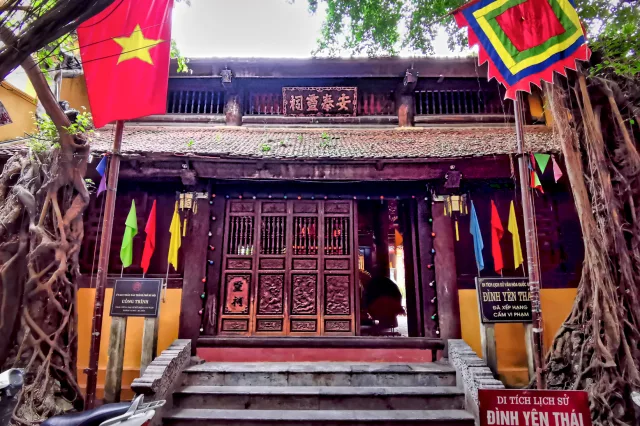


Tên gọi và vị trí địa lý
Đình Yên Thái, còn được gọi là Quán Linh Từ, là một ngôi đình cổ thuộc thôn An Thái, tổng Thuận Mỹ, huyện Thọ Xương, phủ Hoài Đức xưa. Hiện nay, đình Yên Thái tọa lạc tại số 8 ngõ Tạm Thương, phường Hoàn Kiếm, thành phố Hà Nội.
Lịch sử và nhân vật
Thần tích đình Yên Thái chép lại câu chuyện về vua Lý Thánh Tông đã 40 tuổi nhưng vẫn chưa có con trai nối dõi. Lo lắng về việc kế tục vương triều, nhà vua nhiều lần đến các chùa chiền để cầu tự, mong có người kế nghiệp. Trong một lần nhà vua thân hành đi viếng chùa Dâu, khi xa giá trở về, dân chúng các làng ven đường đều tổ chức nghênh đón. Khi đoàn xa giá đi qua vùng Thổ Lỗi, người dân trong vùng đều nô nức ra xem và nghênh đón nhà vua. Tuy nhiên, giữa không khí đông vui của hội làng, có một cô gái thôn quê vẫn điềm nhiên hái dâu, không chạy ra xem đoàn rước. Cô gái ấy được thần tích xác định là Yến Nương, người sau này trở thành Ỷ Lan Hoàng thái hậu. Sự bình thản và khác thường của cô gái khiến Lý Thánh Tông chú ý. Nhà vua cho người gọi cô đến trước kiệu rồng để hỏi rõ nguyên do. Đứng trước nhà vua, Yến Nương quỳ xuống và giải thích rằng mình vốn là con nhà nghèo, hằng ngày phải làm lụng vất vả, sớm hôm chăm chỉ để phụng dưỡng cha mẹ. Vì hoàn cảnh gia đình, nàng không thể bỏ công việc để theo mọi người đi xem đoàn xa giá. Câu trả lời của cô gái khiến nhà vua đặc biệt chú ý. Dù xuất thân bình dân, Yến Nương lại có cử chỉ đoan trang, lời nói nhã nhặn, cách ứng đối rõ ràng và giữ gìn lễ nghĩa, khác hẳn vẻ ngoài mộc mạc của một cô gái thôn quê. Lý Thánh Tông nhận thấy ở Yến Nương không chỉ có vẻ đẹp mà còn có sự thông minh, điềm đạm và phẩm chất khác thường. Nhà vua vì thế quyết định cho nàng theo Long giá về kinh đô. Sau khi vào cung, Lý Thánh Tông cho một nữ học sĩ dạy dỗ, giáo dưỡng Yến Nương. Nhà vua đặt cho cung của nàng tên là Ỷ Lan, gắn với hình ảnh nàng từng tựa vào gốc lan khi gặp nhà vua. Từ đó, nàng được gọi là Ỷ Lan. Đến năm 1066, Ỷ Lan sinh một hoàng tử, được đặt tên là Càn Đức. Càn Đức sau này lên ngôi, trở thành vua Lý Nhân Tông. Từ một cô gái hái dâu nơi thôn dã, Ỷ Lan trở thành một nhân vật có vị trí đặc biệt trong hoàng gia nhà Lý và về sau giữ vai trò quan trọng trong lịch sử triều Lý.1
Đình Yên Thái được cho là xây dựng trên nền cung Động Thiên – một cung điện do vua Lý Thánh Tông cho dựng để dành cho Nguyên phi Ỷ Lan. Tuy nhiên, hiện chưa có tư liệu xác định chính xác thời điểm đình Yên Thái được khởi dựng.
Căn cứ vào hệ thống 7 đạo sắc phong còn lưu giữ tại đình, trong đó đạo sắc có niên đại sớm nhất mang niên hiệu Cảnh Hưng thứ 14 (1753) và đạo sắc muộn nhất mang niên hiệu Khải Định thứ 9 (1924), có thể nhận định việc thờ phụng tại đình đã được thiết lập từ trước thế kỷ XVIII. Theo truyền thuyết địa phương, tục thờ Ỷ Lan Hoàng thái hậu tại đây đã hình thành từ sau khi bà qua đời.
Theo văn bia Kim Cổ thôn bi kí/金古村碑記, niên hiệu Tự Đức thứ 13 (1860) ở chùa Kim Cổ cho biết rằng: Đồng Thiên quán là một trong tứ quán ở Thăng Long, quán này do Thái hậu Linh Nhân triều Lý xây dựng để thờ Tam Thanh (tức Ngọc Thanh – nơi ở của Nguyễn Thuỷ Thiên tôn, Thượng Thanh – nơi ở của Thái Thượng Đạo quán; Thái Thanh – nơi ở của Thái Thượng Lão quân). Sau thời Lê Trung hưng, quán hư hỏng đổ nát, bèn dùng làm cung thờ Linh Nhân Hoàng thái hậu, hai nách cung thờ phụ các cung phi trong lục cung. Năm Kỷ Dậu (1789), dân dồn quán sang thôn Yên Thái. Cả hai thôn đều được sắc chỉ ban tặng, nhiều lần dân muốn trùng tu nhưng chi phí không đủ. Nay Bố chánh sứ Tuyên Quang là Bùi Thương Hàn làm quan ở đất thôn Kim Cổ, giữ chức Lại bộ Thị lang, đã bỏ ra 100 lạng bạc để tu sửa đình, công việc khởi công vào đầu mùa đông năm Tự Đức Kỉ Mùi (1859) và cuối mùa đông thì hoàn thành. Hai bên tả, hữu của bái đường được bố trí làm nơi tế lễ. Sau đó, các nhà hảo tâm tiếp tục đóng góp tiền của để đúc chuông và hoàn thiện thêm các hạng mục của di tích.2
Đình Yên Thái tiếp tục trải qua nhiều lần tu bổ trong các giai đoạn sau. Theo nội dung bia Báo ơn công đức niên đại 1926 hiện còn tại đình cho biết đình được trùng tu vào năm Tự Đức thứ 10 (1857); đến năm 1926, đình được xây thêm phần ngoại cung (ống muống).3
Đến những năm đầu 2000, nhân dịp kỷ niệm 1.000 năm Thăng Long – Hà Nội, đình đã được thành phố quan tâm đầu tư kinh phí trùng tu các hạng mục: Gian Đại bái, cung thờ Mẫu, đền thờ Thánh, gian Quan Thái Giám, gian thờ Phật; nhà Tổ; miếu thờ Trời Đất.
Kiến trúc cảnh quan
Đình Yên Thái được xây dựng theo kiểu chữ Công (工), có hướng quay về Đông Bắc. Tổng thể kiến trúc gồm các bộ phận chính được bố trí nối tiếp theo trục thần đạo, tạo nên một không gian thờ tự tương đối khép kín và cân đối. Khi bước vào cổng đình, chính giữa là bức hoành phi sơn son thếp vàng đề bốn chữ “An Thái Linh Từ”. Từ sân đình, qua 5 bậc thềm là khu vực Tiền Tế gồm 3 gian, được thiết kế theo kiểu chồng diêm. Tiền Tế có bức hoành phi cổ sơn son thếp vàng với bốn chữ Hán đại tự “Lý Đại Mẫu Nghi”. Tiếp nối Tiền Tế là Ống Muống một gian, được xây dựng vào năm 1926, gồm bốn cột trụ; khoảng không gian để hở ở hai bên tạo thành cầu nối giữa Tiền Tế và Hậu Cung ba gian.
Hậu Cung là không gian thờ tự quan trọng nhất của đình. Chính giữa Hậu Cung đặt tượng thờ Nguyên phi Ỷ Lan, bức tượng này được phục chế năm 2010, từ bức tượng tạc bằng gỗ mít có từ mấy chục năm trước, trước đó chỉ có bài vị. Tượng tạc theo mẫu tượng gốc của bà ở đền Ghênh (Hưng Yên) và tượng (bản sao) của bà ở đền Bà Tấm (xã Gia Lâm). Hai bên được bố trí các ban thờ phụ: bên trái thờ Mẫu, bên phải thờ Phật, tạo nên sự kết hợp giữa tín ngưỡng thờ nhân vật lịch sử, tín ngưỡng Mẫu và Phật giáo trong cùng một không gian.
Không gian sân đình cũng được tổ chức với các hạng mục phụ trợ. Phía tả sân giữa là một dãy hành lang, nơi đặt các ban thờ khác; phía hữu bố trí bia đá. Phía sau đình là các dãy nhà phụ cùng cổng hậu, tạo thành hệ thống không gian hỗ trợ cho hoạt động thờ tự và sinh hoạt tại di tích.
Nhìn tổng thể, kiến trúc đình Yên Thái được tổ chức theo trục Tiền Tế – Ống Muống – Hậu Cung, vừa bảo đảm sự liên kết giữa các không gian, vừa tạo thứ bậc rõ ràng trong bố trí thờ tự. Cách sắp xếp này đồng thời làm nổi bật Hậu Cung – nơi thờ Ỷ Lan là không gian thiêng và quan trọng nhất của toàn bộ di tích.
Hiện vật
- 07 đạo sắc phong, sắc sớm nhất mang niên đại Cảnh Hưng 14 (1753) và muộn nhất là Khải Định 9 (1924).
- Hai tấm bia đá: 1 bia Báo ơn công đức niên đại Bảo Đại năm thứ 1 (1926), 1 bia Thần hậu bi ký niên đại Bảo Đại năm 19 (1944)
Sự kiện và lễ hội
Lễ hội truyền thống tại đình Yên Thái được tổ chức hằng năm theo lệ Xuân thu nhị kỳ, gắn với hai sự kiện quan trọng trong cuộc đời Nguyên phi Hoàng Thái hậu Ỷ Lan. Lễ hội mùa xuân diễn ra từ ngày 15 đến ngày 17 tháng 3 âm lịch, nhằm tưởng niệm ngày sinh của Thái hậu; lễ hội mùa thu được tổ chức từ ngày 23 đến ngày 25 tháng 7 âm lịch, tưởng niệm ngày bà viên tịch. Đây là dịp để cộng đồng địa phương và du khách tưởng nhớ, tri ân công đức của Ỷ Lan, đồng thời duy trì truyền thống thờ phụng và sinh hoạt văn hóa tại di tích.
Hằng năm, vào dịp lễ hội, đình Yên Thái trở thành nơi đón nhân dân và du khách đến dâng hương, tưởng niệm và tri ân Thánh Mẫu Ỷ Lan. Phần lễ gồm lễ rước trang trọng, lễ tế uy nghiêm và phần hội có đủ tích chèo cho người dân và du khách thêm hiểu về lịch sử ngôi đền cổ gắn với cuộc đời Nguyên phi Ỷ Lan.
Xếp hạng
Ngày 16/01/1995, ngôi đình Yên Thái được Bộ Văn hoá và Thông tin xếp hạng Di tích Lịch sử Kiến trúc Nghệ thuật Quốc gia.
Chú thích
- Ths. Phạm Kim Thanh, “Ngôi đình giữa trung tâm thành phố thờ Thánh Mẫu Ỷ Lan”, Bảo tàng Lịch sử Quốc gia Việt Nam, ngày 23/02/2016.
- Kim Cổ thôn bi kí/金古村碑記 – Chongthieng.com
- Báo ơn công đức bi
Tài liệu tham khảo
- Bia Báo ơn công đức bi
- Kim Cổ thôn bi kí/金古村碑記 – Chongthieng.com
- Ths. Phạm Kim Thanh, “Ngôi đình giữa trung tâm thành phố thờ Thánh Mẫu Ỷ Lan”, Bảo tàng Lịch sử Quốc gia Việt Nam, ngày 23/02/2016.
- Lưu Minh Trị (2011), Hà Nội Danh thắng và Di tích, tập 02, Nxb Hà Nội.
- Nguyễn Trọng Văn, “Đình Yên Thái và Vương phi Ỷ Lan”, Báo An ninh Thế giới – Chuyên trang Công an nhân dân, 01/07/2025.
Ngôn ngữ khác
Tiếng Anh (English)
Name and Geographical Location
Yên Thái Communal House, also known as Quán Linh Từ, is an ancient communal house formerly located in An Thái Hamlet, Thuận Mỹ Canton, Thọ Xương District, Hoài Đức Prefecture. Today, Yên Thái Communal House is situated at No. 8 Tạm Thương Alley, Hoàn Kiếm Ward, Hanoi.
History and Historical Figure
The Deity Legend of Yên Thái Communal House recounts the story of Ỷ Lan, beginning at a time when King Lý Thánh Tông had reached the age of forty but still had no son to succeed him. Concerned about the succession of the royal dynasty, the king repeatedly visited Buddhist temples to pray for an heir.
On one occasion, the king personally visited Dâu Pagoda. As the royal procession was returning, people from the villages along the route gathered to welcome him. When the procession passed through the Thổ Lỗi area, local residents eagerly came out to watch and receive the king. Yet amid the lively atmosphere, one country girl calmly continued picking mulberry leaves instead of joining the crowd to watch the royal procession.
The deity legend identifies this girl as Yến Nương, who would later become Empress Dowager Ỷ Lan. Her composure and unusual behavior attracted the attention of King Lý Thánh Tông. The king ordered that she be summoned before the royal palanquin and asked why she had not gone out to see the procession.
Kneeling before the king, Yến Nương explained that she came from a poor family and had to work hard every day, diligently laboring from morning until evening in order to support her parents. Because of her family circumstances, she could not abandon her work merely to follow the others and watch the royal procession.
Her answer particularly impressed the king. Although of humble birth, Yến Nương displayed dignified manners, courteous speech, clear and composed responses, and a strong observance of propriety, qualities that stood in marked contrast to the rustic appearance of an ordinary village girl. Lý Thánh Tông recognized in Yến Nương not only beauty but also intelligence, composure, and exceptional qualities. He therefore decided to have her accompany the royal entourage back to the capital.
After she entered the royal palace, Lý Thánh Tông appointed a female scholar to instruct and educate Yến Nương. The king named her residence Ỷ Lan, in reference to the image of her leaning against an orchid tree when she first encountered the king. From then on, she became known as Ỷ Lan.
In 1066, Ỷ Lan gave birth to a prince named Càn Đức. Càn Đức later ascended the throne as King Lý Nhân Tông. From a mulberry-picking village girl, Ỷ Lan rose to become a figure of exceptional standing within the Lý royal family and subsequently played an important role in the history of the Lý dynasty.1
Yên Thái Communal House is believed to have been built on the site of Động Thiên Palace, a palace constructed by King Lý Thánh Tông for Imperial Consort Ỷ Lan. However, there is currently no documentary evidence establishing the exact date when Yên Thái Communal House was first founded.
Based on the system of seven royal investiture edicts still preserved at the communal house, of which the earliest dates to the 14th year of the Cảnh Hưng era (1753) and the latest to the 9th year of the Khải Định era (1924), it may be inferred that worship at the site had already been established before the eighteenth century. According to local tradition, the worship of Empress Dowager Ỷ Lan here began after her death.
According to the stele inscription Kim Cổ thôn bi kí/金古村碑記 (Stele Inscription of Kim Cổ Village), dated to the 13th year of the Tự Đức era (1860) and preserved at Kim Cổ Pagoda, Đồng Thiên Quán was one of the four quán of Thăng Long. It was built by Empress Dowager Linh Nhân of the Lý dynasty for the worship of the Three Purities (Tam Thanh), namely Ngọc Thanh—the abode of Nguyễn Thuỷ Thiên Tôn; Thượng Thanh—the abode of Thái Thượng Đạo Quán; and Thái Thanh—the abode of Thái Thượng Lão Quân.
After the Later Lê Restoration period, the quán fell into disrepair and ruin. It was consequently converted into a shrine dedicated to Empress Dowager Linh Nhân, while the two side chambers were used for the subsidiary worship of imperial consorts from the Six Palaces.
In the Kỷ Dậu year (1789), the local people relocated the quán to Yên Thái Hamlet. Both villages received royal decrees. The inhabitants repeatedly wished to restore the structure, but insufficient funds prevented them from doing so.
At that time, Bùi Thương Hàn, the Provincial Administration Commissioner (Bố chánh sứ) of Tuyên Quang, who had served as an official in the land of Kim Cổ Hamlet and held the position of Vice Minister of the Ministry of Personnel (Lại bộ Thị lang), contributed 100 taels of silver toward the restoration of the communal house. Construction began in early winter of the Kỷ Mùi year under Emperor Tự Đức (1859) and was completed by the end of winter. The left and right sides of the ceremonial hall were arranged as spaces for ritual ceremonies. Subsequently, benefactors continued to contribute funds for the casting of a bell and the completion of additional components of the monument.2
Yên Thái Communal House underwent further restorations in later periods. According to the inscription on the Báo ơn công đức stele, dated 1926 and still preserved at the communal house, the structure was restored in the 10th year of the Tự Đức era (1857). In 1926, an additional outer section, known as the Ống Muống connecting chamber, was constructed.3
In the early 2000s, in connection with the commemoration of the 1,000th anniversary of Thăng Long–Hanoi, the municipal authorities allocated funding for the restoration of a number of components of the communal house, including the Đại Bái ceremonial hall, the shrine to the Mother Goddess, the shrine to the Saint, the chamber dedicated to Quan Thái Giám, the Buddhist worship chamber, the Ancestor House, and the shrine dedicated to Heaven and Earth.
Architecture and Landscape
Yên Thái Communal House was constructed according to a plan in the shape of the Chinese character Công (工) and faces northeast. The architectural complex consists of a series of principal structures arranged successively along the sacred axis, forming a relatively enclosed and balanced place of worship.
Upon entering the communal house gate, visitors see at the center a red-lacquered and gilded horizontal plaque bearing the four characters “An Thái Linh Từ.”
From the courtyard, five steps lead to the Tiền Tế, or Front Ceremonial Hall, consisting of three bays and designed in a double-roofed (chồng diêm) style. The Tiền Tế contains an ancient red-lacquered and gilded horizontal plaque inscribed with four large Chinese characters: “Lý Đại Mẫu Nghi.”
Adjoining the Tiền Tế is the single-bay Ống Muống, a connecting chamber constructed in 1926. It consists of four pillars, with open spaces on both sides, forming a link between the Tiền Tế and the three-bay Hậu Cung, or Rear Sanctuary.
The Hậu Cung is the most important sacred space within the communal house. At its center stands a worship statue of Imperial Consort Ỷ Lan. The present statue was reconstructed in 2010 on the basis of an older statue carved from jackfruit wood several decades earlier; prior to the existence of that earlier statue, there had only been a spirit tablet.
The statue was modeled after the original image of Ỷ Lan at Ghềnh Temple in Hưng Yên and the replica statue of her at Bà Tấm Temple in Gia Lâm Commune. Subsidiary altars are arranged on either side: the Mother Goddess is worshipped on the left and the Buddha on the right. This arrangement reflects the coexistence within a single sacred space of the worship of a historical figure, Mother Goddess beliefs, and Buddhism.
The courtyard is likewise organized with a number of auxiliary structures. On the left side of the central courtyard is a corridor containing additional altars, while stone steles are placed on the right. Behind the communal house are rows of auxiliary buildings and a rear gate, forming a system of supporting spaces used for worship and other activities at the monument.
Viewed as a whole, the architecture of Yên Thái Communal House is organized along the sequence of Tiền Tế – Ống Muống – Hậu Cung, ensuring both spatial continuity and a clearly defined hierarchy of worship spaces. This arrangement simultaneously emphasizes the Hậu Cung, where Ỷ Lan is worshipped, as the most sacred and important space within the entire monument.
Artifacts
Seven royal investiture edicts, the earliest dating to the 14th year of the Cảnh Hưng era (1753) and the latest to the 9th year of the Khải Định era (1924).
Two stone steles: one Báo ơn công đức stele dating to the 1st year of the Bảo Đại era (1926), and one Thần hậu bi ký stele dating to the 19th year of the Bảo Đại era (1944).
Events and Festivals
The traditional festival at Yên Thái Communal House is held annually according to the custom of two observances in spring and autumn (Xuân thu nhị kỳ), associated with two important events in the life of Imperial Consort and Empress Dowager Ỷ Lan.
The spring festival takes place from the 15th to the 17th day of the third lunar month, commemorating the Empress Dowager’s birthday. The autumn festival is held from the 23rd to the 25th day of the seventh lunar month, commemorating the anniversary of her passing.
These festivals provide an occasion for the local community and visitors to commemorate and express gratitude for the merits and contributions of Ỷ Lan, while at the same time maintaining the traditions of worship and cultural activities associated with the monument.
Each year during the festival, Yên Thái Communal House welcomes local residents and visitors who come to offer incense, commemorate, and pay tribute to Holy Mother Ỷ Lan. The ritual component includes a solemn procession and dignified sacrificial ceremonies, while the festive component features chèo traditional theatre performances depicting historical episodes, enabling residents and visitors to gain a deeper understanding of the history of the ancient shrine associated with the life of Imperial Consort Ỷ Lan.
Heritage Classification
On 16 January 1995, Yên Thái Communal House was officially classified by the Ministry of Culture and Information as a National Historical, Architectural and Artistic Monument.
References
- Bia Báo ơn công đức bi
- Kim Cổ thôn bi kí/金古村碑記 – Chongthieng.com
- Ths. Phạm Kim Thanh, “Ngôi đình giữa trung tâm thành phố thờ Thánh Mẫu Ỷ Lan”, Bảo tàng Lịch sử Quốc gia Việt Nam, ngày 23/02/2016.
- Lưu Minh Trị (2011), Hà Nội Danh thắng và Di tích, tập 02, Nxb Hà Nội.
- Nguyễn Trọng Văn, “Đình Yên Thái và Vương phi Ỷ Lan”, Báo An ninh Thế giới – Chuyên trang Công an nhân dân, 01/07/2025.
Tiếng Pháp (Français)
Dénomination et situation géographique
La maison communale de Yên Thái, également appelée Quán Linh Từ, est une ancienne maison communale autrefois située dans le hameau d’An Thái, canton de Thuận Mỹ, district de Thọ Xương, préfecture de Hoài Đức. Aujourd’hui, la maison communale de Yên Thái se trouve au n° 8, ruelle Tạm Thương, quartier de Hoàn Kiếm, ville de Hanoï.
Histoire et personnages
Le Thần tích đình Yên Thái (Récit hagiographique de la maison communale de Yên Thái) rapporte l’histoire d’Ỷ Lan, qui débute alors que le roi Lý Thánh Tông, âgé de quarante ans, n’avait toujours pas de fils pour lui succéder. Préoccupé par la continuité de la dynastie, le souverain se rendit à plusieurs reprises dans des pagodes afin de prier pour obtenir une descendance et espérer avoir un héritier.
Un jour, le roi se rendit personnellement en pèlerinage à la pagode Dâu. Lorsque le cortège royal revint, les habitants des villages bordant la route organisèrent partout des cérémonies d’accueil. Lorsque le cortège traversa la région de Thổ Lỗi, toute la population locale accourut avec enthousiasme pour voir et saluer le souverain. Cependant, au milieu de l’animation de cette foule en liesse, une jeune paysanne continua tranquillement à cueillir des feuilles de mûrier, sans se précipiter pour contempler le cortège.
Selon le récit hagiographique, cette jeune fille était Yến Nương, celle qui deviendrait plus tard l’impératrice douairière Ỷ Lan. Son calme et son comportement inhabituel attirèrent l’attention de Lý Thánh Tông. Le roi ordonna qu’on la fasse venir devant son palanquin afin de lui demander la raison de son attitude.
Devant le souverain, Yến Nương s’agenouilla et expliqua qu’elle était issue d’une famille pauvre et qu’elle devait travailler durement chaque jour, matin et soir, afin de subvenir aux besoins de ses parents. En raison de la situation de sa famille, elle ne pouvait abandonner son travail pour suivre les autres habitants venus contempler le cortège royal.
Sa réponse éveilla tout particulièrement l’intérêt du roi. Malgré ses origines modestes, Yến Nương se distinguait par son maintien digne, son langage courtois, la clarté de ses réponses et son respect des convenances, qualités qui contrastaient avec l’apparence simple d’une jeune fille de la campagne. Lý Thánh Tông reconnut en elle non seulement la beauté, mais également l’intelligence, le calme et des qualités remarquables. Le souverain décida donc de l’emmener avec le cortège royal jusqu’à la capitale.
Après son entrée au palais, Lý Thánh Tông confia l’instruction et l’éducation de Yến Nương à une femme lettrée de la cour. Le roi donna à sa résidence le nom de Ỷ Lan, en référence à l’image de la jeune femme appuyée contre un plant d’orchidée lors de leur première rencontre. Elle fut dès lors appelée Ỷ Lan.
En 1066, Ỷ Lan donna naissance à un prince qui reçut le nom de Càn Đức. Celui-ci monta par la suite sur le trône et devint le roi Lý Nhân Tông. Ainsi, d’une jeune fille cueillant des feuilles de mûrier dans la campagne, Ỷ Lan devint une personnalité occupant une place particulière au sein de la famille impériale des Lý et joua par la suite un rôle important dans l’histoire de cette dynastie.1
La maison communale de Yên Thái aurait été construite sur l’emplacement de l’ancien palais Động Thiên, résidence que le roi Lý Thánh Tông aurait fait édifier à l’intention de la Première Consort impériale Ỷ Lan. Toutefois, aucun document actuellement connu ne permet de déterminer avec précision la date de fondation de la maison communale de Yên Thái.
D’après les sept édits impériaux de nomination et de consécration encore conservés dans la maison communale, dont le plus ancien date de la quatorzième année de l’ère Cảnh Hưng (1753) et le plus récent de la neuvième année de l’ère Khải Định (1924), il est possible de considérer que le culte pratiqué dans ce sanctuaire était déjà établi avant le XVIIIe siècle. Selon la tradition locale, le culte rendu à l’impératrice douairière Ỷ Lan aurait commencé après son décès.
Selon la stèle Kim Cổ thôn bi kí/金古村碑記, datée de la treizième année de l’ère Tự Đức (1860) et conservée à la pagode Kim Cổ, le temple taoïste Đồng Thiên était l’un des quatre grands quán de Thăng Long. Il aurait été fondé par l’impératrice douairière Linh Nhân de la dynastie des Lý afin d’y vénérer les Trois Puretés (Tam Thanh) : Ngọc Thanh, résidence de Nguyễn Thuỷ Thiên Tôn ; Thượng Thanh, résidence de Thái Thượng Đạo Quán ; et Thái Thanh, résidence de Thái Thượng Lão Quân.
Après la période de la restauration des Lê, le temple se dégrada et tomba en ruine. Il fut alors transformé en sanctuaire dédié à l’impératrice douairière Linh Nhân, tandis que les deux espaces latéraux étaient réservés au culte des consortes impériales des six palais.
En l’année Kỷ Dậu (1789), les habitants transférèrent le temple dans le village de Yên Thái. Les deux villages avaient reçu des édits impériaux de consécration. À plusieurs reprises, les habitants souhaitèrent restaurer l’édifice, mais ne disposaient pas de ressources financières suffisantes.
Par la suite, Bùi Thương Hàn, Bố chánh sứ de Tuyên Quang, qui exerçait comme mandarin sur le territoire du village de Kim Cổ et occupait la fonction de Lại bộ Thị lang, consacra 100 taëls d’argent à la restauration de la maison communale. Les travaux commencèrent au début de l’hiver de l’année Kỷ Mùi, sous le règne de Tự Đức (1859), et furent achevés à la fin de cet hiver. Les espaces situés à gauche et à droite du Bái đường furent aménagés pour accueillir les cérémonies rituelles. Par la suite, des bienfaiteurs continuèrent à apporter des contributions financières afin de faire fondre une cloche et d’achever d’autres éléments du monument.2
La maison communale de Yên Thái connut encore plusieurs campagnes de restauration au cours des périodes suivantes. D’après le contenu de la stèle Báo ơn công đức, datée de 1926 et toujours conservée sur le site, la maison communale fut restaurée au cours de la dixième année de l’ère Tự Đức (1857). En 1926, une partie extérieure du sanctuaire, appelée Ống Muống, fut ajoutée.3
Au début des années 2000, à l’occasion de la commémoration du millénaire de Thăng Long – Hanoï, la ville accorda des financements pour restaurer plusieurs éléments de la maison communale : la salle du Đại Bái, le sanctuaire de la Mẫu, le temple consacré au Saint, l’espace du Quan Thái Giám, l’espace consacré au Bouddha, la maison des Patriarches ainsi que le sanctuaire dédié au Ciel et à la Terre.
Architecture et paysage
La maison communale de Yên Thái est construite selon un plan en forme du caractère chinois Công (工) et orientée vers le nord-est. L’ensemble architectural se compose de plusieurs éléments principaux disposés successivement le long de l’axe rituel, formant un espace cultuel relativement fermé et équilibré.
Dès que l’on franchit la porte de la maison communale, on aperçoit au centre un panneau horizontal laqué de rouge et doré portant les quatre grands caractères « An Thái Linh Từ ».
Depuis la cour, après avoir gravi cinq marches, on accède au Tiền Tế, composé de trois travées et conçu selon une architecture à toitures superposées (chồng diêm). Le Tiền Tế abrite un ancien panneau horizontal laqué rouge et doré portant quatre grands caractères chinois : « Lý Đại Mẫu Nghi ».
Dans le prolongement du Tiền Tế se trouve l’Ống Muống, une travée construite en 1926, reposant sur quatre piliers. Les espaces ouverts de part et d’autre assurent la liaison entre le Tiền Tế et le Hậu Cung, composé de trois travées.
Le Hậu Cung, ou sanctuaire arrière, constitue l’espace cultuel le plus important de la maison communale. En son centre se trouve la statue de la Première Consort impériale Ỷ Lan. Cette statue fut restaurée en 2010 à partir d’une statue en bois de jacquier réalisée plusieurs décennies auparavant ; avant l’existence de cette statue, seul un tableau ancestral était présent.
La statue a été réalisée sur le modèle de la statue originale d’Ỷ Lan conservée au temple Ghềnh, dans la province de Hưng Yên, ainsi que de sa statue — une copie — au temple Bà Tấm, dans la commune de Gia Lâm.
Des autels secondaires sont disposés de part et d’autre : à gauche se trouve l’autel consacré à la Mẫu, tandis qu’à droite se trouve celui consacré au Bouddha. Cet agencement témoigne de la coexistence, dans un même espace, du culte d’un personnage historique, du culte de la Mère-Déesse et du bouddhisme.
La cour de la maison communale comprend également plusieurs constructions annexes. Sur le côté gauche de la cour centrale se trouve une galerie abritant différents autels ; sur le côté droit sont disposées les stèles de pierre. Derrière la maison communale se trouvent plusieurs bâtiments annexes ainsi qu’une porte arrière, constituant un ensemble d’espaces destinés à soutenir les activités cultuelles et la vie communautaire du monument.
Dans son ensemble, l’architecture de la maison communale de Yên Thái s’organise suivant l’axe Tiền Tế – Ống Muống – Hậu Cung. Cette disposition garantit à la fois la continuité entre les différents espaces et l’établissement d’une hiérarchie claire dans l’organisation cultuelle. Elle met également en valeur le Hậu Cung, où est vénérée Ỷ Lan, considéré comme l’espace le plus sacré et le plus important de l’ensemble du monument.
Objets et vestiges conservés
Sept édits impériaux de consécration, dont le plus ancien date de la quatorzième année de l’ère Cảnh Hưng (1753) et le plus récent de la neuvième année de l’ère Khải Định (1924).
Deux stèles de pierre : une stèle Báo ơn công đức, datée de la première année du règne de Bảo Đại (1926), et une stèle Thần hậu bi ký, datée de la dix-neuvième année du règne de Bảo Đại (1944).
Événements et fêtes traditionnelles
La fête traditionnelle de la maison communale de Yên Thái est organisée chaque année suivant la coutume dite « Xuân thu nhị kỳ », c’est-à-dire deux célébrations annuelles, l’une au printemps et l’autre à l’automne. Ces deux fêtes sont liées à deux événements importants de la vie de la Première Consort impériale et impératrice douairière Ỷ Lan.
La fête du printemps se déroule du 15e au 17e jour du troisième mois lunaire afin de commémorer la naissance de l’impératrice douairière. La fête d’automne est organisée du 23e au 25e jour du septième mois lunaire, en commémoration du jour de son décès.
Ces célébrations offrent à la communauté locale et aux visiteurs l’occasion de se souvenir d’Ỷ Lan, de lui témoigner leur reconnaissance pour ses mérites et, en même temps, de perpétuer la tradition cultuelle ainsi que les activités culturelles liées au monument.
Chaque année, durant la période de la fête, la maison communale de Yên Thái accueille de nombreux habitants et visiteurs venus brûler de l’encens, commémorer et honorer la Sainte Mère Ỷ Lan.
La partie cérémonielle comprend une procession solennelle et des rites sacrificiels accomplis avec gravité. La partie festive propose notamment des représentations de différents épisodes du théâtre traditionnel chèo, permettant aux habitants et aux visiteurs de mieux connaître l’histoire de cet ancien sanctuaire étroitement associé à la vie de la Première Consort impériale Ỷ Lan.
Classement
Le 16 janvier 1995, la maison communale de Yên Thái a été classée par le ministère vietnamien de la Culture et de l’Information en tant que Monument national d’intérêt historique, architectural et artistique.
Références bibliographiques
- Bia Báo ơn công đức bi
- Kim Cổ thôn bi kí/金古村碑記 – Chongthieng.com
- Ths. Phạm Kim Thanh, “Ngôi đình giữa trung tâm thành phố thờ Thánh Mẫu Ỷ Lan”, Bảo tàng Lịch sử Quốc gia Việt Nam, ngày 23/02/2016.
- Lưu Minh Trị (2011), Hà Nội Danh thắng và Di tích, tập 02, Nxb Hà Nội.
- Nguyễn Trọng Văn, “Đình Yên Thái và Vương phi Ỷ Lan”, Báo An ninh Thế giới – Chuyên trang Công an nhân dân, 01/07/2025.
Tiếng Trung (中文)
名称与地理位置
安泰亭(Đình Yên Thái),又称“灵祠观”(Quán Linh Từ),是一座古老的村亭,旧属怀德府寿昌县顺美总安泰村。如今,安泰亭位于河内市还剑坊暂商巷8号。
历史与人物
《安泰亭神迹》记载了倚兰(Ỷ Lan)的故事。故事始于李圣宗皇帝年届四十,却仍没有儿子继承皇位。由于忧虑王朝的继承问题,皇帝曾多次前往寺院祈求子嗣,希望能够获得继承人。
一次,皇帝亲自前往陀寺(Chùa Dâu)参拜。御驾返回途中,沿途各村百姓纷纷举行迎驾仪式。当御驾经过土磊(Thổ Lỗi)地区时,当地居民都兴高采烈地前来观看并迎接皇帝。然而,在热闹的乡村节庆气氛中,却有一名乡村少女仍然从容地采摘桑叶,并没有像其他人一样跑去观看御驾。
《神迹》称,这名少女名叫燕娘(Yến Nương),即后来成为倚兰皇太后的女子。少女这种镇定而与众不同的表现引起了李圣宗的注意。皇帝命人将她召到龙辇之前,询问其中缘由。
面对皇帝,燕娘跪下解释说,自己本出身贫寒,每日都必须辛勤劳作,早晚勤勉,以奉养父母。由于家庭境况所迫,她不能放下手中的工作,随众前去观看御驾。
少女的回答使皇帝格外关注。虽然出身平民,燕娘却举止端庄,言语文雅,回答条理清晰,而且恪守礼仪,与一个乡村少女朴素的外表颇不相同。李圣宗看出燕娘不仅容貌秀美,而且聪颖、沉静,具有不同寻常的品格。因此,皇帝决定让她随龙驾返回京城。
入宫之后,李圣宗安排一名女学士教导、培养燕娘。皇帝将她所居宫室命名为“倚兰”,这一名称与她当初遇见皇帝时曾倚靠兰木的形象有关。自此,她便被称为“倚兰”。
1066年,倚兰生下一位皇子,取名乾德(Càn Đức)。乾德后来即位,即李仁宗皇帝。就这样,倚兰从乡野的一名采桑女子,成为李朝皇室中具有特殊地位的人物,并在后来李朝历史中发挥了重要作用。1
据认为,安泰亭建于洞天宫(Động Thiên)的旧址之上。洞天宫是李圣宗皇帝为元妃倚兰修建的一座宫殿。不过,目前尚无资料能够准确确定安泰亭最初创建的时间。
根据亭内现存的七道敕封文书,其中年代最早的一道为景兴十四年(1753),最晚的一道为启定九年(1924),可以推断,安泰亭的祭祀活动至少在十八世纪以前便已经形成。根据当地传说,对倚兰皇太后的奉祀是在她去世以后逐渐形成的。
据金古寺(Chùa Kim Cổ)现存嗣德十三年(1860)《金古村碑记》记载:洞天观是升龙四观之一,此观由李朝灵仁皇太后创建,用于供奉三清,即玉清——元始天尊所居之境;上清——太上道君所居之境;太清——太上老君所居之境。
黎中兴时期以后,洞天观逐渐毁坏、倾圮,遂改为供奉灵仁皇太后的宫祠,宫室两侧则附祀六宫中的各位宫妃。己酉年(1789),居民将该观迁至安泰村。两个村庄均曾获朝廷敕旨褒赐。当地居民多次希望修缮,但因经费不足而未能实现。
其后,宣光布政使裴商翰(Bùi Thương Hàn)曾在金古村所在地任官,并官至吏部侍郎。他捐出白银一百两,用于修缮亭宇。工程于嗣德己未年(1859)初冬开工,至冬末竣工。拜堂左右两侧被布置为举行祭祀仪式的场所。此后,各方善信继续捐资,用于铸钟并进一步完善遗迹内的各项建筑。2
此后,安泰亭还经历过多次修缮。根据亭内现存、年代为1926年的《报恩功德碑》记载,该亭曾于嗣德十年(1857)重修;至1926年,又增建了外宫,即“筒栱”(Ống Muống)部分。3
进入21世纪初,为纪念升龙—河内建都1000周年,安泰亭受到河内市政府重视并获得经费进行修缮,修缮项目包括:大拜间、圣母祠宫、圣祠、太监官间、佛堂;祖堂;天地祠等。
建筑与景观
安泰亭整体按照“工”字形(工)布局建造,坐向东北。
建筑整体由若干主要部分组成,依次沿神道轴线排列,形成一个相对封闭而均衡的祭祀空间。
进入亭门后,正中央悬挂着一方朱漆贴金横匾,上书“安泰灵祠”四个大字。
从亭院登上五级台阶,便进入由三间组成的前祭殿(Tiền Tế),建筑采用重檐式结构。前祭殿内悬挂一方古老的朱漆贴金横匾,上书四个汉字大字:“李代母仪”。
前祭殿之后为一间“筒栱”(Ống Muống),建于1926年,由四根立柱构成;两侧留有开放空间,作为连接前祭殿与三间后宫的过渡区域。
后宫是安泰亭最重要的祭祀空间。后宫正中央供奉元妃倚兰塑像。这尊塑像于2010年重新制作,其依据是一尊数十年前雕刻的菠萝蜜木像;在木像出现以前,此处仅供奉牌位。
塑像参照兴安省Ghềnh庙中倚兰的原像以及嘉林社(xã Gia Lâm)婆ấm庙(Đền Bà Tấm)中倚兰塑像的复制品雕制。
后宫两侧另设附属祭坛:左侧供奉圣母,右侧供奉佛陀,由此形成历史人物崇拜、母神信仰与佛教信仰共存于同一祭祀空间的格局。
亭院空间内还设置了若干辅助建筑。中院左侧建有一排廊屋,其中设置其他祭坛;右侧则立有石碑。亭后设有辅助房屋及后门,共同构成服务于祭祀活动及遗迹日常活动的辅助空间体系。
从整体来看,安泰亭的建筑按照“前祭殿—筒栱—后宫”的轴线组织,既保证了不同空间之间的连接,又形成清晰的祭祀空间等级。这种布局同时突出了后宫的地位——作为供奉倚兰之处,它是整座遗迹中最神圣、最重要的空间。
文物
七道敕封文书,其中最早的一道为景兴十四年(1753),最晚的一道为启定九年(1924)。
两方石碑:
一方《报恩功德碑》,年代为保大元年(1926);
一方《神后碑记》,年代为保大十九年(1944)。
活动与节庆
安泰亭传统祭典每年依照“春秋二祭”的惯例举行,与元妃、皇太后倚兰一生中的两个重要纪念日有关。
春季祭典于农历三月十五日至十七日举行,以纪念皇太后的诞辰;秋季祭典则于农历七月二十三日至二十五日举行,以纪念她圆寂之日。
这是当地社区与游客缅怀、感念倚兰功德的重要时刻,同时也是延续遗迹祭祀传统和地方文化活动的重要方式。
每逢一年一度的祭典,安泰亭都会迎来当地民众及游客前来进香,纪念并感念倚兰圣母。
祭祀部分包括庄严的迎神巡游、肃穆的祭礼;民俗活动部分则演出与历史故事相关的传统嘲剧(Chèo)剧目,使当地居民和游客能够进一步了解这座古老祠亭的历史,以及其与元妃倚兰一生之间的密切联系。
文物保护等级
1995年1月16日,安泰亭被越南文化与通信部列为国家级历史、建筑与艺术遗迹。
参考资料
- Bia Báo ơn công đức bi
- Kim Cổ thôn bi kí/金古村碑記 – Chongthieng.com
- Ths. Phạm Kim Thanh, “Ngôi đình giữa trung tâm thành phố thờ Thánh Mẫu Ỷ Lan”, Bảo tàng Lịch sử Quốc gia Việt Nam, ngày 23/02/2016.
- Lưu Minh Trị (2011), Hà Nội Danh thắng và Di tích, tập 02, Nxb Hà Nội.
- Nguyễn Trọng Văn, “Đình Yên Thái và Vương phi Ỷ Lan”, Báo An ninh Thế giới – Chuyên trang Công an nhân dân, 01/07/2025.