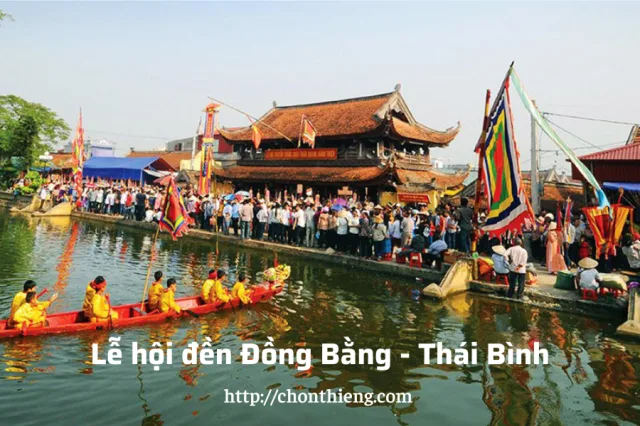


Khái quát về đền Đồng Bằng và lễ hội
Đền Đồng Bằng nằm tại thôn Đồng Bằng (xưa là trang Đào Động), xã An Lễ, huyện Quỳnh Phụ, tỉnh Thái Bình, bên dòng sông cổ Mai Diêm. Đây là một trong những di tích tín ngưỡng nổi tiếng của vùng đồng bằng Bắc Bộ, từ lâu được xem là trung tâm sinh hoạt văn hóa – tâm linh lớn của cư dân ven biển và vùng châu thổ sông Hồng. Đền còn được gọi là đền Đức Vua Cha Bát Hải Động Đình hay đền Đức Vua. Không chỉ nổi tiếng bởi quy mô kiến trúc đồ sộ, nghệ thuật chạm khắc gỗ tinh xảo, nơi đây còn được biết đến với lễ hội truyền thống kéo dài từ ngày 20 đến ngày 26 tháng 8 âm lịch hằng năm.
Trong tâm thức dân gian, lễ hội đền Đồng Bằng gắn liền với câu truyền tụng quen thuộc:
Dù ai buồn xa, bán xa,
Hai mươi tháng tám giỗ cha thì về.
Dù ai buôn bán trăm nghề,
Hai mươi tháng tám nhớ về Đào Thôn.
Hay:
Dù ai buôn bán trăm nghề
Hai mươi tháng tám nhớ về Đào thôn.
Những câu ca ấy cho thấy vị trí đặc biệt của lễ hội trong đời sống tinh thần người dân vùng Bắc Bộ. Đây không chỉ là ngày hội của riêng cư dân Đào Động xưa mà còn là dịp hội tụ đông đảo du khách, thanh đồng, cung văn và tín đồ tín ngưỡng tứ phủ từ khắp nơi đổ về hành hương, chiêm bái.
Lễ hội đền Đồng Bằng vừa mang ý nghĩa tưởng niệm Đức Vua Cha Bát Hải Động Đình, vừa gắn với tục thờ Đức Thánh Trần Hưng Đạo. Vì vậy, tâm thức “tháng tám giỗ cha” ở nơi đây được hiểu theo cả hai lớp tín ngưỡng: thờ thủy thần bản địa và thờ vị anh hùng dân tộc thời Trần.
Nguồn gốc lịch sử và truyền thuyết
Truyền thuyết về Đức Vua Cha Bát Hải Động Đình
Theo thần tích lưu giữ tại đền, Đức Vua Cha Bát Hải Động Đình có tên húy là Vĩnh Công, được tôn là một vị thủy thần linh thiêng của vùng đất Lạc Việt. Truyền thuyết kể rằng vào đời Hùng Vương thứ 18, nước Văn Lang bị ngoại bang xâm lấn. Triều đình lập đàn cầu đảo để triệu linh khí non sông về giúp nước. Khi ấy, Long Cung Hoàng Thái Tử – con của Lạc Long Quân – đã đầu thai xuống vùng cửa biển Hoa Diêm thuộc đất Đào Động để giúp vua đánh giặc.
Ngài cùng các em, các tướng lĩnh và quân sĩ chỉ trong thời gian ngắn đã đánh tan giặc ở tám cửa biển phía Tây nước Nam. Sau chiến thắng, Vĩnh Công không nhận bổng lộc mà trở về quê khai khẩn đất hoang, chiêu dân lập ấp, giữ yên vùng duyên hải và bảo vệ giang sơn. Khi mất vào ngày 25 tháng 8 âm lịch năm Bính Dần, dân chúng vô cùng thương tiếc nên tôn ngài là “Vua Cha Bát Hải Đại Vương”, lập đền thờ phụng.
Trong dân gian còn lưu truyền câu nói nổi tiếng: “Tháng 8 giỗ Cha, tháng 3 giỗ Mẹ”. Trong đó “giỗ Cha” chính là lễ hội tháng Tám tại đền Đồng Bằng, còn “giỗ Mẹ” là hội Phủ Giày thờ Thánh Mẫu Liễu Hạnh ở Nam Định.
Dấu ấn thời Trần và Đức Thánh Trần
Ngoài tín ngưỡng thờ thủy thần, đền Đồng Bằng còn gắn chặt với lịch sử kháng chiến chống quân Nguyên – Mông thời Trần. Nhiều tài liệu cho biết vùng An Lễ – Đào Động từng là căn cứ thủy quân quan trọng của nhà Trần nhờ hệ thống sông lớn, đầm lầy hiểm yếu, thuận lợi cho việc luyện binh và ém quân.
Theo truyền thuyết dân gian, Hưng Đạo Đại Vương Trần Quốc Tuấn từng lui quân về vùng này, cùng Phạm Ngũ Lão luyện tập thủy quân và cầu đảo tại đền Đồng Bằng trước khi tiến đánh quân Nguyên. Những địa danh như cầu Vật, đầm Bà… được cho là dấu tích nơi quân sĩ luyện võ, tập trận thủy chiến.
Dân gian cũng truyền rằng ngày 20 tháng 8 là ngày giỗ Đức Thánh Trần. Tuy nhiên, người dân Đào Động mãi đến ngày 21 mới nhận được tin dữ nên ngoài lễ giỗ ngày 20 như nhiều nơi khác, tại Đồng Bằng ngày 21 mới mở đại lễ rước lớn để tưởng niệm ngài. Chính điều này tạo nên nét riêng của lễ hội đền Đồng Bằng.
Truyền thuyết kết chạ và tục bơi trải
Một trong những nét nổi bật nhất của lễ hội đền Đồng Bằng là tục bơi trải trên sông. Theo truyền thuyết, vào cuối thế kỷ XIII, sau khi chiến thắng quân Nguyên, hai người lính nhà Trần chia tay nhau tại quán nước làng Nuồi (Thanh Miện, Hải Dương). Một người ở lại khai khẩn đất đai lập làng Nuồi, người còn lại về Đào Động mở mang vùng đất mới và lập nên tám trang Đào Động.
Để ghi nhớ tình chiến hữu, hai làng kết nghĩa giao chạ với nhau và hằng năm tổ chức đua thuyền trên sông Đồng Bằng và sông Nuồi. Hoạt động này vừa là dịp gắn kết cộng đồng, vừa giúp trai làng quen thuộc sông nước và rèn luyện kỹ năng thủy chiến. Khi hai người mất đi, dân làng đều tôn họ làm thành hoàng.
Từ đó, tục bơi trải trở thành nghi lễ quan trọng bậc nhất của lễ hội đền Đồng Bằng và được lưu truyền qua nhiều thế kỷ.
Không gian kiến trúc và tín ngưỡng của đền Đồng Bằng
Đền Đồng Bằng được xem như một “bảo tàng mỹ thuật điêu khắc gỗ” của vùng đồng bằng Bắc Bộ. Công trình hiện có diện tích hơn 20.000m² với hệ thống 13 tòa, 66 gian liên hoàn, chạm trổ tinh vi và dày đặc các hoành phi, câu đối, đại tự sơn son thếp vàng.
Kiến trúc của đền là sự kết hợp giữa phong cách truyền thống Bắc Bộ và ảnh hưởng nghệ thuật cung đình Huế, nổi bật với mái chồng diêm, nghệ thuật ghép gốm và hệ thống cung thờ đồ sộ. Quần thể di tích bao gồm đền Đức Vua, đền Sinh, đền Quan Đệ Nhị, đền Quan Đệ Tam, đền Quan Điều Thất, đền Quan Đệ Bát cùng nhiều đền phủ dọc sông Mai Diêm.
Trong tín ngưỡng dân gian, đền Đồng Bằng là nơi hội tụ nhiều lớp tín ngưỡng khác nhau như thờ thủy thần, thờ Cha, thờ Mẹ, thờ Đức Thánh Trần, thờ các danh tướng thời Trần và tín ngưỡng Tứ phủ. Chính sự đan xen ấy tạo cho lễ hội nơi đây màu sắc tâm linh đặc biệt và sức hút rất lớn đối với cộng đồng.
Phần lễ
Công tác chuẩn bị và lễ mộc dục
Từ ngày 19 tháng 8 âm lịch, không khí lễ hội đã bắt đầu tràn ngập khắp Đào Thôn. Người dân quét dọn sân đền, trang hoàng cờ ngũ hành, cờ đuôi nheo từ trong đền kéo dài ra tận tam quan và đầu xóm. Lá cờ đại được treo cao giữa sân đền để mọi nơi đều có thể nhìn thấy.
Các bô lão và chức sắc tiến hành lễ mộc dục – nghi lễ tắm tượng, lau rửa đồ thờ nhằm thanh tẩy không gian linh thiêng trước khi bước vào chính hội. Đây là nghi thức mở đầu cho chuỗi lễ tiết kéo dài nhiều ngày sau đó.
Lễ khai hội ngày 20 tháng 8
Sáng ngày 20 tháng 8 âm lịch, tiếng chiêng trống vang lên mở cửa đền báo hiệu khai hội. Khách hành hương từ khắp nơi đổ về dâng hương, cầu tài, cầu lộc và tưởng niệm Đức Vua Cha cùng Đức Thánh Trần.
Trong ngày này diễn ra nhiều nghi thức tế lễ của hội Tứ phủ. Đây cũng là thời điểm các thanh đồng, cung văn, con nhang đệ tử tụ hội đông nhất để thực hành nghi lễ hầu đồng và hát văn. Vì vậy, lễ hội đền Đồng Bằng từ lâu được xem là một trong những trung tâm tín ngưỡng Tứ phủ lớn nhất miền Bắc.
Lễ rước ngày 21 tháng 8
Ngày 21 mới thực sự là cao điểm của phần lễ. Từ sáng sớm, không khí đã vô cùng náo nhiệt. Các kiệu rước, tàn lọng, bát bửu và lỗ bộ được bày kín sân đền. Đám rước diễn ra long trọng với sự tham gia của hàng trăm người trong trang phục truyền thống.
Đoàn rước đưa bài vị và kiệu Đức Vua ra “đình bơi” – nơi diễn ra hội đua trải. Người dân tin rằng Đức Vua Cha cùng các vị thần sẽ ngự xem dân làng thi bơi. Đây là nghi thức thiêng liêng thể hiện sự kết nối giữa thần linh với cộng đồng cư dân địa phương.
Trong những năm gần đây, lễ rước còn có sự tham gia của hàng chục kiệu từ các đền thờ Quan Đệ Nhất, Quan Đệ Nhị, Quan Đệ Tam, Quan Điều Thất, đền Mẫu Sinh… tạo nên cảnh tượng vô cùng rực rỡ và trang nghiêm.
Lễ trình thánh và nghi thức trước cuộc bơi trải
Sáng ngày 22 tháng 8, sau khi hạ trải xuống sông, toàn bộ trai bơi cùng các chức sắc vào đình làm lễ trình thánh. Mỗi trải đều chuẩn bị lễ vật gồm trầu rượu và tượng “ông Mó” – một con phượng gỗ sơn son thếp vàng đặt ở đầu thuyền.
Trang phục của trai bơi được quy định rất rõ ràng. Người chấp hiệu, người lái và người phất cờ mặc áo quần chẽn gọn gàng, thắt lưng đỏ hoặc vàng. Mỗi tích bơi lại có màu sắc riêng để phân biệt. Tất cả tạo nên không khí vừa trang nghiêm vừa hào hùng như một cuộc xuất quân thủy trận.
Khi hiệu pháo nổ vang, các trải đồng loạt hất “ông Mó” cùng mâm lễ xuống nước rồi lao mạnh về phía trước trong tiếng hô: “Giai bơi, giai khỏe!”. Các trai bơi đồng thanh đáp: “Dô huậy!”. Tiếng hô vang dội hòa cùng tiếng mõ, tiếng pháo và tiếng reo hò tạo nên bầu không khí cực kỳ sôi động trên mặt sông.
Lễ hoàn cung và giã hội
Sau nhiều ngày hội tưng bừng, sáng ngày 26 tháng 8 diễn ra lễ rước “hoàn cung”, đưa bài vị Đức Vua và các vị thần trở lại đền. Đây là nghi lễ khép lại mùa hội trong không khí trang nghiêm nhưng cũng đầy phấn khởi.Người dân tin rằng sau khi hoàn tất lễ hội, thần linh sẽ tiếp tục phù hộ cho mưa thuận gió hòa, quốc thái dân an và mùa màng bội thu.
Phần hội
Tục bơi trải – linh hồn của lễ hội
Bơi trải là hoạt động nổi bật và đặc sắc nhất của hội đền Đồng Bằng. Đào Động xưa có ba trải chính gồm trải Đào Động, trải Trung Toán và trải Thượng Thắng. Mỗi trải dài khoảng 8 – 10m, làm bằng gỗ dổi nhẹ và bền, có hình “đầu rồng đuôi tôm” với đầu thuyền gắn hình rồng gọi là “ống réo”.
Mỗi trải có khoảng 20 – 30 người gồm người chấp hiệu, người phất cờ, người lái, người tát nước và các trai bơi khỏe mạnh. Các cuộc đua diễn ra trên quãng sông dài khoảng 4km, từ đình bơi tới thẻ Thượng rồi xuống thẻ Hạ trước khi quay trở lại điểm xuất phát.
Ngày 22 và 23 là các cuộc “thăm thẻ” giữa ba trải của Đào Động. Ngày 24 là cuộc thi lớn giữa Đào Động và làng Nuồi – làng kết chạ theo truyền thuyết. Sáu trải dàn hàng ngang xuất phát trong tiếng pháo lệnh, tạo nên khung cảnh vô cùng hào hùng.
Giải thưởng xưa gồm pháo lớn, xôi, thủ lợn, lụa điều và tiền thưởng. Tuy giá trị vật chất không lớn nhưng cuộc thi mang ý nghĩa danh dự và tinh thần cộng đồng rất cao.
Các trò diễn và sinh hoạt dân gian
Ngoài tục bơi trải, lễ hội còn có rất nhiều hoạt động dân gian đặc sắc như múa rồng, múa lân, kéo co, đấu vật, đấu kiếm, chọi gà, đánh cờ tướng và hát chèo.
Vào buổi tối, các sân chèo trở nên đông đúc với những tích cổ phục vụ dân làng và khách thập phương. Không khí hội kéo dài suốt nhiều ngày tạo nên một không gian văn hóa cộng đồng sôi động, phản ánh đời sống tinh thần phong phú của cư dân đồng bằng Bắc Bộ.
Hát văn và tín ngưỡng Tứ phủ
Một nét rất đặc biệt của hội đền Đồng Bằng là tục hát văn và hầu đồng. Từ lâu, nơi đây đã trở thành trung tâm thực hành tín ngưỡng Tứ phủ nổi tiếng của miền Bắc, tương tự như Phủ Giày ở Nam Định.
Hát văn, hay còn gọi là hát chầu văn, là loại hình nghệ thuật kết hợp ca nhạc với nghi lễ hầu đồng. Lời ca, tiếng đàn và nhịp phách hòa quyện để tái hiện hình tượng các vị thánh trong tín ngưỡng dân gian. Những giá hầu mô phỏng cảnh chèo thuyền, cưỡi ngựa, luyện kiếm, đánh trận… khiến không gian lễ hội vừa linh thiêng vừa giàu tính nghệ thuật.
Ngày nay, trong tâm thức nhiều người, đền Đồng Bằng được xem là “đệ nhất linh từ” của tín ngưỡng Đức Vua Cha Bát Hải Động Đình và là nơi hội tụ đông đảo thanh đồng, cung văn từ khắp mọi miền đất nước.
Giá trị lịch sử và văn hóa của lễ hội
Lễ hội đền Đồng Bằng là sự kết hợp giữa tín ngưỡng dân gian, lịch sử chống ngoại xâm và văn hóa cộng đồng vùng sông nước Bắc Bộ. Những nghi lễ, truyền thuyết và trò hội nơi đây phản ánh rõ tinh thần thượng võ, ý thức cố kết cộng đồng và ký ức về thời kỳ chống giặc ngoại xâm của dân tộc.
Không chỉ là nơi sinh hoạt tín ngưỡng, lễ hội còn góp phần bảo tồn nhiều loại hình văn hóa dân gian truyền thống như bơi trải, hát văn, hát chèo, múa lân, đấu vật… Đồng thời, lễ hội cũng trở thành điểm du lịch tâm linh quan trọng của tỉnh Thái Bình và khu vực đồng bằng Bắc Bộ.
Với những giá trị tiêu biểu ấy, ngày 16/9/2016, Bộ Văn hóa, Thể thao và Du lịch đã quyết định ghi danh Lễ hội đền Đồng Bằng vào Danh mục Di sản Văn hóa phi vật thể quốc gia. Đây là sự ghi nhận đối với giá trị lịch sử, văn hóa và tín ngưỡng lâu đời của lễ hội nổi tiếng này.
Tài liệu tham khảo
- Lễ hội đền Đồng Bằng ghi danh Di sản Văn hóa phi vật thể quốc gia, Báo điện tử Chính phủ, ngày 09/10/2017.
- Thạc Phương – Lê Trung Vũ (2015), 60 lễ hội truyền thống Việt Nam, Nxb Tổng hợp Thành phố Hồ Chí Minh.
- Dương Tươi, Ngôi đền thiêng 4000 năm tuổi thờ Đức Vua Cha Bát Hải Đông Đình, Báo Pháp luật, ngày 25/02/2020.
- Đức Văn, Lễ khai hội truyền thống đền Đồng Bằng, Báo Dân trí, ngày 30/09/2018.
- Tưng bừng khai hội đền Đồng Bằng ở Thái Bình, Cục du lịch quốc gia Việt Nam, ngày 05/10/2015.
- Phạm Thị Minh Huyền (2011), Phát huy giá trị di sản văn hóa phục vụ phát triển du lịch tỉnh Thái Bình, Khóa luận tốt nghiệp, Trường Đại học Dân lập Hải Phòng.
Ngôn ngữ khác
Tiếng Anh (English)
Overview of Dong Bang Temple and the Festival
Dong Bang Temple is located in Dong Bang Village (formerly Dao Dong Hamlet), An Le Commune, Quynh Phu District, Thai Binh Province, on the banks of the ancient Mai Diem River. It is one of the most renowned religious sites in the Red River Delta and has long been regarded as a major cultural and spiritual center for coastal communities and residents of the delta region. The temple is also known as the Temple of Duc Vua Cha Bat Hai Dong Dinh or simply Duc Vua Temple. Besides its grand architectural scale and exquisite woodcarving art, the site is particularly famous for its traditional festival, which takes place annually from the 20th to the 26th day of the eighth lunar month.
In folk memory, the Dong Bang Temple Festival is associated with the well-known verses:
No matter how far one travels or trades away from home,
On the twentieth day of the eighth month, return for Father’s death anniversary.
No matter what profession one follows,
Remember to return to Dao Village on the twentieth day of the eighth month.
Or:
No matter what trade one pursues,
Remember to return to Dao Village on the twentieth day of the eighth month.
These folk verses demonstrate the festival’s special place in the spiritual life of northern Vietnamese communities. It is not only a festival for the people of the former Dao Dong area but also an occasion that attracts large numbers of pilgrims, spirit mediums, ritual musicians, and followers of the Four Palaces belief system from across the country.
The Dong Bang Temple Festival serves both as a commemoration of Duc Vua Cha Bat Hai Dong Dinh and as a celebration connected with the worship of Saint Tran Hung Dao. Therefore, the popular saying “the eighth month is Father’s death anniversary” embodies two layers of belief: the worship of a local water deity and the veneration of a national hero of the Tran Dynasty.
Historical Origins and Legends
The Legend of Duc Vua Cha Bat Hai Dong Dinh
According to the sacred records preserved at the temple, Duc Vua Cha Bat Hai Dong Dinh, whose personal name was Vinh Cong, is revered as a sacred water deity of ancient Lac Viet territory. Legend recounts that during the reign of the eighteenth Hung King, the kingdom of Van Lang was invaded by foreign enemies. The royal court established a ceremonial altar and prayed for divine assistance to protect the nation.
At that time, the Crown Prince of the Dragon Palace, a son of Lac Long Quan, descended to the coastal region of Hoa Diem in Dao Dong to help defend the kingdom. Together with his brothers, generals, and soldiers, he defeated enemy forces at eight western sea gateways of the southern land within a short period.
After victory, Vinh Cong declined rewards and honors. Instead, he returned to his homeland to reclaim wasteland, establish settlements, maintain peace along the coast, and protect the country. When he passed away on the twenty-fifth day of the eighth lunar month in the year of Binh Dan, the people deeply mourned his death and honored him as “Vua Cha Bat Hai Dai Vuong” (The Great Father King of Bat Hai), building a temple in his honor.
A famous saying survives in Vietnamese folk culture:
“The eighth month commemorates Father; the third month commemorates Mother.”
In this saying, “Father’s death anniversary” refers to the eighth-month festival at Dong Bang Temple, while “Mother’s death anniversary” refers to the Phu Giay Festival dedicated to Saint Mother Lieu Hanh in Nam Dinh.
The Tran Dynasty Legacy and Saint Tran
Beyond the worship of a water deity, Dong Bang Temple is closely associated with the resistance wars against the Mongol-Yuan invasions during the Tran Dynasty. Historical sources indicate that the An Le–Dao Dong area served as an important naval base due to its network of rivers and marshlands, which were ideal for military training and troop concealment.
According to local tradition, Hung Dao Dai Vuong Tran Quoc Tuan once retreated to this area, where he and Pham Ngu Lao trained naval forces and offered prayers at Dong Bang Temple before launching campaigns against the Yuan army. Place names such as Cau Vat and Dam Ba are believed to preserve memories of military training grounds and naval exercises.
Local folklore also maintains that the twentieth day of the eighth lunar month marks the death anniversary of Saint Tran. However, the people of Dao Dong allegedly received the news one day later. As a result, while many places commemorate him on the twentieth, Dong Bang celebrates a grand procession on the twenty-first. This tradition has become a distinctive feature of the festival.
The Brotherhood Alliance and the Boat Racing Tradition
One of the most remarkable features of the Dong Bang Temple Festival is the traditional boat racing ceremony known as boi trai.
According to legend, at the end of the thirteenth century, after the victory over the Yuan invaders, two soldiers of the Tran Dynasty parted ways at a village teahouse in Nuoi Village (Thanh Mien, Hai Duong Province). One remained there to cultivate land and establish Nuoi Village, while the other returned to Dao Dong and founded eight settlements in the area.
To commemorate their brotherhood, the two villages established a ceremonial alliance and annually organized boat races on the Dong Bang River and the Nuoi River. The activity strengthened community bonds while helping village youths become familiar with waterways and develop naval skills. After the two men died, both villages honored them as tutelary deities.
Since then, boat racing has become the most important ritual activity of the Dong Bang Temple Festival and has been preserved for centuries.
Architectural and Religious Space of Dong Bang Temple
Dong Bang Temple is often regarded as a “museum of woodcarving art” in the Red River Delta. The complex covers more than 20,000 square meters and consists of thirteen interconnected buildings with sixty-six compartments. Intricate carvings, gilded lacquered panels, horizontal boards, and parallel sentences adorn nearly every structure.
Its architecture combines traditional northern Vietnamese styles with influences from the royal art of Hue. Distinctive features include multi-tiered roofs, ceramic mosaic decoration, and an extensive network of shrines.
The complex includes Duc Vua Temple, Den Sinh, the shrines of Quan De Nhi, Quan De Tam, Quan Dieu That, Quan De Bat, and numerous temples and palaces along the Mai Diem River.
In folk religion, Dong Bang Temple represents the convergence of multiple belief systems, including the worship of water deities, Father worship, Mother worship, Saint Tran, military heroes of the Tran Dynasty, and the Four Palaces belief tradition. This combination gives the festival its unique spiritual character and broad appeal.
Ritual Activities
Preparations and the Moc Duc Purification Ceremony
From the nineteenth day of the eighth lunar month, the atmosphere of the festival begins to spread throughout Dao Village. Residents clean the temple grounds and decorate the area with Five Elements flags and pennants extending from the temple to the village gates.
A large ceremonial flag is raised in the temple courtyard where it can be seen from afar.
Village elders and ritual officials perform the Moc Duc ceremony, which involves bathing sacred statues and cleansing ritual objects to purify the sacred space before the main festival begins. This ritual marks the opening of a sequence of ceremonies that continue for several days.
Opening Ceremony on the Twentieth Day of the Eighth Lunar Month
On the morning of the twentieth day, the sound of drums and gongs signals the opening of the temple gates and the beginning of the festival. Pilgrims from across the country arrive to offer incense, pray for prosperity and blessings, and honor Duc Vua Cha and Saint Tran.
Various Four Palaces rituals are conducted throughout the day. This is also the time when spirit mediums, ritual musicians, and devotees gather in the largest numbers to perform len dong rituals and chau van singing.
For this reason, Dong Bang Temple has long been regarded as one of the most important centers of Four Palaces religious practice in northern Vietnam.
The Grand Procession on the Twenty-First Day
The twenty-first day marks the true climax of the ritual program.
From early morning, the temple grounds are filled with ceremonial palanquins, parasols, ritual insignia, and processional equipment. Hundreds of participants dressed in traditional attire take part in the grand procession.
The procession carries the sacred tablet and palanquin of Duc Vua to the “boat-racing pavilion,” where the racing ceremonies take place. Local people believe that Duc Vua Cha and other deities attend the races and observe the villagers’ performances.
In recent years, dozens of palanquins from neighboring temples dedicated to Quan De Nhat, Quan De Nhi, Quan De Tam, Quan Dieu That, and Mau Sinh have joined the procession, creating a spectacular and solemn scene.
Presentation to the Deities and Pre-Race Rituals
On the morning of the twenty-second day, after the racing boats are launched into the river, all rowers and ritual officials gather at the communal house to present offerings to the deities.
Each racing team prepares offerings consisting of betel leaves, rice wine, and a carved wooden phoenix called “ong Mo,” painted in red and gold and mounted at the bow of the boat.
The rowers’ attire follows strict regulations. Signal leaders, helmsmen, and flag bearers wear fitted garments with red or yellow belts. Each team is assigned distinctive colors. The overall appearance evokes the spirit of a naval military expedition.
When the starting firecracker explodes, all teams simultaneously cast the “ong Mo” and offerings into the water before surging forward amid the chant:
“Strong rowers, strong rowers!”
The rowers respond in unison:
“Do huay!”
These chants, combined with drums, wooden clappers, firecrackers, and cheering spectators, create an electrifying atmosphere along the river.
Return Procession and Closing Ceremony
After several days of festivities, the morning of the twenty-sixth day features the “return procession,” during which the sacred tablets of Duc Vua and other deities are ceremonially brought back to the temple.
This ritual concludes the festival season in an atmosphere of solemnity and celebration. Local people believe that after the festival, the deities will continue to bless the community with favorable weather, peace, prosperity, and abundant harvests.
Festival Activities
Boat Racing: The Soul of the Festival
Boat racing is the most prominent and distinctive activity of the Dong Bang Temple Festival.
Historically, Dao Dong maintained three principal racing teams: Dao Dong, Trung Toan, and Thuong Thang. Each racing boat measured approximately eight to ten meters in length and was constructed from durable doi wood. The boats featured a “dragon head and shrimp tail” design, with a dragon-shaped bow known as an “ong reo.”
Each boat crew consisted of twenty to thirty members, including signal leaders, flag bearers, helmsmen, water bailers, and strong rowers.
The races covered a distance of roughly four kilometers along the river, extending from the racing pavilion to designated upper and lower markers before returning to the starting point.
The races on the twenty-second and twenty-third days served as preliminary competitions among Dao Dong teams. On the twenty-fourth day, the major contest took place between Dao Dong and Nuoi Village, its ceremonial brother village according to legend.
Six boats lined up side by side and launched at the sound of starting firecrackers, creating a scene of remarkable grandeur.
Traditional prizes included large firecrackers, sticky rice, pig heads, red silk cloth, and monetary rewards. Although the material value was modest, the competitions carried tremendous significance in terms of honor and community pride.
Folk Performances and Traditional Activities
In addition to boat racing, the festival includes many traditional folk activities such as dragon dances, lion dances, tug-of-war competitions, wrestling matches, sword demonstrations, cockfighting, Chinese chess, and cheo folk theater performances.
In the evenings, cheo stages become crowded with villagers and visitors enjoying traditional plays. The festive atmosphere continues for several days, creating a vibrant cultural environment that reflects the rich spiritual life of the Red River Delta.
Chau Van Singing and the Four Palaces Belief System
One particularly distinctive aspect of the Dong Bang Temple Festival is the practice of chau van singing and spirit mediumship rituals.
For generations, the temple has been recognized as a major center of Four Palaces religious practice in northern Vietnam, comparable to Phu Giay in Nam Dinh Province.
Chau van is a ritual musical genre that combines singing, instrumental accompaniment, and spirit mediumship ceremonies. Through song, music, and rhythmic percussion, performers evoke the images and deeds of sacred figures within Vietnamese folk religion.
Spirit possession performances depicting rowing boats, riding horses, sword training, and military campaigns contribute both sacred significance and artistic richness to the festival atmosphere.
Today, Dong Bang Temple is widely regarded as the foremost sanctuary dedicated to Duc Vua Cha Bat Hai Dong Dinh and remains a gathering place for spirit mediums and ritual musicians from all regions of Vietnam.
Historical and Cultural Values of the Festival
The Dong Bang Temple Festival represents a unique combination of folk religion, anti-invasion historical memory, and the communal culture of northern riverine societies.
Its rituals, legends, and festival activities vividly reflect martial traditions, social solidarity, and collective memories of national resistance against foreign invaders.
Beyond its religious significance, the festival contributes to the preservation of many traditional cultural forms, including boat racing, chau van singing, cheo theater, lion dancing, and wrestling.
At the same time, it has become an important spiritual tourism destination in Thai Binh Province and throughout the Red River Delta.
In recognition of these outstanding values, on September 16, 2016, the Ministry of Culture, Sports and Tourism officially inscribed the Dong Bang Temple Festival on the National Intangible Cultural Heritage List of Vietnam. This designation acknowledges the festival’s enduring historical, cultural, and religious significance.
References
- Lễ hội đền Đồng Bằng ghi danh Di sản Văn hóa phi vật thể quốc gia, Báo điện tử Chính phủ, ngày 09/10/2017.
- Thạc Phương – Lê Trung Vũ (2015), 60 lễ hội truyền thống Việt Nam, Nxb Tổng hợp Thành phố Hồ Chí Minh.
- Dương Tươi, Ngôi đền thiêng 4000 năm tuổi thờ Đức Vua Cha Bát Hải Đông Đình, Báo Pháp luật, ngày 25/02/2020.
- Đức Văn, Lễ khai hội truyền thống đền Đồng Bằng, Báo Dân trí, ngày 30/09/2018.
- Tưng bừng khai hội đền Đồng Bằng ở Thái Bình, Cục du lịch quốc gia Việt Nam, ngày 05/10/2015.
- Phạm Thị Minh Huyền (2011), Phát huy giá trị di sản văn hóa phục vụ phát triển du lịch tỉnh Thái Bình, Khóa luận tốt nghiệp, Trường Đại học Dân lập Hải Phòng.
Tiếng Trung (中文)
同平祠与庙会概述
同平祠位于太平省琼辅县安礼社同平村(旧称桃洞庄),坐落于古老的梅炎河畔。这里是北部平原地区著名的民间信仰遗迹之一,长期以来被视为沿海居民和红河三角洲居民重要的文化与精神信仰中心。同平祠又称八海洞庭德王父祠或德王祠。这里不仅以规模宏大的建筑群、精美绝伦的木雕艺术闻名,还因每年农历八月二十日至二十六日举行的传统庙会而享誉四方。
在民间记忆中,同平祠庙会与广为流传的歌谣紧密相连:
“无论远近在何方,
八月二十父王忌日要归乡。
无论经商百业忙,
八月二十莫忘回到桃村庄。”
又有:
“无论经商百业忙,
八月二十莫忘回到桃村庄。”
这些民谣充分说明了庙会在北部居民精神生活中的特殊地位。这不仅是昔日桃洞居民的节日,更是来自各地香客、乩童、唱文艺人以及四府信仰信众朝圣礼拜的重要盛会。
同平祠庙会既是纪念八海洞庭德王父的重要活动,也与祭祀兴道大王陈国峻密切相关。因此,当地人所说的“八月祭父”,同时包含两层信仰意义:一是祭祀本土水神,二是祭祀陈朝民族英雄。
历史渊源与传说
关于八海洞庭德王父的传说
根据庙内保存的神迹记载,八海洞庭德王父名讳永公(Vinh Cong),被尊奉为骆越地区极具灵验的水神。
传说在雄王第十八代时期,文郎国遭受外敌入侵。朝廷设坛祈祷,召请山河灵气护国救民。当时龙宫皇太子——骆龙君之子——投胎降生于桃洞地区的花炎海口,以辅佐国王抗击敌军。
他率领诸弟、将领和士兵,在短时间内平定了南国西部八个海口的敌军。战后,永公不受封赏,而是返回故里开垦荒地、招民立村,守护海滨地区和国家疆土。其于丙寅年农历八月二十五日逝世后,百姓深感哀痛,尊其为“八海大王父”,并建祠奉祀。
民间还流传着一句著名俗语:
“八月祭父,三月祭母。”
其中“祭父”指的正是同平祠八月庙会,而“祭母”则是祭祀圣母柳杏的南定府鞋庙会。
陈朝历史与圣陈信仰
除水神信仰外,同平祠还与陈朝抗击元蒙入侵的历史密切相关。
许多史料记载,安礼—桃洞地区凭借纵横交错的河流与险要沼泽,曾是陈朝重要的水军基地,适宜练兵和驻军。
民间传说称,兴道大王陈国峻曾率军退驻此地,与范五老共同训练水军,并在出征元军前于同平祠举行祭祀祈祷。当地的“桥物”“婆潭”等地名,据说都是当年将士习武和操练水战的遗迹。
民间又传说农历八月二十日是圣陈忌辰。然而桃洞居民直到二十一日才得知噩耗,因此除了二十日举行祭礼之外,当地特别于二十一日举办盛大的迎神仪式纪念圣陈。这也成为同平祠庙会独具特色的重要原因。
结义传说与赛船习俗
同平祠庙会最具特色的活动之一是河上赛船。
传说十三世纪末抗元战争胜利后,两位陈朝士兵在Nuoi村(今海阳省清沔县)的一家茶铺分别。其中一人在当地开垦土地建立Nuoi村,另一人返回桃洞开发新地,并建立八个桃洞庄。
为了纪念战友情谊,两村结为兄弟村,每年都会在同平河和Nuoi河举行赛船活动。此举不仅增进社区联系,也让村中青年熟悉水性并锻炼水战技能。两人去世后,均被尊奉为城隍神。
自此以后,赛船仪式成为同平祠庙会最重要的传统之一,并延续至今数百年。
同平祠的建筑与信仰空间
同平祠被誉为北部平原地区的“木雕艺术博物馆”。
整个建筑群占地超过两万平方米,共有十三座建筑、六十六间殿宇彼此相连,到处可见精致雕刻以及贴金漆彩的匾额、楹联和题字。
其建筑风格融合北部传统建筑与顺化宫廷艺术特色,以重檐屋顶、陶瓷镶嵌工艺以及规模宏大的祭祀空间而著称。
遗迹群包括:
德王祠
生祠
第二官祠
第三官祠
第七官祠
第八官祠
以及沿梅炎河分布的众多神祠与府第
在民间信仰体系中,同平祠汇聚了水神信仰、父神信仰、母神信仰、圣陈信仰、陈朝名将崇拜以及四府信仰等多重信仰层次。这种丰富而复杂的融合,使这里成为极具吸引力的精神圣地。
仪式部分
庙会准备与沐浴仪式
从农历八月十九日起,桃村便洋溢着节日气氛。
村民打扫庙宇,悬挂五行旗和彩旗,从庙内一直延伸到三关门和村口。巨大的主旗高高竖立在庙前广场中央。
长老和祭祀人员举行“沐浴礼”,为神像及祭器进行清洁净化,以迎接正式庙会的到来。这是整个祭典活动的开端。
八月二十日开庙仪式
农历八月二十日上午,锣鼓齐鸣,庙门开启,宣告庙会正式开始。
来自四面八方的香客前来进香,祈求财运、福禄,并缅怀德王父与圣陈。
当天还举行四府信仰的重要祭礼活动。众多乩童、唱文艺人及信众齐聚一堂,举行扶乩和唱文仪式。
因此,同平祠长期以来被视为越南北部最重要的四府信仰中心之一。
八月二十一日迎神大典
农历八月二十一日才是真正的祭祀高潮。
清晨开始,庙前广场已热闹非凡。神轿、华盖、八宝仪仗和礼器排列整齐。
迎神队伍规模盛大,数百人身着传统服饰参加。神位与德王神轿被迎送至“赛船亭”,观看赛船活动。
人们相信德王父及诸神会亲临观赛。这一仪式象征着神灵与社区居民之间的紧密联系。
近年来,迎神队伍还吸纳了第一官祠、第二官祠、第三官祠、第七官祠、生母祠等众多神庙的神轿参加,场面更加壮观庄严。
赛船前的祭圣仪式
农历八月二十二日上午,赛船下水后,所有划手和祭祀人员进入赛船亭举行祭圣仪式。
每支赛船队都准备槟榔酒以及“翁莫”木雕供品。“翁莫”是一只贴金彩绘木凤凰,安放于船首。
划手服饰有严格规定。旗手、舵手及领队均穿着紧身便于活动的服装,并系红色或黄色腰带。不同船队拥有不同颜色标志。
这一切使活动既庄严肃穆,又充满古代水军出征的豪迈气势。
发令炮响后,各队同时将“翁莫”和祭品投入河中,然后奋力向前冲刺。岸边不断响起:
“划手们,加油!划手们,健壮!”
划手们则齐声回应:
“Zo huay!”
呐喊声与锣鼓、鞭炮及观众欢呼声交织在一起,令河面沸腾。
还宫与闭幕仪式
经过数日盛会之后,农历八月二十六日上午举行“还宫礼”,将德王及诸神神位迎回庙中。
这是整个庙会的结束仪式。
人们相信,庙会结束后,神灵将继续保佑风调雨顺、国泰民安和五谷丰登。
娱乐活动部分
赛船——庙会的灵魂
赛船活动是同平祠庙会最具代表性的内容。
昔日桃洞共有三支主要船队:
桃洞队
中算队
上胜队
赛船长约八至十米,以轻巧耐用的都依木制成,造型为“龙头虾尾”,船首装有龙形装饰,称为“翁兆”。
每支赛船约有二十至三十人,包括领队、旗手、舵手、排水手以及年轻健壮的划手。
比赛河段全长约四公里,从赛船亭出发,到达上标志点,再下行至下标志点后返回起点。
农历二十二、二十三日为桃洞内部比赛。
二十四日则举行桃洞村与结义兄弟村Nuoi村之间的大赛。
六艘赛船并列出发,在发令炮声中飞驰前进,场面极其壮观。
过去奖品包括大鞭炮、糯米饭、猪头、红绸和奖金。虽然物质价值不高,但象征着极高的荣誉与社区精神。
民间表演与传统娱乐
除了赛船之外,庙会还举行丰富多彩的传统活动:
舞龙
舞狮
拔河
摔跤
剑术比赛
斗鸡
象棋比赛
唱筹戏
夜晚,各戏台人潮涌动,上演经典传统剧目,服务村民和四方游客。
整个庙会持续数日,展现出北部平原居民丰富多彩的精神文化生活。
唱文艺术与四府信仰
同平祠庙会最独特的特色之一,是唱文与扶乩仪式。
长期以来,这里与南定府鞋一样,被视为越南北部重要的四府信仰实践中心。
唱文(Hat Van),又称朝文唱,是一种结合音乐与扶乩仪式的传统艺术形式。
歌声、琴声与节拍相互交融,再现民间信仰中诸位圣神的形象。
许多扶乩表演模拟划船、骑马、练剑、作战等场景,使整个庙会既神圣庄严,又富有浓厚艺术魅力。
如今,在许多人心目中,同平祠被誉为八海洞庭德王父信仰的“第一灵祠”,也是全国各地乩童与唱文艺人云集的重要圣地。
庙会的历史与文化价值
同平祠庙会融合了民间信仰、抗击外敌历史以及北部水乡社区文化。
这里的祭祀仪式、传说和民间活动,充分体现了越南民族尚武精神、社区凝聚力以及抵御外敌的历史记忆。
庙会不仅是重要的宗教信仰活动,同时也是保护和传承赛船、唱文、唱筹戏、舞狮、摔跤等传统民间文化的重要平台。
此外,它还是太平省乃至北部平原地区重要的精神文化旅游目的地。
凭借这些突出的历史、文化和信仰价值,2016年9月16日,越南文化体育与旅游部正式将同平祠庙会列入国家级非物质文化遗产名录。
这是对这一历史悠久、文化底蕴深厚的著名庙会的重要认可。
参考资料
- Lễ hội đền Đồng Bằng ghi danh Di sản Văn hóa phi vật thể quốc gia, Báo điện tử Chính phủ, ngày 09/10/2017.
- Thạc Phương – Lê Trung Vũ (2015), 60 lễ hội truyền thống Việt Nam, Nxb Tổng hợp Thành phố Hồ Chí Minh.
- Dương Tươi, Ngôi đền thiêng 4000 năm tuổi thờ Đức Vua Cha Bát Hải Đông Đình, Báo Pháp luật, ngày 25/02/2020.
- Đức Văn, Lễ khai hội truyền thống đền Đồng Bằng, Báo Dân trí, ngày 30/09/2018.
- Tưng bừng khai hội đền Đồng Bằng ở Thái Bình, Cục du lịch quốc gia Việt Nam, ngày 05/10/2015.
- Phạm Thị Minh Huyền (2011), Phát huy giá trị di sản văn hóa phục vụ phát triển du lịch tỉnh Thái Bình, Khóa luận tốt nghiệp, Trường Đại học Dân lập Hải Phòng.
Tiếng Pháp (Français’)
Aperçu du temple Dong Bang et de sa fête traditionnelle
Le temple Dong Bang (Den Dong Bang), situé dans le hameau de Dong Bang (anciennement le domaine de Dao Dong), commune d’An Le, district de Quynh Phu, province de Thai Binh, s’élève sur les rives de l’ancien cours du fleuve Mai Diem. Il constitue l’un des plus célèbres sanctuaires cultuels de la plaine du Nord du Vietnam et est depuis longtemps considéré comme un important centre de vie culturelle et spirituelle pour les populations côtières ainsi que pour les habitants du delta du Fleuve Rouge.
Le temple est également connu sous le nom de Temple du Roi-Père Bat Hai Dong Dinh (Den Duc Vua Cha Bat Hai Dong Dinh) ou encore Temple du Roi (Den Duc Vua). Outre ses vastes dimensions architecturales et la remarquable finesse de ses sculptures sur bois, le site est réputé pour sa fête traditionnelle qui se déroule chaque année du 20 au 26 du huitième mois lunaire.
Dans l’imaginaire populaire, la fête du temple Dong Bang est associée à des vers bien connus transmis de génération en génération :
« Même si l’on vit loin, même si l’on commerce au loin,
Le vingtième jour du huitième mois, pour l’anniversaire de la mort du Père, il faut revenir.
Même si l’on exerce cent métiers de commerce,
Le vingtième jour du huitième mois, il faut se souvenir de revenir à Dao Thon. »
Ou encore :
« Même si l’on exerce cent métiers de commerce,
Le vingtième jour du huitième mois, il faut se souvenir de revenir à Dao Thon. »
Ces chants populaires témoignent de la place particulière qu’occupe cette fête dans la vie spirituelle des habitants du Nord du Vietnam. Il ne s’agit pas seulement de la fête des anciens habitants de Dao Dong, mais également d’un important rassemblement attirant pèlerins, médiums, chanteurs rituels et fidèles du culte des Quatre Palais venus de toutes les régions du pays.
La fête du temple Dong Bang possède une double signification : elle commémore le Roi-Père Bat Hai Dong Dinh tout en étant associée au culte de Saint Tran Hung Dao. Ainsi, l’expression populaire « le huitième mois est l’anniversaire de la mort du Père » renvoie ici à deux couches cultuelles distinctes : le culte local des divinités aquatiques et celui du héros national de la dynastie Tran.
Origines historiques et légendaires
La légende du Roi-Père Bat Hai Dong Dinh
Selon les généalogies sacrées conservées au temple, le Roi-Père Bat Hai Dong Dinh portait le nom personnel de Vinh Cong et était vénéré comme une puissante divinité des eaux de l’ancienne terre de Lac Viet.
La tradition rapporte qu’au cours du dix-huitième règne des rois Hung, le royaume de Van Lang fut envahi par des forces étrangères. La cour royale organisa alors des cérémonies d’invocation afin de solliciter l’aide des forces spirituelles du pays. C’est à cette époque que le Prince héritier du Palais du Dragon, fils de Lac Long Quan, se réincarna dans la région maritime de Hoa Diem, sur le territoire de Dao Dong, afin de soutenir le souverain dans la lutte contre les envahisseurs.
Accompagné de ses frères, de ses généraux et de ses troupes, il réussit en peu de temps à repousser les ennemis présents dans les huit embouchures maritimes situées à l’ouest du pays. Après la victoire, Vinh Cong refusa récompenses et privilèges. Il retourna dans sa région natale, défricha les terres incultes, installa les populations, protégea le littoral et contribua à la défense du territoire.
À sa mort, survenue le vingt-cinquième jour du huitième mois lunaire d’une année Binh Dan, la population, profondément attristée, lui décerna le titre de « Roi-Père, Grand Roi de Bat Hai » et érigea un temple en son honneur.
La tradition populaire conserve également le dicton célèbre : « Au troisième mois, l’anniversaire de la Mère ; au huitième mois, celui du Père. » Ici, « l’anniversaire du Père » désigne la fête du temple Dong Bang, tandis que « l’anniversaire de la Mère » renvoie à la fête de Phu Giay consacrée à la Sainte Mère Lieu Hanh dans la province de Nam Dinh.
L’empreinte de la dynastie Tran et le culte de Saint Tran
Outre le culte des divinités aquatiques, le temple Dong Bang est étroitement lié à l’histoire de la résistance contre les invasions mongoles sous la dynastie Tran.
De nombreuses sources indiquent que la région d’An Le – Dao Dong constituait autrefois une importante base navale des Tran grâce à son réseau de grands cours d’eau et de marécages stratégiques, particulièrement favorables à l’entraînement militaire et au stationnement des troupes.
Selon la tradition populaire, le Prince Hung Dao, Tran Quoc Tuan, se serait retiré dans cette région avec Pham Ngu Lao afin d’y entraîner la flotte militaire et d’accomplir des rites d’invocation au temple Dong Bang avant de lancer ses offensives contre les armées mongoles.
Des toponymes tels que Cau Vat ou Dam Ba sont encore aujourd’hui considérés comme les vestiges des lieux où les soldats s’exerçaient aux arts martiaux et aux combats navals.
La tradition rapporte également que le vingtième jour du huitième mois lunaire correspond à l’anniversaire de la mort de Saint Tran. Toutefois, les habitants de Dao Dong n’auraient appris la nouvelle qu’un jour plus tard. Ainsi, alors que les cérémonies commémoratives sont célébrées le 20 dans de nombreuses régions, une grande procession solennelle est organisée à Dong Bang le 21, ce qui confère à la fête son caractère singulier.
La légende du pacte d’alliance entre villages et la tradition des courses de bateaux « boi trai »
L’un des éléments les plus remarquables de la fête du temple Dong Bang est la tradition des courses de bateaux sur la rivière. Selon la légende, à la fin du XIIIe siècle, après la victoire contre les armées mongoles, deux soldats de la dynastie Tran se séparèrent dans une auberge située dans le village de Nuoi (district de Thanh Mien, province de Hai Duong). L’un demeura sur place pour défricher les terres et fonder le village de Nuoi ; l’autre retourna à Dao Dong où il développa de nouvelles terres et fonda les huit domaines de Dao Dong.
Afin de perpétuer le souvenir de leur fraternité d’armes, les deux villages conclurent une alliance communautaire (ket cha) et organisèrent chaque année des compétitions nautiques sur la rivière Dong Bang et la rivière Nuoi. Ces activités renforçaient les liens entre les communautés tout en permettant aux jeunes hommes de se familiariser avec le milieu aquatique et de perfectionner leurs aptitudes au combat naval. Après leur décès, les habitants des deux villages les honorèrent comme génies tutélaires.
Depuis lors, les courses de bateaux « boi trai » sont devenues l’un des rituels les plus importants de la fête du temple Dong Bang et se sont transmises à travers les siècles.
L’espace architectural et cultuel du temple Dong Bang
Le temple Dong Bang est souvent considéré comme un véritable « musée de la sculpture sur bois » de la plaine du Nord du Vietnam.
Le complexe actuel couvre une superficie de plus de 20 000 m² et comprend treize bâtiments regroupant soixante-six travées communicantes. L’ensemble se distingue par la richesse de ses décors sculptés ainsi que par la présence abondante de panneaux horizontaux, de sentences parallèles et d’inscriptions monumentales laquées et dorées.
Son architecture associe les traditions constructives du Nord du Vietnam à certaines influences de l’art de cour de Hue. Parmi ses caractéristiques les plus remarquables figurent les toitures à doubles niveaux superposés (mai chong diem), les décors de céramique incrustée et un vaste système de sanctuaires cultuels.
Le complexe comprend notamment le Temple du Roi, le Temple de la Naissance (Den Sinh), le Temple du Deuxième Mandarin, le Temple du Troisième Mandarin, le Temple du Septième Mandarin, le Temple du Huitième Mandarin ainsi que de nombreux sanctuaires et palais cultuels répartis le long du fleuve Mai Diem.
Dans la religion populaire vietnamienne, le temple Dong Bang constitue un lieu de convergence de plusieurs traditions cultuelles : culte des divinités aquatiques, culte du Père, culte de la Mère, culte de Saint Tran, vénération des généraux de la dynastie Tran et pratique du culte des Quatre Palais. Cette superposition de croyances confère à la fête une dimension spirituelle particulière et explique son immense pouvoir d’attraction.
Les cérémonies rituelles
Les préparatifs et le rite du « moc duc »
Dès le dix-neuvième jour du huitième mois lunaire, l’atmosphère festive gagne tout Dao Thon. Les habitants nettoient les cours du temple, installent les drapeaux des cinq éléments et les bannières cérémonielles qui s’étendent depuis les sanctuaires jusqu’aux portes monumentales et aux entrées du village. Le grand étendard est hissé au centre de la cour afin d’être visible de tous.
Les anciens du village et les dignitaires accomplissent ensuite le rite du « moc duc », cérémonie de purification consistant à laver les statues sacrées et les objets du culte afin de préparer l’espace sacré à l’ouverture de la fête. Ce rituel marque le commencement d’une longue série de cérémonies.
La cérémonie d’ouverture du 20e jour du huitième mois lunaire
Le matin du vingtième jour, les sons des gongs et des tambours annoncent l’ouverture officielle de la fête. Des pèlerins venus de toutes les régions affluent pour offrir de l’encens, solliciter bénédictions et prospérité, et rendre hommage au Roi-Père ainsi qu’à Saint Tran.
De nombreux rites du culte des Quatre Palais sont célébrés durant cette journée. C’est également le moment où se rassemblent le plus grand nombre de médiums, de chanteurs rituels et de fidèles afin de pratiquer les cérémonies de possession spirituelle (hau dong) accompagnées du chant rituel « hat van ».
Pour cette raison, la fête du temple Dong Bang est depuis longtemps considérée comme l’un des plus importants centres du culte des Quatre Palais dans le nord du Vietnam.
La grande procession du 21e jour du huitième mois lunaire
Le vingt-et-unième jour constitue le point culminant des cérémonies.
Dès l’aube, l’ambiance est particulièrement animée. Les palanquins processionnels, les parasols d’honneur, les emblèmes rituels des Huit Trésors (bat buu) et les insignes cérémoniels (lo bo) remplissent la cour du temple. La procession se déroule avec une grande solennité et rassemble plusieurs centaines de participants vêtus de costumes traditionnels.
Le cortège transporte les tablettes sacrées et le palanquin du Roi jusqu’au « pavillon des courses », lieu où se déroulent les compétitions nautiques. Les habitants croient que le Roi-Père et les divinités assistent alors aux épreuves organisées par la communauté. Cette cérémonie symbolise le lien sacré entre les dieux et la population locale.
Au cours des dernières années, des dizaines de palanquins provenant des sanctuaires dédiés au Premier Mandarin, au Deuxième Mandarin, au Troisième Mandarin, au Septième Mandarin et à la Mère de la Naissance ont également rejoint le défilé, offrant un spectacle particulièrement majestueux.
La présentation aux divinités et les rites précédant les courses
Le matin du vingt-deuxième jour, après la mise à l’eau des embarcations, les rameurs et les dignitaires se rendent au pavillon cérémoniel afin de présenter leurs hommages aux divinités.
Chaque équipage prépare des offrandes composées de bétel, d’alcool rituel et d’une effigie appelée « Ong Mo » : un phénix en bois laqué et doré placé à la proue de l’embarcation.
Les costumes des rameurs sont strictement réglementés. Les chefs d’équipe, les pilotes et les porte-étendards portent des vêtements ajustés ornés de ceintures rouges ou jaunes. Chaque équipe possède ses propres couleurs distinctives.
L’ensemble évoque à la fois la solennité d’une cérémonie religieuse et l’atmosphère héroïque d’un départ pour une campagne navale.
Lorsque retentit le signal du canon cérémoniel, tous les équipages lancent simultanément l’effigie d’« Ong Mo » et les offrandes dans la rivière avant de s’élancer en criant : « Giai boi, giai khoe ! ». Les rameurs répondent d’une seule voix : « Do huay ! ».
Ces clameurs, mêlées aux sons des cloches de bois, aux détonations des pétards et aux acclamations de la foule, créent une ambiance d’une extraordinaire intensité.
La cérémonie de retour au sanctuaire et la clôture de la fête
Après plusieurs jours de réjouissances, la matinée du vingt-sixième jour est consacrée à la cérémonie dite de « retour au palais » (hoan cung), au cours de laquelle les tablettes sacrées du Roi et des autres divinités sont reconduites dans le temple.
Cette cérémonie marque la fin de la saison festive dans une atmosphère à la fois solennelle et joyeuse. Les habitants croient qu’après l’achèvement des rites, les divinités continueront à accorder leur protection, à assurer des conditions climatiques favorables, la paix du royaume et l’abondance des récoltes.
Les festivités
Les courses de bateaux « boi trai », âme de la fête
Les courses de bateaux constituent l’activité la plus emblématique de la fête du temple Dong Bang.
Autrefois, Dao Dong possédait trois principales embarcations de compétition : Dao Dong, Trung Toan et Thuong Thang. Chaque bateau mesurait environ huit à dix mètres de longueur et était construit en bois de doi, apprécié pour sa légèreté et sa résistance. Leur forme traditionnelle était décrite comme « tête de dragon et queue de crevette », la proue étant ornée d’une sculpture de dragon appelée « ong reo ».
Chaque équipage comprenait entre vingt et trente personnes : chef d’équipe, porte-étendard, pilote, écopier et rameurs sélectionnés parmi les jeunes hommes les plus robustes.
Les compétitions se déroulaient sur un parcours fluvial d’environ quatre kilomètres reliant le pavillon des courses aux bornes de Thuong et de Ha avant le retour au point de départ.
Les journées des 22 et 23 étaient consacrées aux compétitions internes entre les trois équipages de Dao Dong. Le 24 avait lieu la grande course opposant Dao Dong au village allié de Nuoi. Six embarcations prenaient alors le départ côte à côte au signal des pétards cérémoniels, offrant un spectacle particulièrement impressionnant.
Les récompenses traditionnelles comprenaient de grands pétards, du riz gluant, des têtes de porc, des étoffes écarlates et des sommes d’argent. Bien que leur valeur matérielle fût limitée, ces prix revêtaient une forte signification symbolique liée à l’honneur collectif et à la cohésion communautaire.
Jeux populaires et activités festives
Outre les courses de bateaux, la fête comprend de nombreuses activités traditionnelles : danse du dragon, danse du lion, tir à la corde, lutte traditionnelle, démonstrations d’escrime, combats de coqs, parties d’échecs vietnamiens et représentations de théâtre cheo.
Le soir, les scènes de cheo attirent de nombreux habitants et visiteurs venus assister aux représentations des pièces classiques du répertoire populaire.
L’ensemble de ces activités crée pendant plusieurs jours un vaste espace culturel communautaire qui reflète la richesse de la vie spirituelle des populations de la plaine septentrionale.
Le chant rituel « hat van » et le culte des Quatre Palais
L’une des caractéristiques les plus remarquables de la fête du temple Dong Bang réside dans la pratique du chant rituel « hat van » et des cérémonies de possession spirituelle.
Depuis longtemps, le site est devenu l’un des principaux centres de pratique du culte des Quatre Palais dans le Nord du Vietnam, comparable à Phu Giay dans la province de Nam Dinh.
Le « hat van », également appelé « chant de chau van », est une forme artistique associant musique vocale et rituel de possession. Les chants, les instruments et les rythmes de percussion contribuent à évoquer la présence des saints et des divinités du panthéon populaire.
Certaines séquences rituelles reproduisent symboliquement la navigation, l’équitation, l’entraînement militaire ou les combats, conférant à la fête un caractère à la fois sacré et artistique.
Aujourd’hui encore, dans la conscience collective, le temple Dong Bang est considéré comme le plus prestigieux sanctuaire consacré au Roi-Père Bat Hai Dong Dinh et comme un lieu de rassemblement majeur pour les médiums et chanteurs rituels venus de tout le pays.
Valeurs historiques et culturelles de la fête
La fête du temple Dong Bang constitue une synthèse remarquable entre croyances populaires, mémoire historique des luttes contre les invasions étrangères et culture communautaire des régions fluviales du Nord du Vietnam.
Ses rituels, ses légendes et ses jeux festifs témoignent de l’esprit martial, du sentiment de solidarité communautaire et du souvenir collectif des périodes de résistance nationale.
Au-delà de sa dimension religieuse, la fête contribue également à la préservation de nombreuses formes du patrimoine culturel immatériel traditionnel telles que les courses de bateaux « boi trai », le chant rituel « hat van », le théâtre cheo, les danses du lion et les compétitions de lutte.
Par ailleurs, elle est devenue une importante destination de tourisme spirituel pour la province de Thai Binh ainsi que pour l’ensemble du delta du Fleuve Rouge.
En reconnaissance de ces valeurs exceptionnelles, le ministère vietnamien de la Culture, des Sports et du Tourisme a inscrit, le 16 septembre 2016, la fête du temple Dong Bang sur la Liste nationale du patrimoine culturel immatériel.
Cette distinction consacre l’importance historique, culturelle et religieuse de l’une des fêtes traditionnelles les plus célèbres du Vietnam septentrional.
Références bibliographiques
- Lễ hội đền Đồng Bằng ghi danh Di sản Văn hóa phi vật thể quốc gia, Báo điện tử Chính phủ, ngày 09/10/2017.
- Thạc Phương – Lê Trung Vũ (2015), 60 lễ hội truyền thống Việt Nam, Nxb Tổng hợp Thành phố Hồ Chí Minh.
- Dương Tươi, Ngôi đền thiêng 4000 năm tuổi thờ Đức Vua Cha Bát Hải Đông Đình, Báo Pháp luật, ngày 25/02/2020.
- Đức Văn, Lễ khai hội truyền thống đền Đồng Bằng, Báo Dân trí, ngày 30/09/2018.
- Tưng bừng khai hội đền Đồng Bằng ở Thái Bình, Cục du lịch quốc gia Việt Nam, ngày 05/10/2015.
- Phạm Thị Minh Huyền (2011), Phát huy giá trị di sản văn hóa phục vụ phát triển du lịch tỉnh Thái Bình, Khóa luận tốt nghiệp, Trường Đại học Dân lập Hải Phòng.